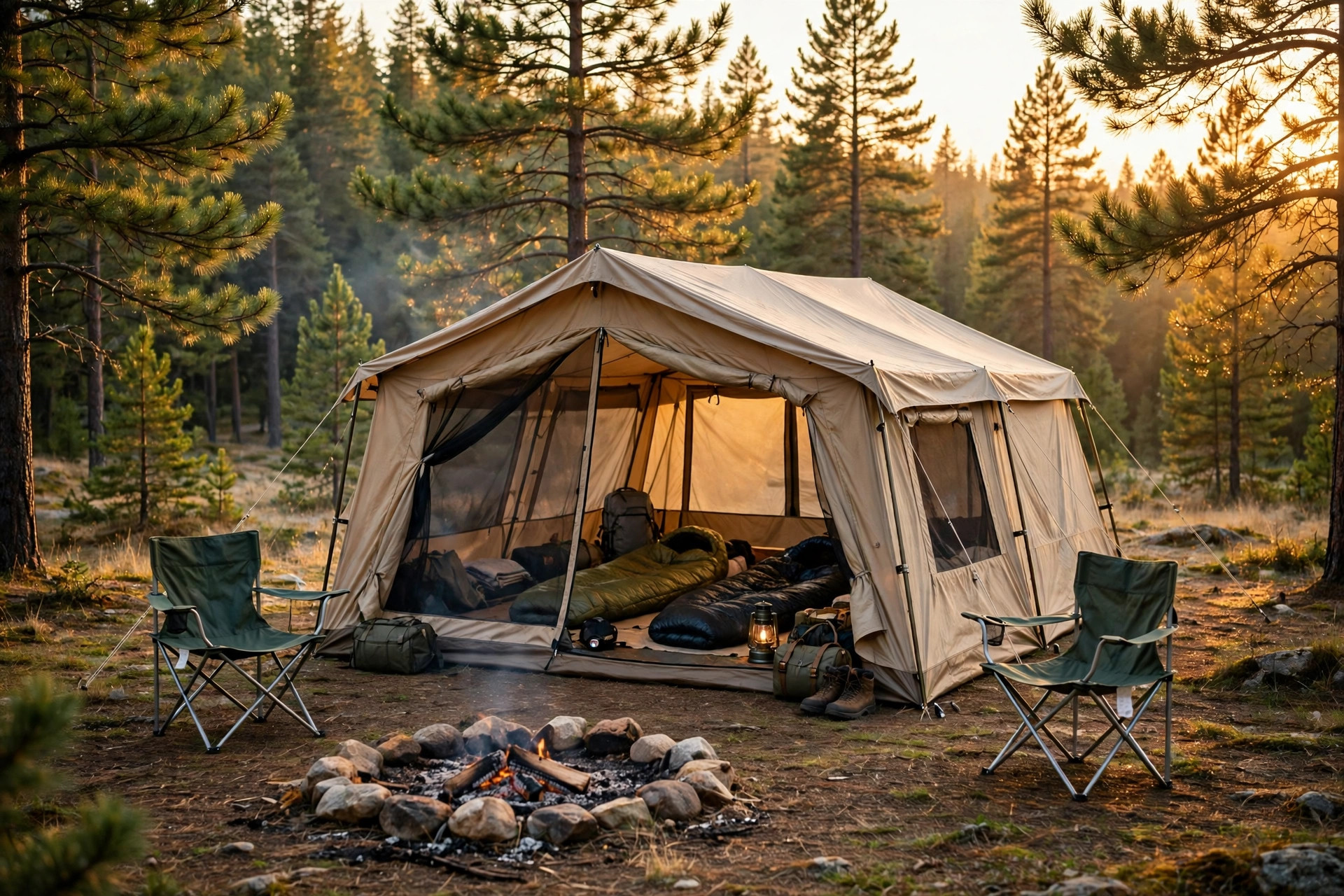
Shopping for the best tent for a family of 5 sounds simple — until you unzip the door on your first trip and discover that five sleeping bags do not actually fit, the kids are kicking each other, and your duffel bags are getting rained on outside. If your crew is two adults and three kids, the tent market is not really built for you: most “5-person” tents are rated for five adults lying shoulder to shoulder with no gear inside. This guide fixes that. You will learn the sizing math that actually works for a family of five, the sleeping layouts parents use in real life, and six solid tent picks for 2026 — plus the setup tricks that keep a campsite calm when three kids are “helping.”
Why a “5-Person” Tent Rarely Fits a Family of 5
Tent manufacturers rate capacity by how many standard sleeping pads fit on the floor, edge to edge, with nothing else inside. A 5-person tent fits five pads. It does not fit five people plus their clothes, shoes, backpacks, a lantern, and the stuffed animal that cannot be left in the car.
For a family of two adults and three kids, that rating is doubly misleading:
- Kids are not small adults for long. A 10-year-old on a 25-inch-wide sleeping pad takes up nearly adult space, and kids sprawl. A tent that “fits” on paper feels cramped by the second night.
- Adults sleep on bigger gear. Two adults on a queen air mattress need roughly 60 by 80 inches — about 33 square feet — before a single child has lain down.
- Gear has to live somewhere. In rain, everything comes inside. A family of five generates a surprising pile: five duffels, shoes, a camp kitchen box, and wet jackets.
The fix is the rule every experienced camping family learns the expensive way: size up by at least one person. For a family of five, that means shopping in the 6-person class — and judging tents by floor area and peak height, not by the number on the box. If you are still deciding between tent sizes in general, our family tent buying guide walks through the full sizing decision step by step.
The Sizing Math: How Much Tent Does 2 Adults + 3 Kids Need?
Forget the capacity number. Work from square footage instead. Here is the honest math for a family of five:
| What needs floor space | Space needed |
|---|---|
| Queen air mattress (2 adults) | ~33 sq ft |
| Three kids’ sleeping pads | ~30 sq ft |
| Gear, bags, and shoes inside | ~15–20 sq ft |
| Walking / changing space | ~10 sq ft |
| Total for real comfort | ~90–95 sq ft |
That is why a true 5-person tent — typically 70–80 square feet — feels tight, and why a good 6-person tent at 85–100 square feet is the sweet spot for a family of five. Use these minimums when you shop:
- Floor area: at least 85 square feet; 95+ is genuinely comfortable.
- Peak height: 70 inches or taller, so an adult can stand to change clothes and wrangle kids.
- Two doors: non-negotiable with three kids. One door means midnight climbs over sleeping children.
- Full-coverage rainfly: a fly that reaches close to the ground keeps wind-driven rain out. (Not sure what that means? Read what a tent rainfly is and why your family needs one.)
- A vestibule or screen room: somewhere for muddy shoes and wet gear that is not your sleeping area.
Sleeping Layouts That Actually Work for 2 Adults + 3 Kids
The tent is only half the puzzle — how you arrange beds inside it decides whether anyone sleeps. These three layouts cover most families of five:
Layout 1: Queen mattress + three pads in a row
Parents on one side on a queen air mattress, kids in a row on the other side on individual pads. This is the simplest setup and works in any rectangular 6-person tent. Put the youngest closest to the parents and the oldest nearest the door for bathroom trips.
Layout 2: The divider split
Many cabin tents include a fabric room divider. Parents take one “room,” kids take the other. Kids love having their own space, parents love a visual boundary at bedtime, and the divider doubles as a changing screen. This is the layout to choose if your kids are old enough to sleep without a parent in arm’s reach.
Layout 3: Two-room tents for bigger kids
If your kids are 8 and up, a tent with two genuine sleeping rooms — or a large tent plus a small pop-up tent for the oldest — gives everyone breathing room. It costs more and takes longer to pitch, but on a week-long trip it can save the vacation.
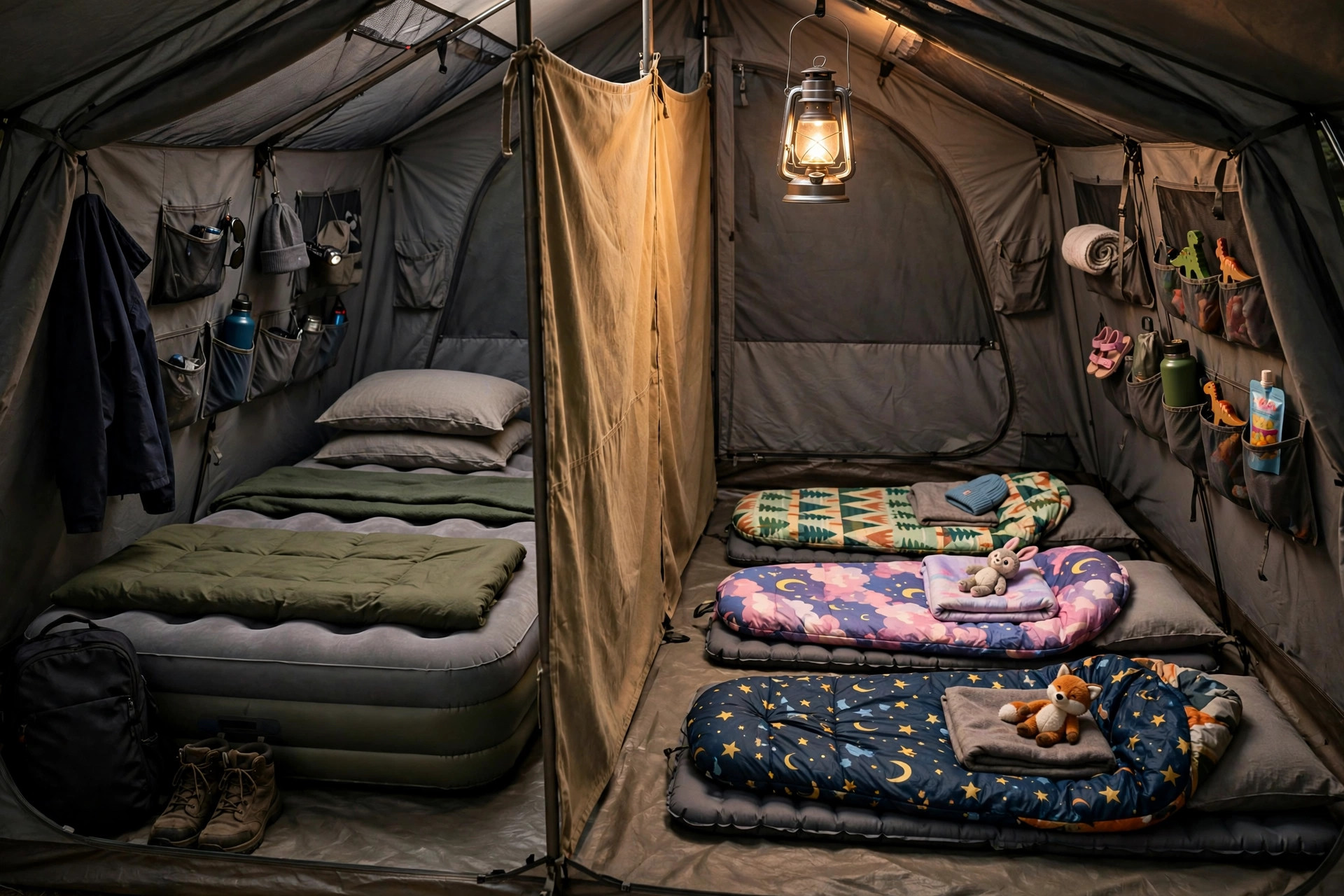
Whatever layout you choose, test it at home first. Pitch the tent in the backyard, lay out every mattress and pad, and have everyone lie down at the same time. This ten-minute rehearsal is how you discover — before you are 200 miles from home — that the queen mattress leaves no room for the toddler’s pad. For more on the sleep side of the equation, see how to get kids to sleep while camping and our guide to kids’ sleeping bags and temperature ratings.
6 Best Tents for a Family of 5 (2026)
These picks are all 6-person-class tents — because, as the math above shows, that is the honest size for a family of five. Each one is judged on the things that matter to parents: real floor area, peak height, setup time with kids around, weather protection, and price range. Check current prices before buying; prices change seasonally.
1. Coleman Skydome 6-Person with Full-Fly Vestibule — Best Value
About 85 square feet of floor and a 72-inch peak height, with a full-coverage rainfly and a front vestibule for gear. The Skydome pitches fast — usually under ten minutes — which matters when three kids are already asking for snacks. Best for: budget-conscious families who want a reliable first big tent. Not for: tall families who want to stand fully upright, or heavy-rain regions where a cabin tent’s vertical walls help more.
2. Coleman Cabin Tent with Screen Room 6P — Best Screened Porch
A cabin shape with near-vertical walls, a room divider, and a screened porch that adds a bug-free hangout space — a lifesaver at dusk when mosquitoes arrive. The boxy shape makes the floor feel bigger than the numbers suggest. Best for: families who spend evenings at camp and want a living room, not just a bedroom. Not for: windy exposed sites, where tall cabin walls catch gusts; guy it out properly.
3. The North Face Wawona 6 — Best Overall Quality
Around 86 square feet with a 75–76-inch peak height and a huge pole-supported front porch vestibule that swallows bikes, chairs, and muddy boots. This is a premium double-wall tent built to last many seasons. Best for: families who camp often and want one tent to grow with them for years. Not for: tight budgets — it costs several times a budget cabin tent, and it is heavier to carry from car to site.
4. REI Co-op Wonderland 6 — Best for Tall Families
About 83 square feet with a generous peak height near 78 inches — one of the tallest in this class — plus two doors and a room divider. REI’s design is famously easy to pitch, with color-coded poles. Best for: tall parents and families who change clothes standing up. Not for: shoppers without an REI nearby or a membership; it is also a premium-priced option.
5. NEMO Aurora Highrise 6P — Best Standing Room in a Dome
About 83 square feet and a 77-inch peak height in a dome shape that handles wind better than boxy cabin tents. Dual doors, two vestibules, and a divider included. Best for: families who camp in mixed weather and want dome-tent stability with cabin-like headroom. Not for: families on a strict budget, or anyone who wants a screen room — this one trades the porch for weather performance.
6. CORE 6-Person Instant Cabin Tent — Fastest Setup
An instant-frame cabin that pops up in about two minutes — genuinely two minutes, not marketing two minutes — with around 90 square feet and a 72-inch center height. Best for: parents who arrive at camp late, pitch solo while the other parent watches the kids, or hate pole assembly. Not for: serious storms; instant frames are convenient, but a fully guyed-out pole tent is more storm-worthy.
If you want to compare these against the wider field of family tents, our roundup of the best family camping tents of 2026 covers more sizes and budgets.
How to Choose: The Family-of-5 Decision Checklist
Before you buy, run through this checklist with your actual family in mind — not a hypothetical one:
- Measure your sleep system, not the tent box. Lay your queen mattress and all three kids’ pads on the floor at home and measure the footprint. Buy a tent at least 10 square feet bigger than that.
- Check peak height against your tallest adult. If anyone is over 6 feet, you need 74 inches or more to stand comfortably.
- Count doors and vestibules. Two doors, at least one vestibule. Your future self, making a 2 a.m. bathroom run, will be grateful.
- Ask how it pitches with one adult. One parent often pitches while the other handles kids. Instant frames and color-coded poles are worth real money here.
- Check the rainfly coverage. Full coverage to near the ground beats a partial “cap” fly every time in real rain.
- Think about your car. A 6-person tent packs to a large, heavy bag. Make sure it fits your trunk alongside everything else a family of five brings.
- Look at the warranty and replacement poles. Kids break poles. A brand that sells spares easily saves a trip.
Setup Tips When You’re Pitching with Kids Underfoot
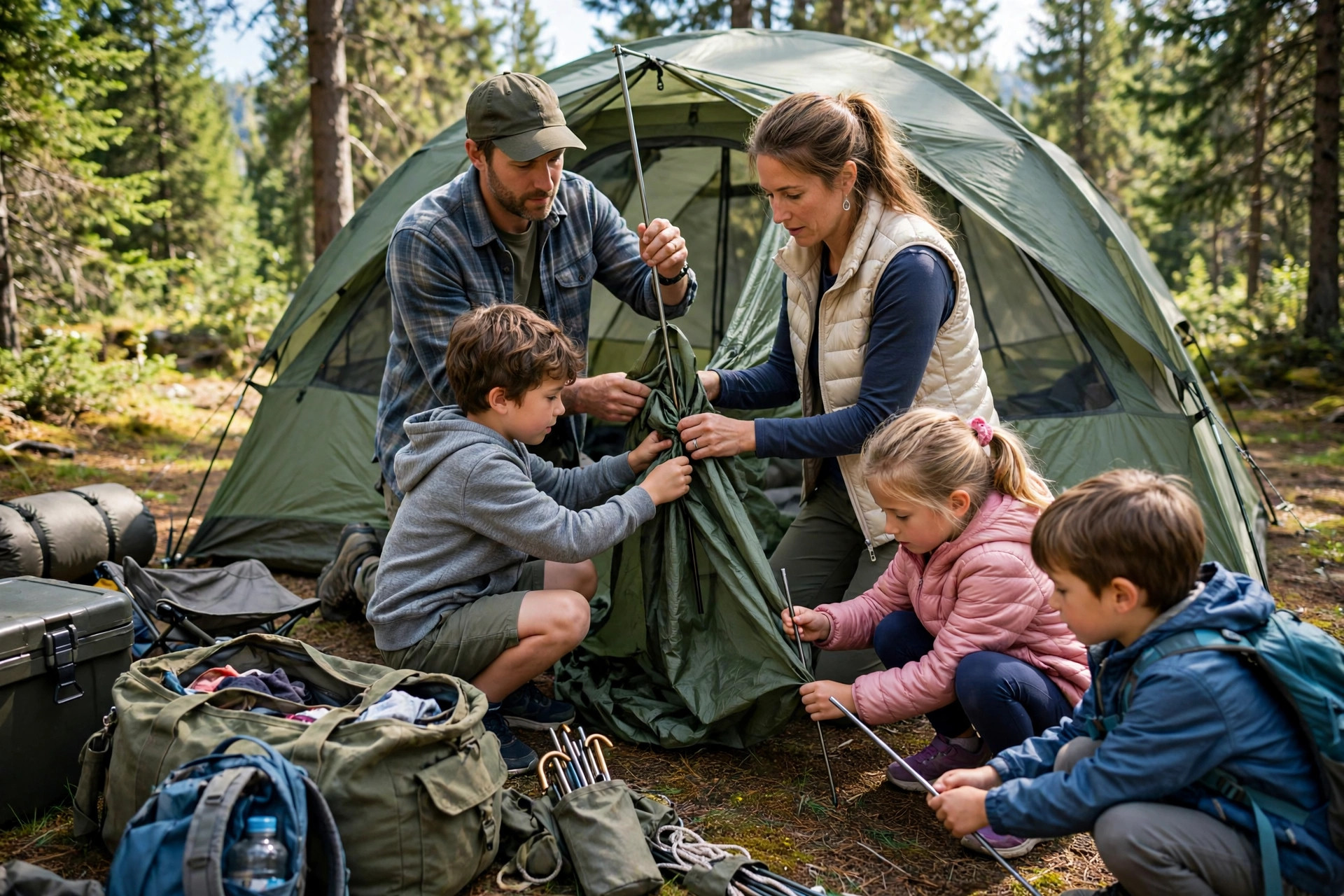
The tent is only as good as the pitch. With three kids, setup is a project — plan it like one. Before the trip, check the National Park Service camping pages for the rules at the park you are visiting — some campgrounds limit tent sizes and party numbers.
- Give every kid a job. Ages 4 and up can hold a pole, carry stakes, or be the official “rainfly holder.” A kid with a job is a kid who is not unrolling the tent in the wrong direction.
- Stake the corners first. On a windy site, stake two corners before raising poles so the tent cannot blow away mid-pitch.
- Pitch in daylight, always. Plan your arrival at least 90 minutes before sunset. A family-of-five tent takes 10–20 minutes with practice and twice that the first time. Book popular campgrounds well ahead through Recreation.gov, where many family sites release months in advance.
- Guy out every line. In wind, un-guyed cabin tents flap, leak, and collapse. It takes three extra minutes and transforms the tent’s stability.
- Set the sleep system last. Inflate mattresses and lay out sleeping bags only after the tent is fully pitched and staked — otherwise kids bounce on them while you are still working.
Common Mistakes Families of 5 Make
- Buying exactly a 5-person tent. The number-one mistake. It fits five pads and nothing else. Size up to a 6-person tent.
- Ignoring the vestibule. Without one, muddy shoes and wet jackets live in the sleeping area — or outside in the rain. Neither is fun.
- Skipping the backyard test. First pitch should never be at a dark, rainy campsite. Practice once at home with the whole family.
- Forgetting the car test. The packed tent, five sleeping bags, a cooler, and a camp kitchen box do not always fit in a sedan trunk. Load the car before the trip, not during it.
- Skipping Leave No Trace basics. Teach kids the 7 Leave No Trace principles before the trip — it keeps campsites clean and wildlife away from your food.
- Choosing a tent for the kids’ current ages. Kids grow fast. A tent that barely fits a family with a toddler and two preschoolers will be too small in two years. Buy for next summer, not just this one.
Frequently Asked Questions
What size tent do I need for a family of 5?
A 6-person tent with at least 85 square feet of floor space and a peak height of 70 inches or more. The “5-person” rating only counts sleeping pads edge to edge, with no room for gear, so families of five should always size up one step.
Is a 6-person tent big enough for 2 adults and 3 kids?
Yes, if it has roughly 85–100 square feet of floor. Two adults on a queen air mattress need about 33 square feet, three kids on pads need about 30, and the rest covers gear and walking space. Go above 95 square feet if your kids are older than 10 or you camp in rainy weather, when everything comes inside.
What is the best tent layout for a family of 5?
Parents on a queen air mattress on one side and the three kids on individual pads on the other side works in most 6-person tents. If the tent has a room divider, split the tent into a parents’ room and a kids’ room — kids love the sense of their own space, and it helps at bedtime.
How much should a good family-of-5 tent cost?
Budget cabin tents start in the low-hundreds, mid-range options run a few hundred, and premium tents from brands like The North Face or REI cost more but last many more seasons. Prices change with sales, so check the current price before buying — and weigh setup speed and warranty, not just the sticker price.
Can one person set up a 6-person tent?
Yes, especially instant-frame models, which one adult can pitch in about two minutes. Pole tents take 10–20 minutes solo once you have practiced. The trick is to stake two corners first so wind cannot move the tent while you work, and to practice once in the backyard before the trip.
Do I need a tent with a screen room for a family of 5?
Not strictly, but it is one of the most-loved features among families of five. A screen room gives kids a bug-free place to play cards or eat at dusk, and it keeps muddy gear out of the sleeping area. If you camp mostly in buggy or rainy places, prioritize it; if you camp in dry, windy country, prioritize a lower, sturdier dome instead.
A family of five does not need the biggest tent on the market — just one sized with honest math instead of the number on the box. Aim for a 6-person tent with 85+ square feet, two doors, a full rainfly, and a layout you have tested at home, and the tent stops being the thing you fight with and becomes the basecamp your kids remember fondly. Happy camping!
