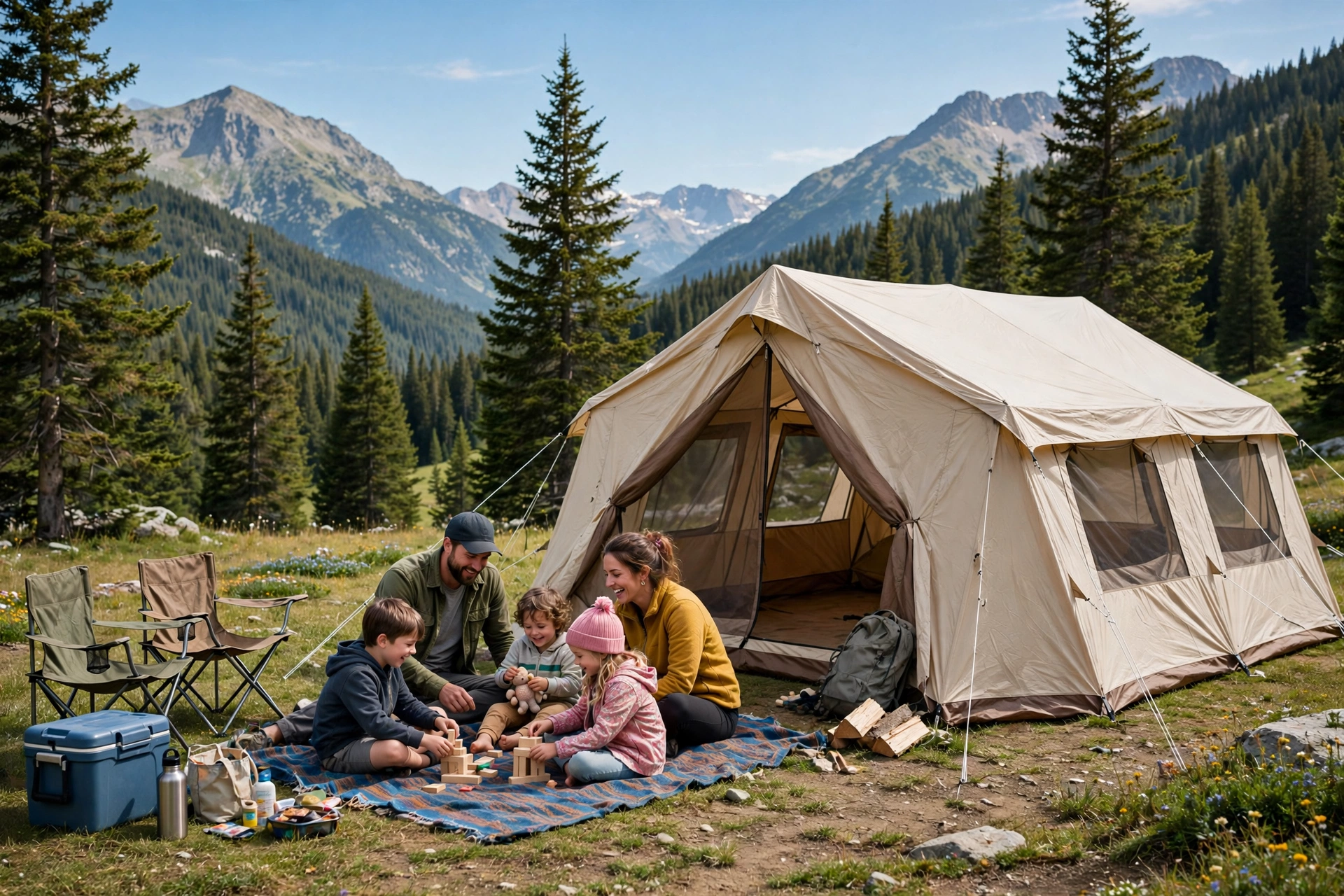
Shopping for the best family camping tent is really shopping for a small house your kids will sleep in, fight over, and drag muddy shoes through. The right tent gives the whole crew standing room, dry gear storage, and enough separation that bedtime isn’t a negotiation. The wrong tent turns the first rainy night into a memorable disaster. This guide compares the best family camping tents for 2026 by what actually matters with kids: honest sleeping capacity, room dividers, dark-room fabric for early risers, vestibule space for gear and strollers, and setup time when little ones are underfoot.
What “Family Size” Really Means: The Size-Up Rule
Tent capacity ratings are optimistic. An “8-person tent” sleeps eight adults shoulder-to-shoulder with no gear, no sleeping pads, and no elbows. For families, treat the rating as a starting point and subtract: kids’ sleeping bags, a cooler, backpacks, a stroller, and the space a toddler needs to roll around at 2 a.m.
The rule that works for almost every family: buy one size up from your family count. A family of four buys a 6-person tent. A family of five buys an 8-person tent. A family of six or more looks at 10- or 12-person tents. If you camp with air mattresses or cots, size up again — they eat floor space fast. For a deeper walkthrough of dimensions, see our family tent sizing guide, which breaks down exactly how floor dimensions translate to real sleeping layouts.
| Family size | Minimum tent rating | Sweet spot | Best layout |
|---|---|---|---|
| 2 adults + 1 child | 4-person | 6-person | Cabin or hybrid dome with one door per side |
| 2 adults + 2 children | 6-person | 8-person | Cabin tent with room divider |
| 2 adults + 3 children | 8-person | 10-person | Two-room or three-room instant cabin |
| 2 adults + 4+ children | 10-person | 12-person | Multi-room cabin with vestibule |
The 6 Kid-Friendly Features That Matter More Than the Rating
1. Room dividers and separate sleeping zones
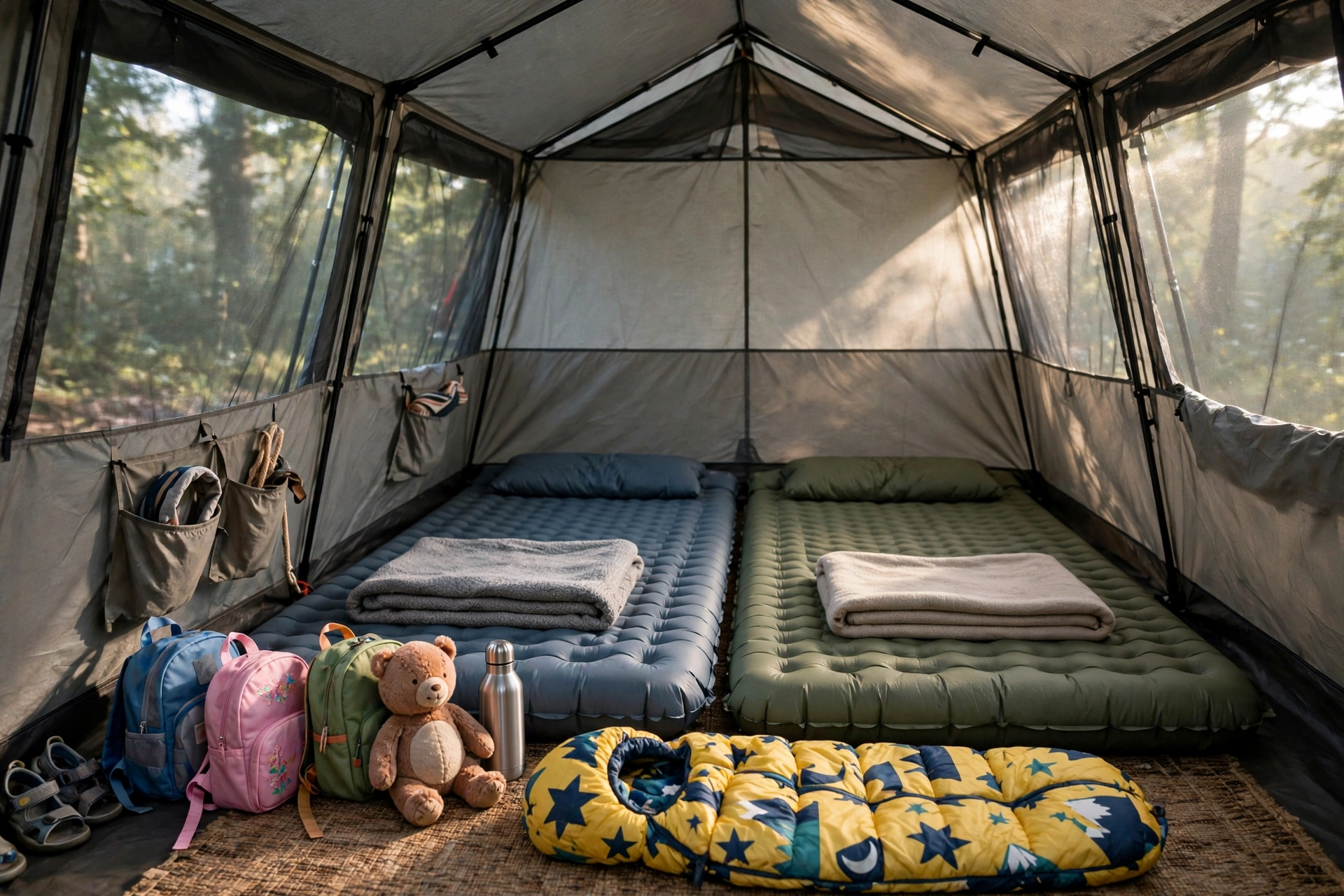
Kids go to bed earlier than adults, and nobody sleeps well when the lantern stays on past the divider. A fabric room divider creates two zones: kids’ beds on one side, adult space on the other. Two-room tents also save marriages: one parent can sleep with a restless toddler while the other gets real rest.
2. Dark-room or blackout bedroom fabric
Most campgrounds wake up at 6 a.m. — not because of birds, but because summer sun hits the tent at 5:30. Tents with darkened bedroom fabric (Coleman calls theirs Dark Room; several brands now offer equivalents) block the vast majority of morning light, and families routinely report an extra hour or more of sleep. If your kids sleep best in the dark at home, this feature is worth more than an extra foot of floor space. For more bedtime wins, see our guide on getting kids to sleep while camping.
3. Vestibules for gear (and strollers)
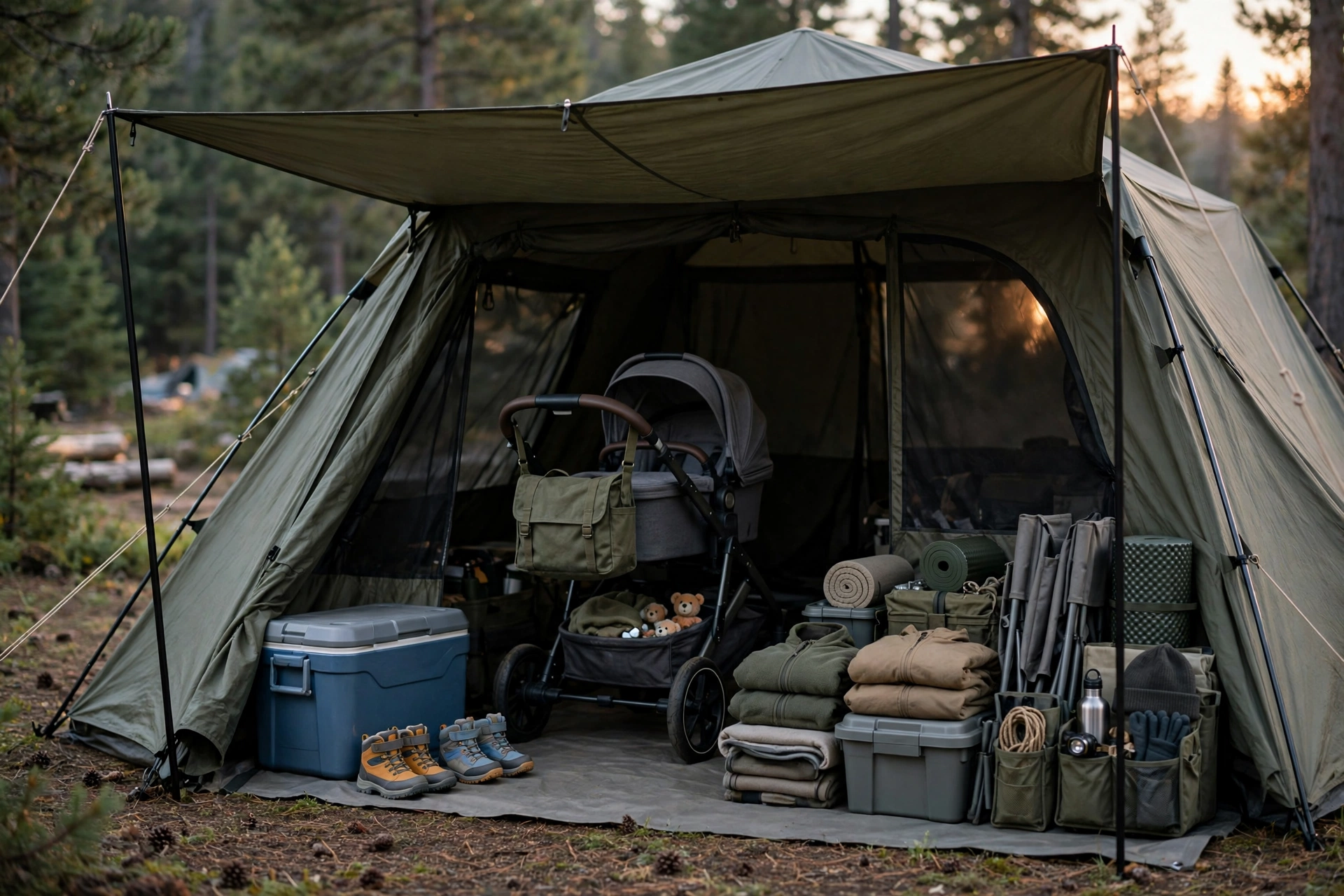
A vestibule is the covered area outside the tent door, and with kids it is not a luxury — it is where wet shoes, the stroller, backpacks, and the cooler live overnight. Two vestibules (one per door) keep gear out of the sleeping area entirely. One caution: in bear country, food, coolers, and anything scented should never sleep in the vestibule — follow NPS food storage guidance and use the site’s provided lockers or your vehicle. Our bear-country food storage guide covers the family-specific details.
4. Setup time with kids underfoot
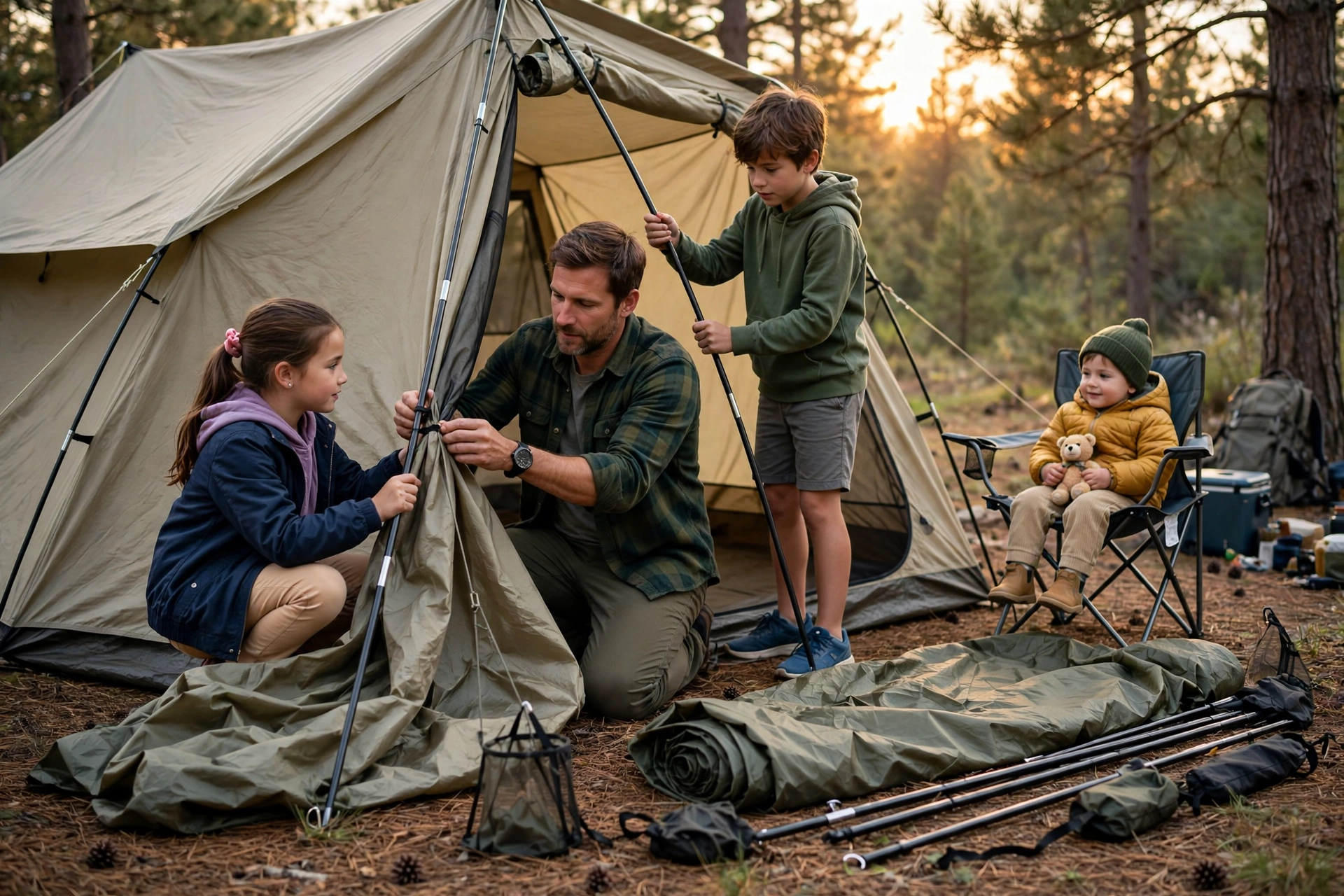
Traditional pole tents take 15–20 minutes with practice. Instant tents with pre-attached poles go up in a few minutes — a genuine advantage when a toddler is exploring the campsite’s hazards while you work. The trade-off: instant frames are heavier and bulkier in the car. For weekend car camping, most parents gladly accept the bulk. For windy sites, though, a well-staked pole tent often holds up better than a boxy instant cabin.
5. Floor durability and tub floors
Kids do not tiptoe — they drag coolers, dump toy bins, and jump on air mattresses. Look for a thick floor (70-denier or heavier), fully taped seams, and a “tub floor” that curves up the walls several inches to keep ground water out. A footprint (ground cloth) under the tent doubles floor life and is one of the cheapest upgrades in camping.
6. Peak height and cabin vs. dome shape
Dome tents curve inward, so headroom shrinks toward the walls — great for wind resistance, cramped for dressing a wiggly toddler. Cabin tents have near-vertical walls and 6+ feet of standing room almost everywhere, which makes changing clothes and riding out a rainy afternoon dramatically more pleasant. REI’s tent-buying guide has a useful breakdown of how shape affects livability. With small kids, cabin shape usually wins for car camping; dome shapes win when storms are likely.
Best Family Camping Tents for 2026
The picks below are compared on published manufacturer specifications and widely reported owner patterns — no fake “we slept in all of these” claims. Prices shift constantly, so treat ranges as ballparks and check current pricing before buying.
| Tent | Best for | Peak height | Floor area | Approx. weight | Setup style |
|---|---|---|---|---|---|
| The North Face Wawona 6 | Best overall (families of 4–5) | ~76 in (6 ft 4 in) | ~86 sq ft | ~19 lbs | Hybrid, front porch vestibule |
| CORE 10-Person Instant Cabin | Best for big families (5–7) | ~78 in (6 ft 6 in) | ~140 sq ft | ~42 lbs | Instant, minutes |
| Coleman Skydome 8P Dark Room | Best budget pick | ~79 in (6 ft 7 in) | ~112 sq ft | ~22 lbs | Instant-ish, under 5 min claimed |
| Eureka! Copper Canyon LX 8P | Best two-room tent | ~76 in (6 ft 4 in) | ~120 sq ft | ~33 lbs | Cabin, two rooms & doors |
| NEMO Aurora Highrise 6P | Best premium pick | ~77 in (6 ft 5 in) | ~83 sq ft | ~19 lbs | Cabin, dual vestibules |
| Kelty Wireless 6 | Best value 6-person | ~79 in (6 ft 7 in) | ~83 sq ft | ~14 lbs | Dome, dual vestibules |
The North Face Wawona 6 — Best Overall for Families of 4–5
The Wawona 6 earns its spot with the feature families ask about most after buying a basic tent: a huge covered front porch. The hybrid design gives a full walk-in vestibule that swallows the stroller, cooler, and everyone’s shoes while the sleeping area stays clean. At roughly 76 inches of peak height, most adults stand upright, and the ~86 sq ft floor fits two queen air mattresses with a squeeze. Who it’s for: families of four or five who camp multiple times a year and want one tent to last. Who it’s NOT for: budget shoppers — it sits in the mid-hundreds; and anyone needing space for six-plus sleepers.
CORE 10-Person Instant Cabin — Best for Big Families
When the crew is five, six, or seven, nothing beats a 10-person instant cabin for pure livable space: roughly 140 sq ft, a room divider, and a pre-attached frame that goes up in a few minutes with two adults. The vertical walls mean a 6-foot-tall parent can walk edge to edge without stooping. Who it’s for: large families doing car camping with the minivan loaded. Who it’s NOT for: exposed windy sites (tall cabin walls catch gusts — stake it thoroughly), or anyone with a small trunk; it packs long and heavy.
Coleman Skydome 8P Dark Room — Best Budget Pick
Coleman’s Dark Room fabric blocks the vast majority of early-morning sunlight — the cheapest way to buy your kids an extra hour of sleep — and the Skydome sets up fast with pre-attached poles. Two doors mean no one crawls over sleeping kids for a midnight bathroom trip.
Eureka! Copper Canyon LX 8P — Best Two-Room Tent
Two rooms, each with its own door: kids on one side, adults on the other, and a divider in between. This layout solves the bedtime-lantern problem better than any single-room tent, and the cabin walls give real standing room on both sides.
NEMO Aurora Highrise 6P — Best Premium Pick
The Highrise takes the cabin concept upmarket: 77 inches of peak height, dual doors with dual vestibules, and aluminum (not fiberglass) poles. Who it’s for: families who camp in shoulder seasons or unpredictable weather and will pay for quality. Who it’s NOT for: anyone outfitting on a budget, or crews bigger than five.
Kelty Wireless 6 — Best Value 6-Person
Roughly 79 inches of peak height, dual vestibules, and a price that usually lands well under $300 make the Wireless 6 the quiet value pick in the 6-person class. It’s lighter than most cabin tents (around 14 lbs), which matters if the hike from the parking lot is long. Who it’s for: families of three or four who want standing room without the premium price. Who it’s NOT for: families of five-plus (size up instead) or anyone wanting a room divider.
How to Choose: A 4-Step Decision Framework
- Count real sleepers, then add one. Two adults + two kids = shop 6-person minimum, 8-person for comfort. Always map the rating to your mattress setup, not just bodies.
- Pick your shape by your weather. Mostly fair-weather weekend trips? Cabin = comfort. Spring/fall trips with storms? Dome or hybrid = survivability. Mixed? Hybrid with a full-coverage rainfly.
- Rank your dealbreakers. Write down three must-haves — e.g., dark room fabric, two doors, under-10-minute setup — and eliminate everything that fails one. The perfect tent doesn’t exist; the right three features do.
- Check the packed size against your car. Family tents pack big. Measure your trunk or roof box before ordering, especially for 10+ person cabins that ship in bags over four feet long.
Common Mistakes Families Make When Buying a Tent
- Trusting the person rating literally. A “4-person tent” fits four adults with zero gear. Families need the size-up rule.
- Skipping the rainfly test. Mesh-heavy “summer” tents are glorious in July and miserable in an October storm. Make sure the fly covers the doors fully.
- Forgetting the footprint. A $40 ground cloth protects a $300 tent’s floor from pine needles, rocks, and kid traffic.
- Buying for the dream trip, not the real trips. If 90% of your camping is two-night summer weekends, buy for that — not for the two-week expedition you might take someday.
- Ignoring door count. One door + four people = nightly climbing. Two doors is a bigger quality-of-life upgrade than an extra square foot.
Frequently Asked Questions
What size tent do I need for a family of 4?
Shop 6-person tents as the minimum and 8-person for real comfort — especially if you use air mattresses, which eat floor space. The size-up rule (buy one size above your headcount) works for almost every family configuration.
Should I buy a bigger tent than my family size?
Yes, in almost all cases. Kids’ gear spreads out, air mattresses are wider than sleeping bags, and rainy days turn a tight tent into a pressure cooker. The only exception: backpacking families, where every pound matters and you split gear into multiple smaller tents.
Are instant tents durable enough for family camping?
For typical weekend car camping, yes. The pre-attached frames handle normal use well; their weak points are high winds (the tall cabin profile catches gusts) and long-term pole-joint wear. Stake and guy them properly, and they last many seasons. For exposed or stormy sites, a pole tent with aluminum poles is sturdier.
Do I need a dark room tent for kids?
Not strictly — but it’s the highest-impact sleep upgrade most families can buy. Summer sun hits a standard tent around 5:30–6 a.m.; dark-room fabric keeps the bedroom dim and commonly buys an extra hour of sleep for early risers. Pair it with the bedtime routine tips in our kids’ camping sleep guide.
Cabin tent vs. dome tent for families — which wins?
For car camping with kids, cabin tents usually win on livability: near-vertical walls mean adults can stand and dress anywhere inside, and rainy afternoons are far more pleasant. Dome tents win on wind resistance and weight. If your trips are mostly fair-weather weekends, choose the cabin.
How long does a family tent last?
A well-cared-for family tent lasts 5–10 years of regular weekend use. The three things that kill tents fastest are UV exposure (don’t leave it pitched in the yard for weeks), packing it away wet (mildew destroys coatings), and floor abrasion (use a footprint). Seam-seal it every couple of seasons and re-treat the rainfly’s DWR when water stops beading.
The Bottom Line
The best family camping tent is the one sized for your real family — one size up from your headcount — with the kid-specific features you’ll feel every single trip: two doors, a vestibule for gear, setup that doesn’t require a babysitter, and dark-room fabric if your kids wake with the sun. Pick your three dealbreakers, check the packed size against your car, and don’t overthink the rest. Before your first trip, run through our 47-item family camping checklist and plan easy dinners from our no-cook camping meals guide — the tent is just the bedroom; the trip is everything around it.
