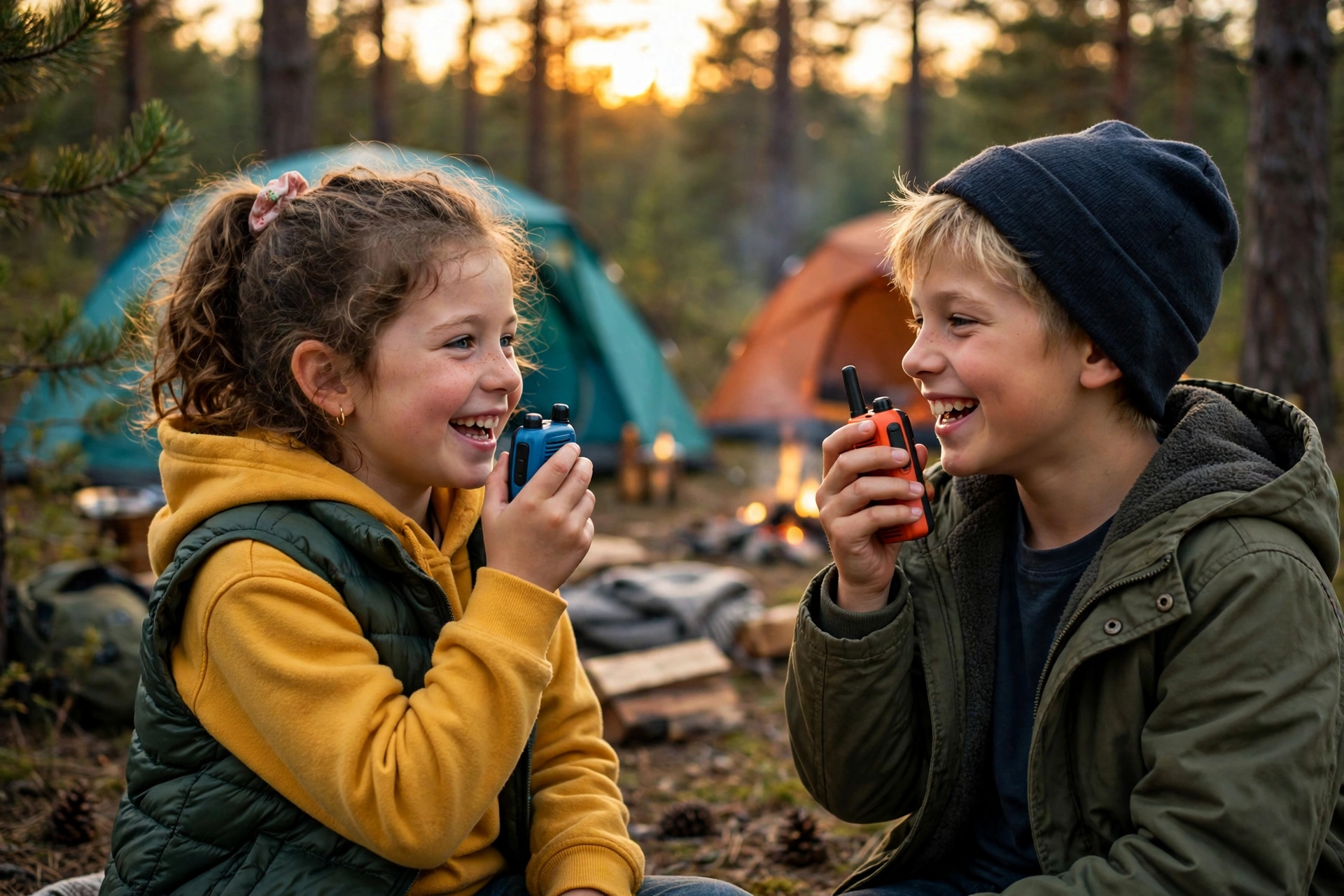
Why Walkie Talkies Beat Phones at the Campground
A cell phone is a terrible tool for a 9-year-old at a campsite. There is often no signal, it invites endless screen time, and it is expensive to replace. Walkie talkies solve all three problems at once: they work without cell service, they have no screen to get lost in, and a kid-size radio can survive drops, dirt, and the occasional splash.
At camp, walkie talkies give kids real independence with a safety line attached. The 8-year-old can ride bikes around the loop road while you stay at the site, siblings can play hide-and-seek across the campground, and when it is dinner time, one “come back to site 14, over” beats yelling across the whole park.
This guide is written specifically for family camping and hiking use — not the backyard, not the neighborhood block. Range among trees, battery life away from outlets, durability on gravel and dirt, and privacy codes for crowded campgrounds: those are the things that actually matter out here.
What to Look for in Walkie Talkies for Kids at Camp
Most “best walkie talkies for kids” lists on the internet review them as toys for the yard. Use these five criteria instead — they are what separate a radio that works in the woods from one that goes quiet fifty yards from your tent.
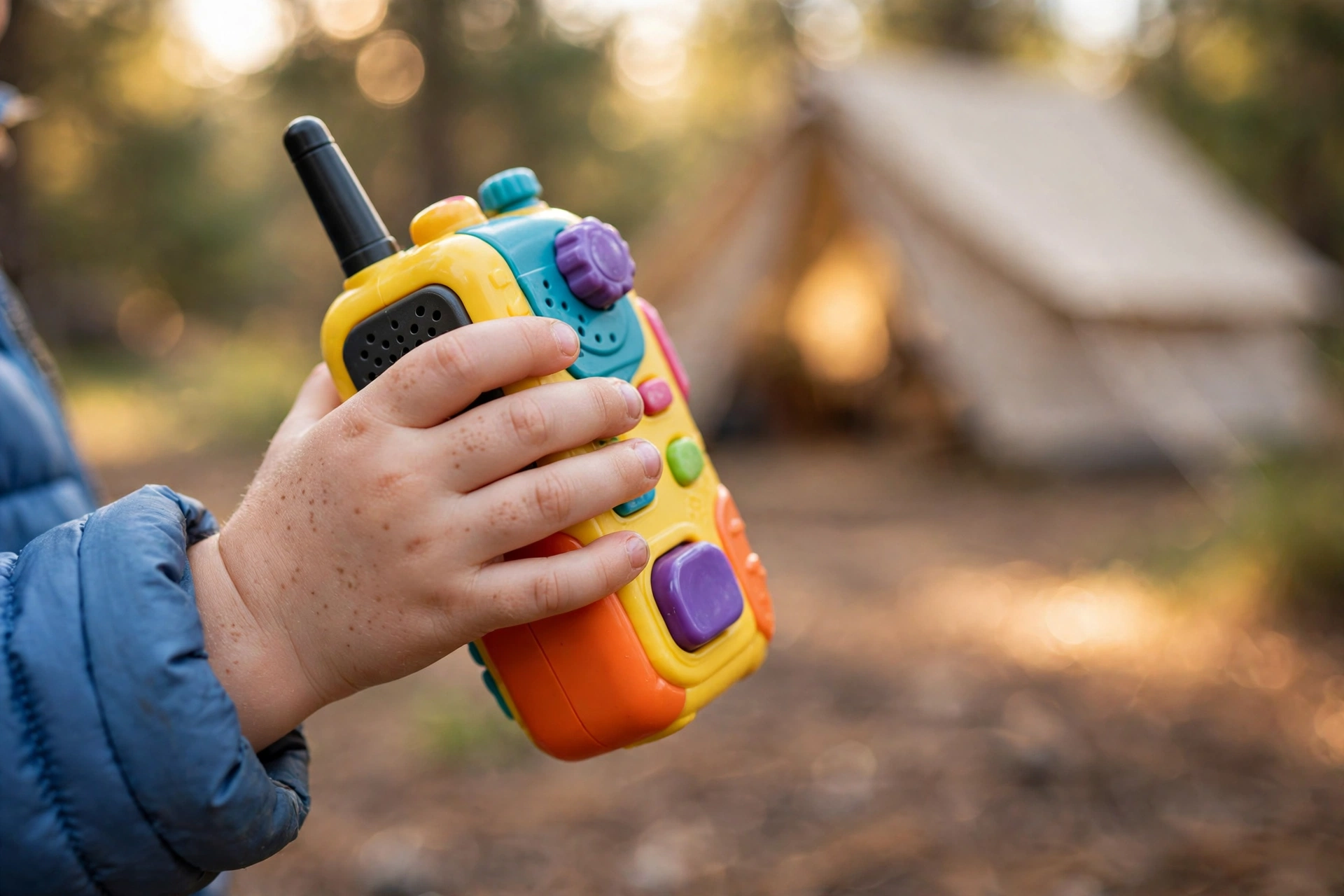
1. Real-world range in trees, not the number on the box
Boxes advertise “up to 3 miles” or even “16 miles.” Treat that as the range across an empty lake on a calm morning. In a forested campground with tents, RVs, and hills, independent reviewers consistently report 0.5 to 1 mile of usable range for typical kid radios — still plenty, since most campgrounds are only a few hundred yards across. Do not buy based on the headline number alone.
2. Channels and privacy codes (CTCSS)
Kids’ radios run on FRS (Family Radio Service) channels, which are license-free in the US. Privacy codes — sometimes called sub-channels — filter out chatter from other campers on the same channel. At a busy campground on a holiday weekend, a radio with 22 channels and 99 privacy codes is noticeably easier for kids to actually hear each other on.
3. Rechargeable vs. replaceable batteries
Rechargeable radios (USB charging) save you from the “drawer full of dead AAAs” problem and are cheaper over a season of trips. The trade-off: charge them before you leave, and on longer trips away from power, bring a portable charger. AA-powered radios are the safer bet for multi-day backcountry trips.
4. Kid-proof build and one-button simplicity
Look for radios that survive drops, have big push-to-talk buttons, adjustable volume, and a keypad lock so settings do not get scrambled in a backpack. VOX (voice-activated hands-free mode) sounds nice but on cheap radios it often keys up at every giggle — many parents end up turning it off.
5. Pack size for your family group
Two radios cover one parent and one kid. Three or four radios cover siblings, cousins, or the whole “bike around the loop” crew. Multi-packs are almost always cheaper per radio — buy for the group you actually travel with.
The 7 Best Walkie Talkies for Kids (2026): Campground-Tested Picks
Curated for family camping and hiking: forest-range reality, simplicity for small hands, durability, and battery life away from outlets. We compared specs, independent reviews, and what real camping families report — not just box claims.
1. Retevis RT628 — Best Overall for Camping Families
Why it wins at camp: The RT628 is one of the most widely recommended kid radios for a reason: it is dead simple (big push-to-talk button, no confusing menus), lightweight enough for small hands, and Retevis has a long reputation for radios that keep working after drops. Adjustable volume and a channel lock keep curious fingers from scrambling settings.
Key specs: 22 FRS channels, VOX hands-free mode, keypad lock, AA-powered.
Best for: First-time camping families with kids ages 5–12 who want a radio that just works.
Not for: Families who want USB charging — the AA batteries mean packing spares for longer trips.
2. Inspireyes Rechargeable (3-Pack) — Best Rechargeable Set
Why it wins at camp: A built-in lithium battery rated by the manufacturer for up to 48 hours of talk time and 7 days of standby means no battery anxiety on a long weekend — just USB-charge before you leave. The 3-pack is the sweet spot for two kids plus a parent, and it supports VOX mode for hands-free use on the trail.
Key specs: 3 radios, 22 channels, 99 privacy codes, rechargeable, VOX.
Best for: Weekend-trip families who want grab-and-go simplicity with zero battery runs.
Not for: Week-long backcountry trips away from any charging — pack a power bank or bring AA-powered backups.
3. Wishouse Rechargeable (Multi-Pack) — Best for Sibling and Cousin Groups
Why it wins at camp: Multi-pack pricing makes this the best value when you need four or more radios — one for every kid in the group plus the parents. USB rechargeable, built-in flashlight (genuinely useful after dark), and memory that saves channel settings after power-off.
Key specs: Multi-pack options, 22 channels, rechargeable, built-in flashlight, auto-squelch.
Best for: Group camping trips — cousins, friends, or multi-family crews.
Not for: Solo-kid families; buy a smaller pack instead of overpaying for radios you will not use.
4. Selieve Toys Walkie Talkies — Best for Young Kids (Ages 3–7)
Why it wins at camp: Bright colors, big buttons, a fun call-alert tone, and a simple key lock — everything a preschooler needs and nothing they do not. Lightweight enough that little arms do not get tired, and simple enough that a 4-year-old can learn “press the big button to talk” in one try.
Key specs: Designed for ages 3–10, push-to-talk button, adjustable volume, call alert, button lock.
Best for: Families with young kids who just want to say “over and out” around the campsite.
Not for: Older kids who want more range and real-radio features — they will outgrow these by about age 9.
5. Obuby Toys Walkie Talkies — Best for Outdoor Adventures
Why it wins at camp: The ergonomic design fits smaller hands well on the trail, and the built-in flashlight is a hit for night hikes. It is a longtime favorite on the campground scene for ages 3–12, with VOX mode for hands-free trail use and an easy learning curve.
Key specs: 22 channels, built-in flashlight, VOX, designed for ages 3–12.
Best for: Active families who hike as much as they camp — the flashlight pulls double duty.
Not for: Parents who want the absolute simplest interface; slightly more buttons than the Selieve.
6. Retevis RT388 — Best for Surviving Drops
Why it wins at camp: If your kid’s idea of ownership is “throw it down and run,” the RT388’s reputation for surviving drops makes it a standout. Parents consistently report these radios lasting multiple camping seasons. A built-in flashlight covers after-dark bathroom trips.
Key specs: Kid-tuned FRS channels, built-in flashlight, drop-resistant build.
Best for: Rough-and-tumble kids and families who camp on gravel and rock, not grass.
Not for: Parents wanting the widest channel/privacy-code options — this one trades features for toughness.
7. Motorola T100 Talkabout — Best Brand Reliability for Older Kids
Why it wins at camp: For tweens who want something that feels like a “real” radio, Motorola’s Talkabout line brings big-brand engineering: clearer audio, a compact design, and a keypad lock. It is a step up in seriousness for kids ages 9+ who hike farther from the group or scout ahead on trails.
Key specs: 16 FRS channels, LCD display, keypad lock, compact design.
Best for: Teens and tweens (9+) who want a more grown-up radio for bigger campgrounds and trail days.
Not for: Young kids — the smaller buttons and menu display are harder for little hands.
For more ideas on keeping older kids engaged outdoors, see our guide to camping with teens.
Quick Comparison Table
| Model | Best For | Pack Size | Power | Standout Feature |
|---|---|---|---|---|
| Retevis RT628 | Best overall | 2 radios | AA batteries | Simple + drop-tough |
| Inspireyes Rechargeable | Best rechargeable | 3 radios | Rechargeable (USB) | 48-hour talk time claim |
| Wishouse Multi-Pack | Best for groups | 3–6 radios | Rechargeable (USB) | Flashlight + saves settings |
| Selieve Toys | Ages 3–7 | 2 radios | AA batteries | Big buttons, call alert |
| Obuby Toys | Outdoor adventures | 2 radios | AA batteries | Ergonomic + flashlight |
| Retevis RT388 | Surviving drops | 2 radios | AA batteries | Extra-tough build |
| Motorola T100 Talkabout | Tweens 9+ | 2 radios | AA batteries | Brand reliability, LCD |
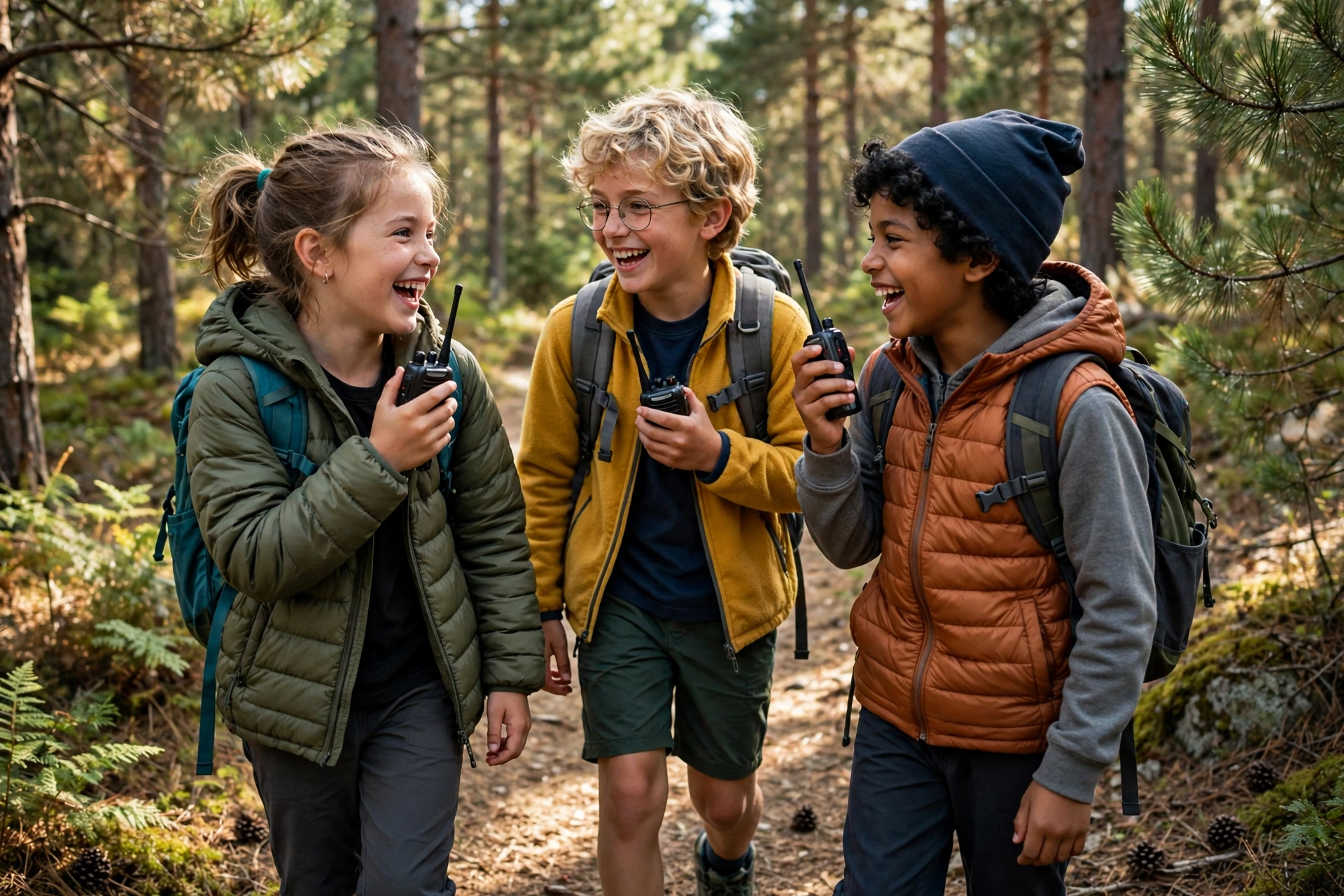
How to Teach Kids Walkie Talkie Safety and Etiquette at Camp
Handing kids radios without ground rules is how you end up with a campground-wide broadcast of silliness at 6 a.m. Set these rules on night one — five minutes that saves the whole trip:
- Assign check-in times. Kids exploring the campground check in every 30 minutes, or immediately if plans change. No exceptions.
- Teach “over” and “over and out.” Say your piece, say “over,” release the button, and listen. This one habit prevents 90% of walkie-talkie frustration.
- Set a home channel and a backup channel. Teach kids the backup channel in case the main one gets busy — then practice switching once.
- Boundaries before batteries. Draw the allowed zone on the campground map together. A radio is not permission to wander the whole park.
- No broadcasting personal info. No last names, no site numbers, no “we’re going to the store, nobody’s home” — other campers can hear everything.
- Night quiet hours apply to radios too. Most campgrounds enforce quiet hours around 10 p.m.; make the radios part of that rule. Our campground etiquette guide covers the rest.
- Practice at home first. A test run in the backyard — or on a dedicated backyard camping practice night — means the first real camp night is not the first lesson.
- Know the campground’s official rules. Radios are welcome at most parks, but quiet hours and restricted areas vary — skim the National Park Service camping guidelines before a national park trip.
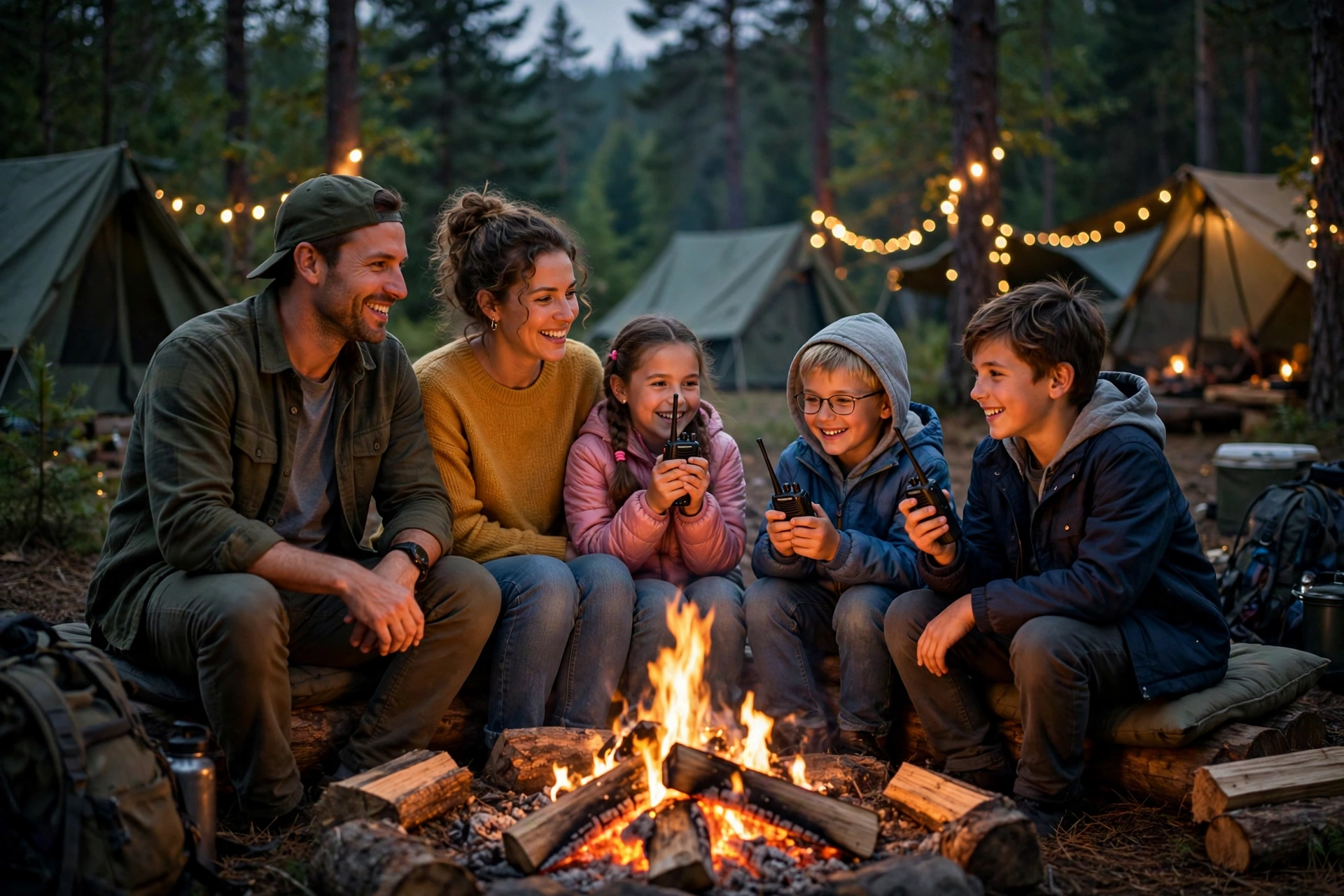
For families driving to camp, walkie talkies are also a lifesaver in the car: hand the second radio to the kid in the back seat and the “are we there yet” loop gets a lot shorter. Pair them with our screen-free road trip games.
Final Word: Which One Should You Buy?
If you only buy one thing before your next trip, make it the Retevis RT628 (simple, tough, proven) or the Inspireyes rechargeable 3-pack (no batteries to fuss with). Match the pack size to your crew, teach the five-minute etiquette lesson on night one, and you will wonder how you ever camped without them. Peak-season sites go fast, so book your campsite early on Recreation.gov if you have not already. And once the kids are settled and quiet — radios off — check our tips on getting kids to sleep while camping to finish the night right.
Frequently Asked Questions
What range do kids’ walkie talkies actually get at a campground?
Expect about 0.5 to 1 mile of usable range among trees, tents, and RVs, even when the box claims 2–3 miles. That headline number is measured in open terrain with no obstacles. For most family campgrounds — typically a few hundred yards across — half a mile is more than enough.
Do kids’ walkie talkies need a license?
No. Kids’ radios use FRS (Family Radio Service) channels, which are license-free in the United States — no paperwork, no test. Just keep the radios on the standard 22 FRS channels and you are covered. Note this applies to US campgrounds; radio rules vary in other countries, so check local regulations if you travel abroad.
Are walkie talkies better than phones for kids at camp?
For most camping families, yes. Walkie talkies need no cell signal, have no screens or apps to distract kids, and are far cheaper to replace than a phone if one goes in the lake. They also give kids the independence they crave — roaming the campground loop with a radio check-in — without the risks of an internet-connected device.
What age can kids start using walkie talkies?
Most kid-size radios are designed for ages 3 and up. Ages 3–5 do best with big-button models like the Selieve; ages 6–9 can handle any standard kid radio; tweens 9+ often prefer the Motorola T100. Supervise use and set the boundaries above.
How do privacy codes work on kids’ radios?
Privacy codes (also called sub-channels or CTCSS codes) are numbered filters — typically 0–99 — that block chatter from other groups on the same main channel. If a busy campground keeps leaking other families’ chatter onto your channel, switch everyone to the same main channel with a unique privacy code (say, channel 4, code 17) and it disappears from your radios.
Can kids use walkie talkies on hiking trails?
Trails are where radios shine. They work well for “scout ahead” games, letting faster hikers report back, and keeping the group in touch around blind corners. Expect reduced range in dense forest or hilly terrain, and set the check-in rule before you start hiking.
