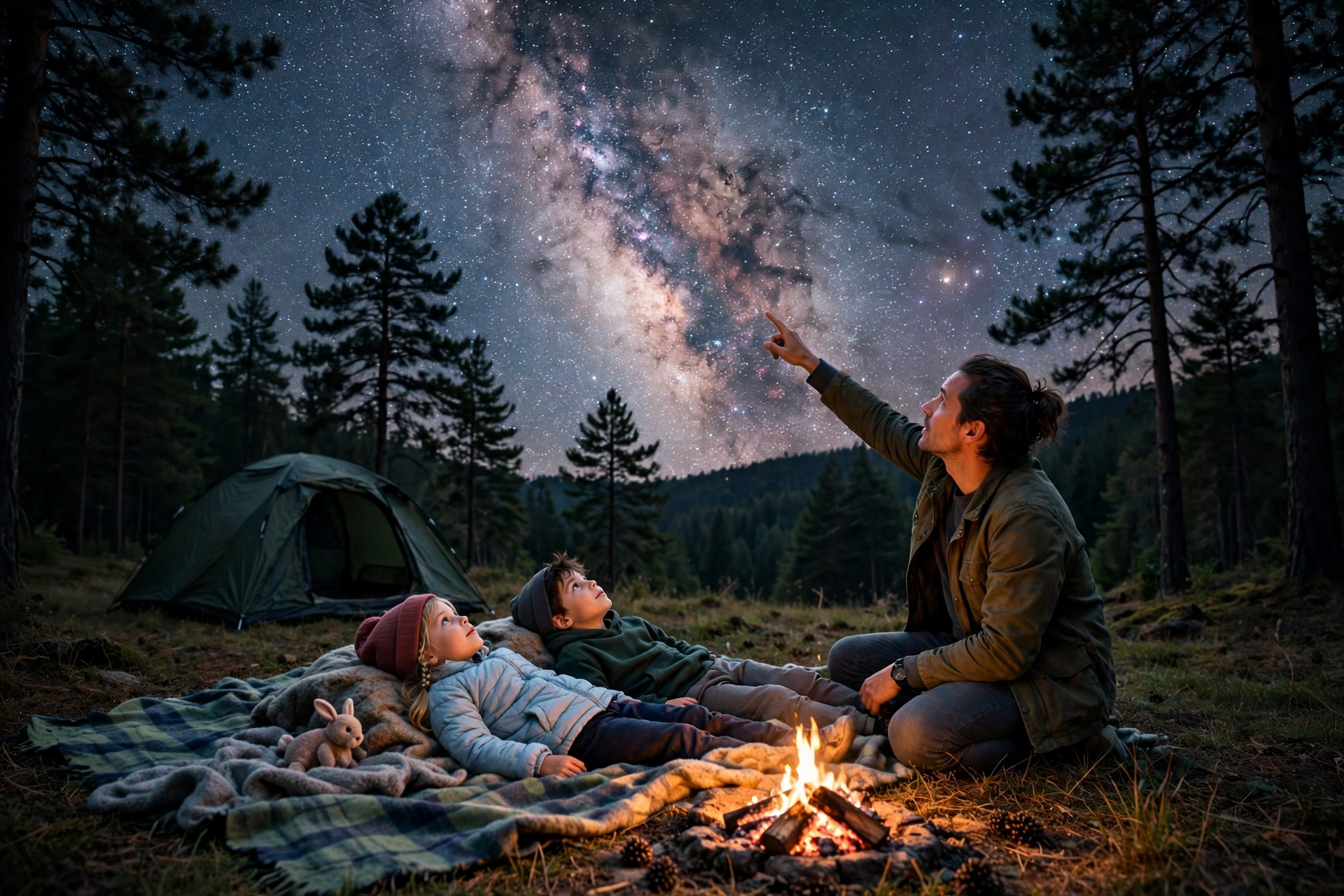
Most families camping with kids plan their days down to the hour — hike in the morning, swim after lunch, s’mores after dinner. But the real magic often starts after bedtime. On a clear night, far from city lights, a campground becomes a free planetarium. This guide shows you how to turn stargazing with kids on camping trips into a highlight of the whole vacation: the easiest constellations to find, the simple gear that helps, and age-specific tips that keep little ones engaged instead of squirming.
Why Stargazing Is the Perfect Family Camping Activity
Stargazing checks every box for a family-friendly evening activity: it’s free, it starts after the kids would normally be winding down (so it feels special), and it works with zero athletic ability. A child who can’t sit through a 20-minute ranger talk will happily lie on a blanket for 45 minutes tracking satellites across the sky.
It also teaches real science without feeling like school. When your seven-year-old uses the Big Dipper to find the North Star, she’s learned practical navigation, geometry, and seasonal astronomy in one go. And because the sky looks different every season, stargazing gives every camping trip a built-in “new content” element — a reason to go out again on your next visit to the same park.
Set Yourself Up for Success: The Basics
Pick a dark campsite
Light pollution is the single biggest factor in how good your stargazing will be. A suburban backyard shows maybe 100 stars; a dark campground shows thousands, plus the Milky Way. You don’t need to travel to a certified dark-sky park for a great show, but it helps to know where to look. The International Dark-Sky Association keeps an official list of dark-sky places you can search by state — many are regular national and state parks that also happen to be excellent camping destinations.
If your first-choice park is fully booked, don’t give up: last-minute campsite cancellations open up surprisingly often at popular parks, and a dark-sky location is worth a little extra effort.
Time it right
- Go when the moon is small. A bright full moon washes out faint stars. Check the moon phase and aim for nights near the new moon, or plan to stargaze before moonrise or after moonset.
- Wait for full darkness. Astronomical twilight ends about 90 minutes after sunset. In summer that can mean a 10:30 PM start — plan a late nap or accept one late bedtime as the “special stargazing night” of the trip.
- Longer nights = more sky. Fall camping brings earlier sunsets, which is why many families find autumn the easiest stargazing season with small kids. Our fall camping guide covers what else changes once the days shorten.
- Clear, dry air is best. Clouds obviously ruin the show, but haze and humidity dim stars too. Desert parks and high-elevation campgrounds typically have the crispest skies.
Protect your night vision
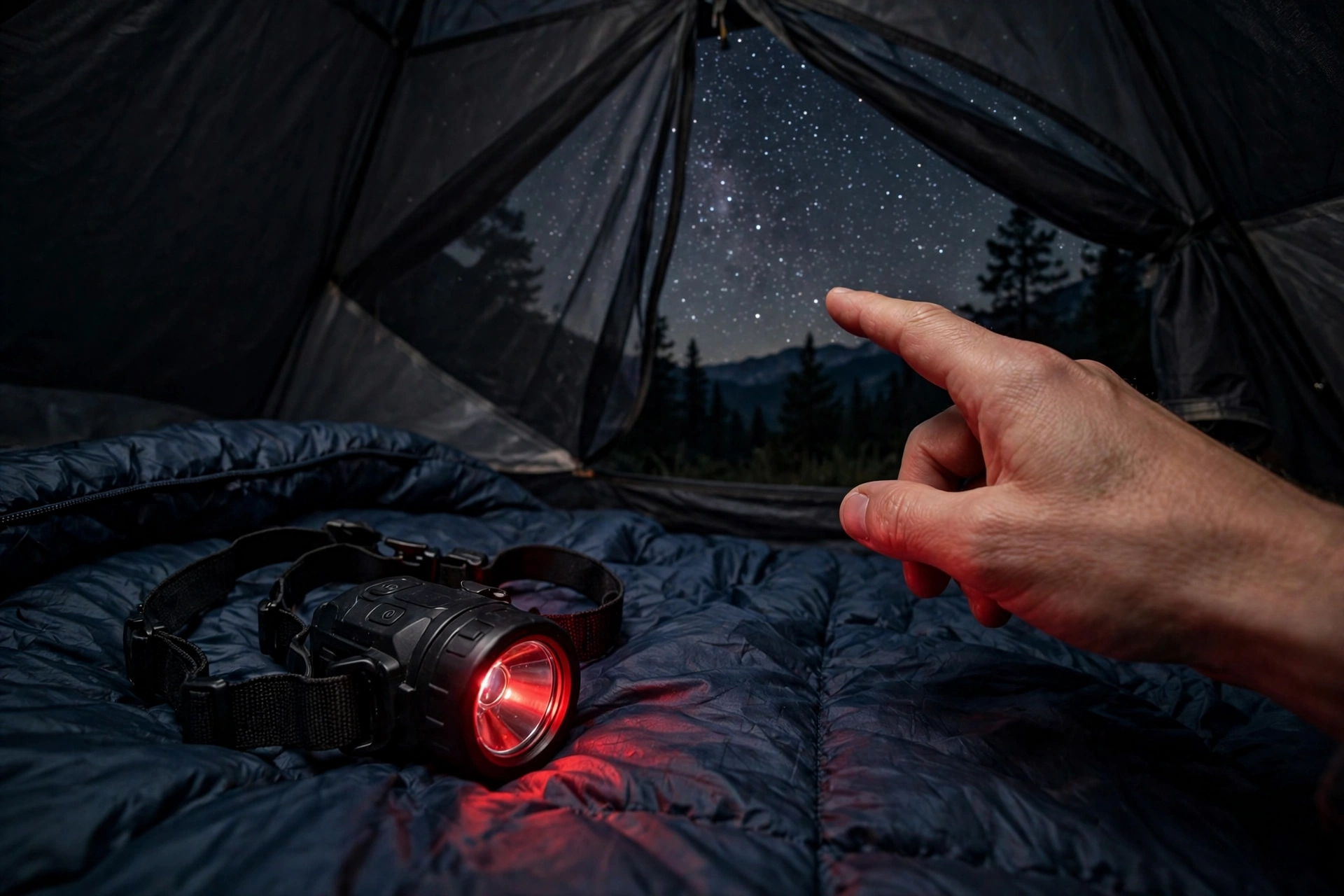
Your eyes need 20–30 minutes to fully adapt to the dark, and one glance at a white phone flashlight resets the clock. Switch every light you use to red:
- Set headlamps to red-light mode for the whole evening (it preserves everyone’s night vision).
- Turn phone screens to minimum brightness and use a stargazing app’s built-in night mode.
- Keep the campfire low or sit with it behind you — flames kill night vision faster than almost anything.
Our campsite lighting guide compares the best red-light headlamps for families and explains which lanterns won’t ruin your dark adaptation.
The 7 Easiest Constellations for Kids
You don’t need to learn 88 constellations. These seven are big, bright, and visible from nearly anywhere in the United States — and each one comes with a story that keeps kids interested.
1. The Big Dipper
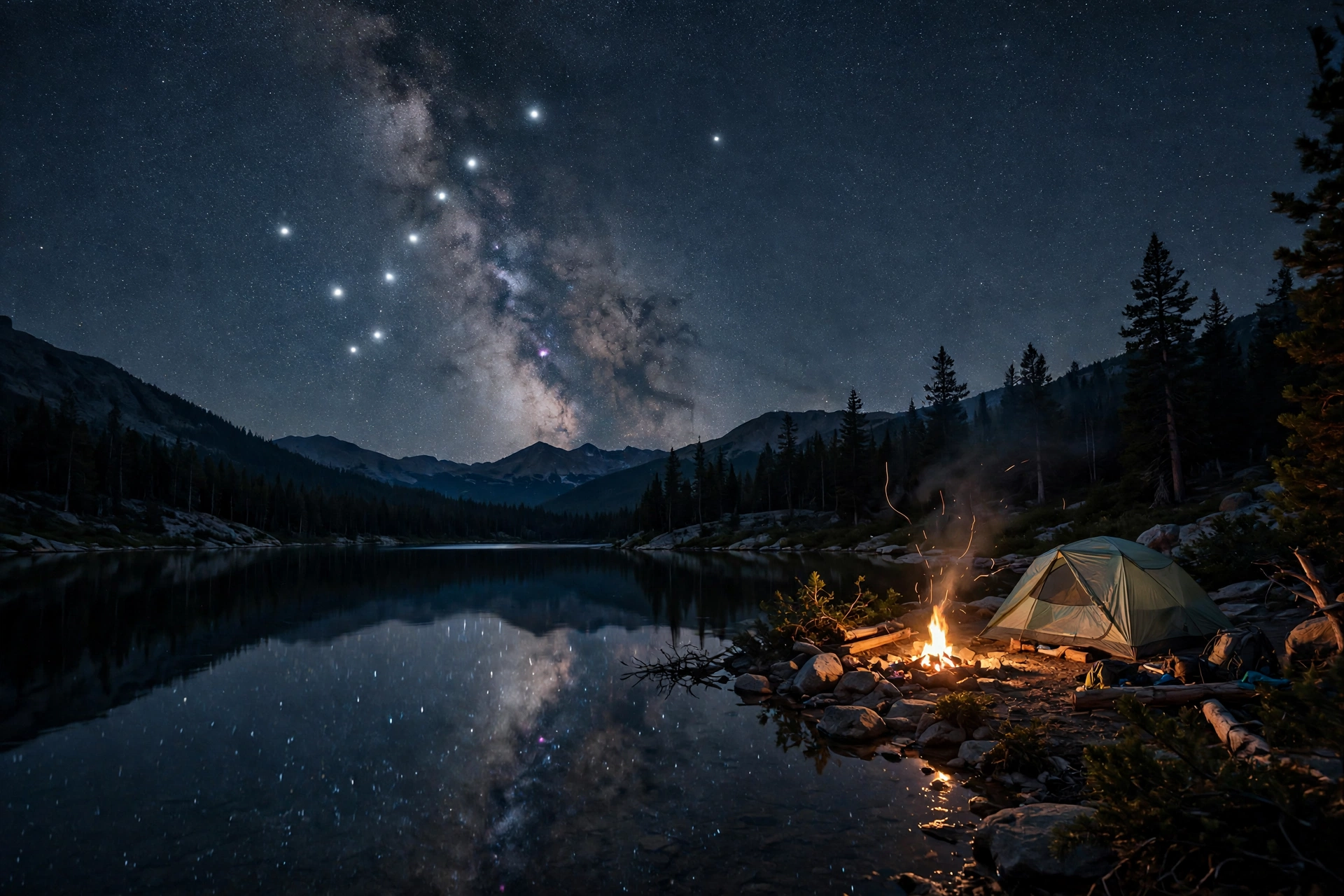
The undisputed starter constellation. Seven bright stars form a shape every child recognizes instantly — a ladle, a saucepan, a shopping cart. It’s visible year-round in most of the US and sits high in the northern sky. The two stars at the front of the “cup” point directly at Polaris, the North Star, which gives kids a real navigation trick they can show off at school.
2. Cassiopeia
Five bright stars in a distinctive “W” or “M” shape, sitting opposite the Big Dipper across the North Star. Kids love it because the W jumps out immediately. In Greek myth Cassiopeia was a vain queen punished by being hung upside down in the sky — which is literally what the W looks like for half the year. A story and a shape in one package.
3. Orion (winter)
Visible October through March, Orion is the showpiece of the winter sky. Three belt stars in a perfect row, bright Betelgeuse and Rigel marking his shoulder and foot, and the Orion Nebula glowing as a fuzzy “fourth star” in his sword. Point binoculars at that fuzzy patch and it resolves into a glowing cloud of gas — the first time most kids see a deep-sky object, and a genuine gasp moment.
4. Scorpius (summer)
Summer’s answer to Orion: a huge, dramatic scorpion curving across the southern sky, anchored by the brilliant red star Antares (“rival of Mars”). The curved tail with its stinger is easy for kids to trace. It’s low in the sky, so find a campsite with a clear view toward the south.
5. Leo (spring)
March through May, look for the backward question mark that forms Leo’s mane and head, with bright Regulus at the bottom. The “sickle” shape is one of the easiest star patterns to spot, and Regulus is one of the brightest stars in the spring sky.
6. Cygnus the Swan (summer)
Also called the Northern Cross — five bright stars forming a huge cross flying along the Milky Way, with Deneb at the tail. Because it sits inside the densest part of the Milky Way, kids see more stars here than anywhere else. A fantastic target for a first look through binoculars.
7. The North Star (Polaris)
Not a constellation, but the single most useful star. Show kids how the Big Dipper’s pointers lead to it, then explain: it’s the only star that never moves. Explorers, sailors, and runaway slaves navigating by the Underground Railroad all used it. Finding it feels like being let in on a secret the whole world shares.
Constellation Quick-Reference Table
| Constellation | Best season | Key landmark star | Kid-friendly hook |
|---|---|---|---|
| Big Dipper | Year-round | — | Looks like a ladle; points to the North Star |
| Cassiopeia | Year-round | — | W shape; the upside-down queen |
| Orion | Oct–Mar | Betelgeuse, Rigel | Three belt stars + glowing nebula in the sword |
| Scorpius | Jun–Sep | Antares | Giant scorpion with a red heart star |
| Leo | Mar–May | Regulus | Backward question-mark mane |
| Cygnus | Jun–Oct | Deneb | Northern Cross inside the Milky Way |
| — (Polaris) | Year-round | Polaris | The one star that never moves |
Simple Gear That Makes a Big Difference
You can stargaze with absolutely nothing — but a few cheap additions transform the experience:
- A red-light headlamp (one per kid if possible) — lets them see without blinding everyone.
- Binoculars — the single best upgrade. Even basic 7×35 or 10×50 binoculars reveal the Orion Nebula, the moons of Jupiter, and star clusters. They’re also far easier for small hands than a telescope.
- A blanket or sleeping pads — neck strain is the fastest way to end a stargazing session. Lying flat changes everything.
- A stargazing app — point your phone at the sky and it labels constellations live. Use night mode and keep brightness minimal. (The National Park Service also runs Night Sky Programs at many parks — free ranger-led sessions with real telescopes.)
- Warm layers and hot drinks — clear nights get cold even in summer. Thermoses of cocoa buy you an extra 30 minutes of kid cooperation.
REI’s beginner stargazing guide is a solid reference for choosing binoculars versus a first telescope if your family gets hooked.
Stargazing by Age: What Actually Works
Toddlers and preschoolers (ages 2–5)
Keep it to 15–20 minutes. Point out the moon, the brightest star, and one easy shape like the Big Dipper. Tell the myth stories — preschoolers love that the stars are “pictures.” Count stars together, watch for shooting stars, and call it a win. Don’t fight bedtime; a short, happy session beats a long, cranky one.
Early elementary (ages 6–8)
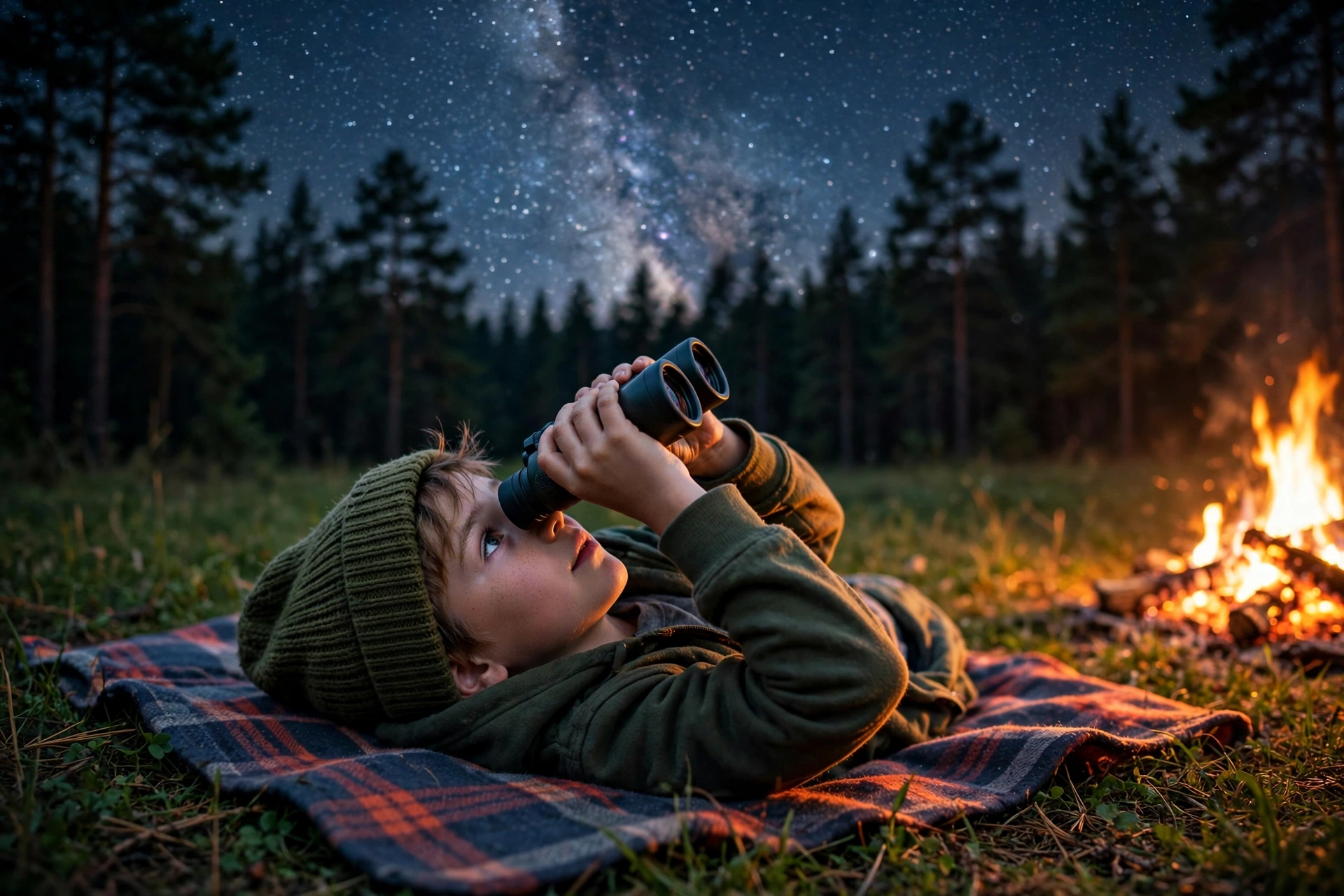
This is the sweet spot. Kids this age can follow the pointer stars to Polaris, spot Orion’s belt, and handle binoculars with help. Give them a mission: “Find three constellations tonight” or “Count how many shooting stars we see before 10 PM.” A simple star wheel (planisphere) makes a great hands-on tool — they turn the dial and match the sky themselves.
Tweens (ages 9–12)
Hand over the stargazing app and let them be the guide — nothing engages a tween like expertise and authority. Challenge them to find the International Space Station (it looks like a bright, fast-moving star; pass times are predictable). Introduce the Milky Way’s structure, light-years, and why different constellations appear in different seasons. Many tweens will happily stay out an hour once they’re in charge.
5 Easy Stargazing Activities for Kids
- Constellation scavenger hunt — print a short checklist (Big Dipper, North Star, Cassiopeia, Orion’s belt, one shooting star). First to check everything off picks tomorrow’s hiking trail.
- Satellite spotting — after dark adaptation, you’ll spot several satellites per hour drifting steadily across the sky. Kids love the “it’s not a star, it’s moving!” game.
- Story constellations — tell the Greek myths (Orion the hunter, Cassiopeia the queen, Scorpius the scorpion). Ancient storytelling is the original astronomy lesson.
- Sky journaling — bring a notebook and let kids sketch what they see. Drawing the Big Dipper from memory the next morning is a surprisingly strong learning exercise.
- Shadow check — on a moonless night in truly dark skies, hold up your hand and look for its shadow on the ground. Starlight alone can cast one. It blows kids’ minds.
If clouds crash the plan, a good backup list matters — our 25 tent-friendly activities will keep everyone happy until the sky clears.
Safety and Leave No Trace at Night
- Stay inside the campground or on marked paths — no wandering into the dark woods.
- Everyone carries their own red light; agree on a meeting point (your tent) before you spread out.
- Keep voices low — you’re sharing the night with neighbors and wildlife.
- Pack out everything you brought to your stargazing spot, including snack wrappers.
- Never shine white lights toward other campsites or at wildlife.
One more thing worth noting: many of the best stargazing spots are also great value trips overall. Stargazing is one of the best free things to do in national parks — proof that the most memorable family moments often cost nothing at all.
Frequently Asked Questions
What is the best age to start stargazing with kids?
As early as age 2–3 for short moon-gazing sessions, but ages 6–10 are the golden window: kids are old enough to stay up a little late, follow star patterns, and use binoculars, yet still young enough to be amazed. Tweens can take it further with apps and satellite tracking.
Do we need a telescope for family stargazing?
No. For the first few trips, naked eyes plus a pair of binoculars will show you constellations, the Milky Way, the Orion Nebula, and Jupiter’s moons. A telescope is worth considering only if the whole family is hooked after several outings — and even then, a ranger-led program with real telescopes is a free way to try one first.
How do I find a dark-sky campsite near me?
Start with the International Dark-Sky Association’s places directory (darksky.org/places), which lists certified dark-sky parks, communities, and reserves. Many national parks run dedicated Night Sky Programs with ranger-led telescope sessions. In general, the farther you camp from the nearest city and the higher the elevation, the darker your sky.
What should we do if the moon is too bright?
Shift your targets: bright constellations, the moon itself (binoculars reveal stunning craters along the terminator line), and bright planets are all great under moonlight. Or plan stargazing for the hours after moonset — set an alarm and treat it as an adventure.
Can stargazing damage kids’ eyes?
Looking at stars, planets, and the moon with the naked eye or binoculars is completely safe. The only rule: never point binoculars or a telescope anywhere near the sun, and put all optics away well before sunrise. Teach this rule explicitly — it’s the one real optical safety issue.
What if it’s cloudy on our stargazing night?
Have a backup plan and stay flexible. Check the forecast each afternoon and pick the clearest night of your trip for stargazing rather than fixing a specific date. Keep a stash of rainy-day backup activities so a cloudy evening still feels like an adventure, not a disappointment.
