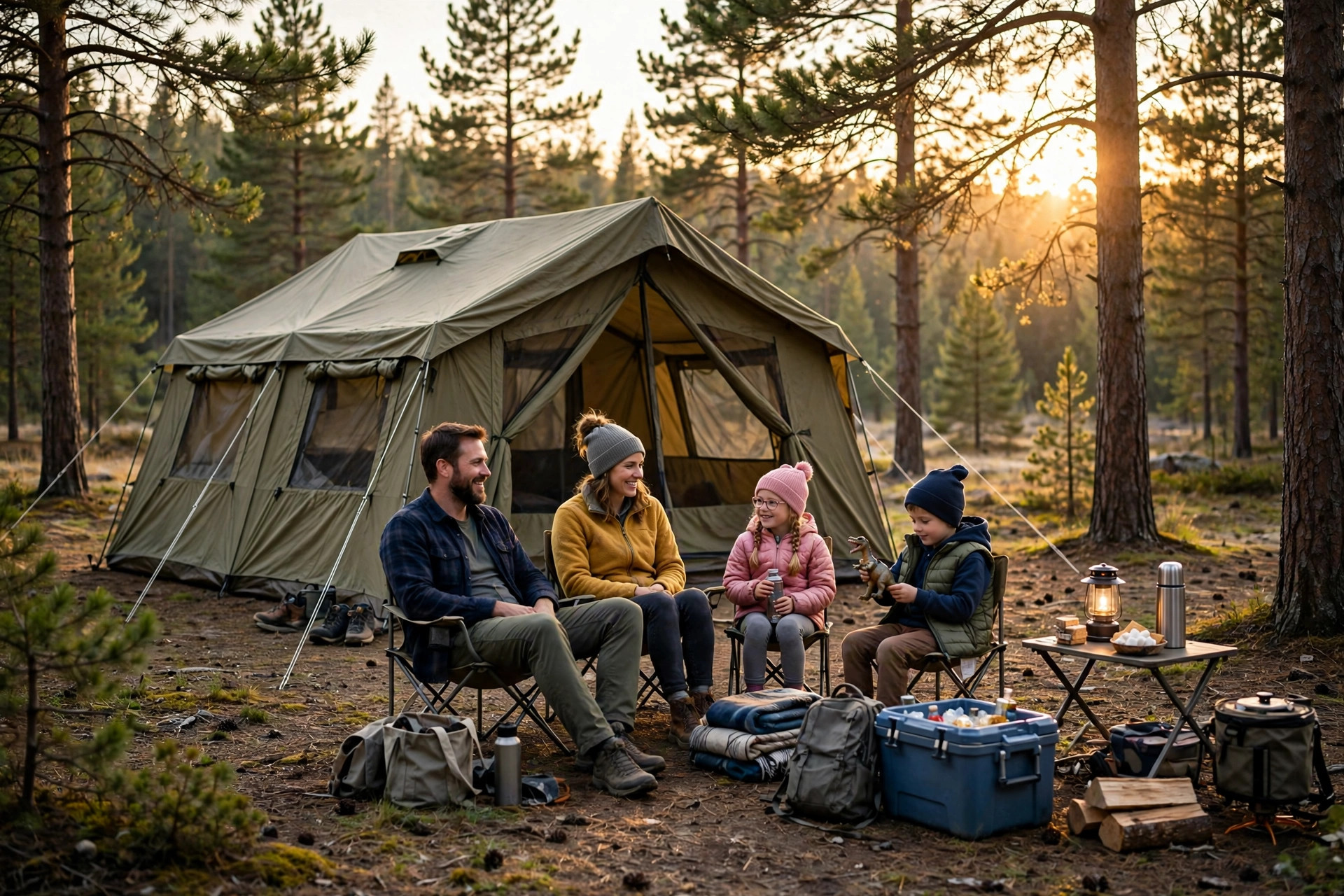
You found the perfect campsite, the weather looks great, and then bedtime arrives — and your family of five is crammed shoulder-to-shoulder in a tent that was supposedly built for eight. If that sounds familiar, you have just met the biggest little lie in camping gear: the person rating on a tent. Family size tents are labelled by how many sleeping pads can technically fit on the floor, not by how many real people — with kids, gear, and a dog — can actually sleep comfortably inside. This guide explains what those numbers really mean, how much space your family actually needs, and how to pick the right size the first time.
What “Family-Size Tent” Actually Means
A family-size tent is usually any tent rated for 4 people or more, but the label tells you almost nothing about comfort. There is no industry-wide standard that forces brands to measure capacity the same way. One company’s 8-person tent can have 30 square feet more floor space than another company’s — and that difference is the gap between a good night’s sleep and elbows in your ribs all night.
How Manufacturers Count “Persons”
Here is the truth most tent boxes never spell out: capacity is calculated by laying standard sleeping pads side by side on the tent floor, edge to edge, with no gaps. The usual assumption is about 20 inches of width per person — roughly the width of a narrow sleeping pad. That math leaves zero room for:
- Your bags, shoes, and clothes — which all have to go somewhere
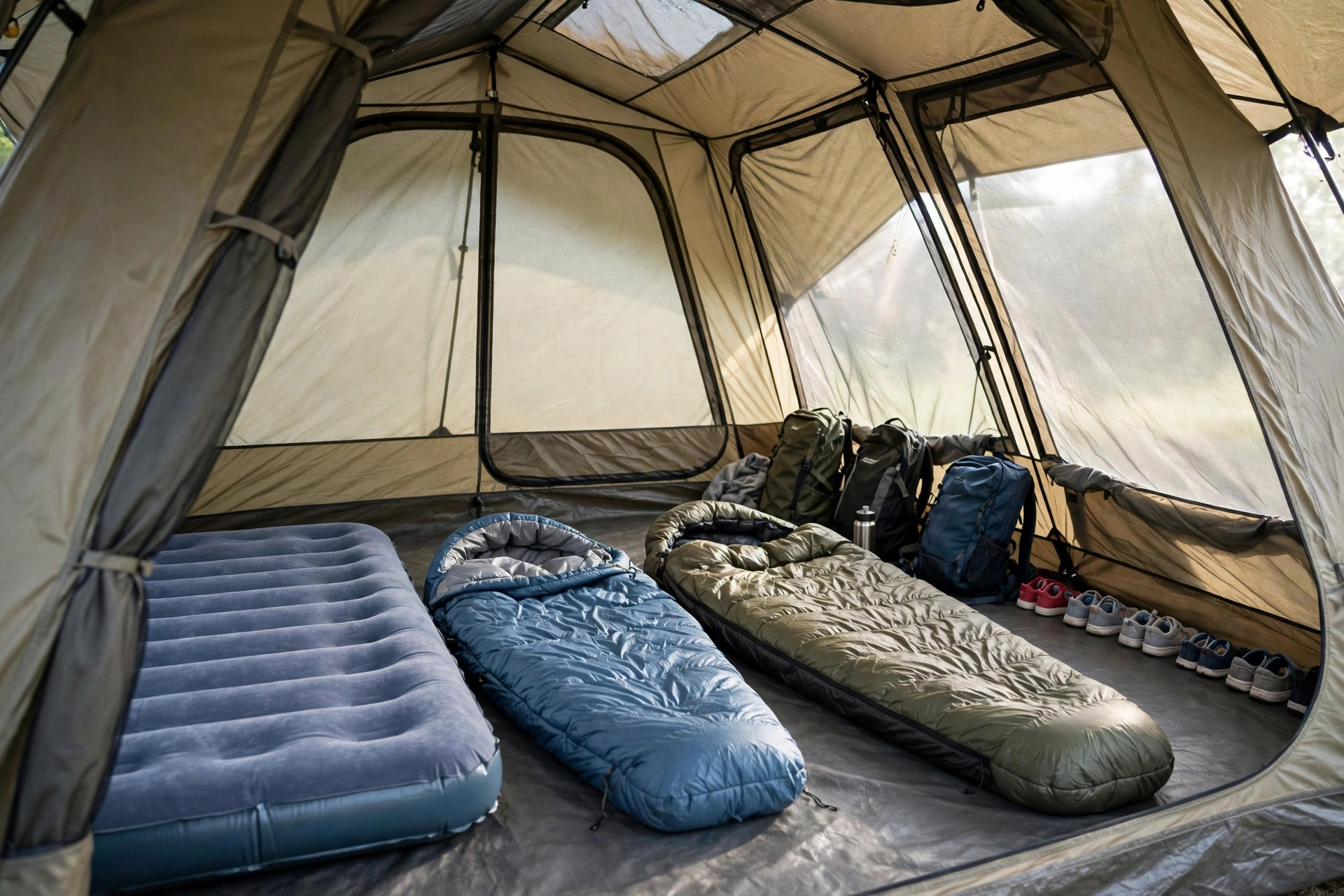
- Air mattresses, which are wider than sleeping pads (a queen air mattress is about 60 inches wide, or three “persons” by itself)
- Kids who sprawl, roll, and migrate across the tent in their sleep
- A dog’s bed, a baby’s travel crib, or a camp cot
- Any space to sit up, change clothes, or wait out a rainstorm
So when a tent says “8-person,” what it really means is “eight adults could lie here like sardines if nobody brings anything.” For a family, that number is a starting point — never the answer.
The Square-Foot Rule That Matters More
Forget the label and look at the floor area instead. It is the single most useful number on a tent’s spec sheet. A practical rule for families: allow about 20–25 square feet per adult and 15–20 square feet per child if you want everyone to sleep with their gear inside the tent. Add another 10–15 square feet if you use air mattresses or cots, because they eat floor space fast.
Family-Size Tent Capacity Chart
Use this table as your starting point. “Comfortable fit” is what actually works for a family sleeping with normal gear inside the tent — not the marketing number.
| Rated capacity | Typical floor area | Comfortable fit for families | Best for |
|---|---|---|---|
| 4-person | 50–65 sq ft | 2 adults + 1 small child | Couples, or a family of three travelling light |
| 6-person | 70–90 sq ft | 2 adults + 2 kids | The sweet spot for most families of four |
| 8-person | 100–130 sq ft | 2 adults + 3 kids, or 4 adults + gear | Large families, families with a dog, air-mattress sleepers |
| 10-person | 130–160 sq ft | 2 adults + 4 kids, or 6 adults | Big families, multi-family trips, basecamp comfort |
| 12-person | 160–200 sq ft | 6–8 people with room to live | Extended families, scout groups, glamping-style trips |
Notice the pattern: for real family comfort, subtract one to two people from the label — and subtract more if anyone sleeps on an air mattress or a cot. If you want a deeper look at the biggest sizes, our guide to the best 8-person tents for large families and our roundup of the best 10-person tents for family camping break down the options by layout and features.
What Size Tent Does Your Family Really Need?
General charts are useful, but your family is specific. Work through your actual scenario below.
Family of Four (2 Adults + 2 Kids)
A 6-person tent is the sweet spot for most families of four. It fits two adult sleeping pads and two kids’ pads with room for a gear pile at the foot of the tent, and most 6-person models are still light and quick enough for one adult to set up alone. If your kids sleep on air mattresses, or you bring a large dog, step up to an 8-person tent.
Family of Five or Six
For two adults and three kids, an 8-person tent is the realistic minimum, and a 10-person tent is the comfortable choice — especially with teenagers, who take up adult-sized space and bring adult-sized bags. Check that the floor fits your sleeping setup: two queen air mattresses need roughly 120 square feet before you count a single bag. Our guide to the best tents for a family of 5 walks through layouts that actually work for two adults and three kids.
Family Plus a Dog (or Lots of Gear)
Dogs need a sleeping spot and a clear path to the door for late-night outings — budget about 10–15 extra square feet for a medium or large dog. The same goes for families who camp with cots or a portable crib. In practice, adding a dog or a baby’s travel crib usually means sizing up one whole capacity step.
5 Things That Change the Size You Need
Two families of four can need very different tents. These five factors decide whether the chart above is right for you — or whether you need to size up.
- Air mattresses vs. sleeping pads. A queen air mattress is 60 inches wide and about 80 inches long. Two of them fill a 6-person tent almost completely. Pads are narrower, so pad-sleeping families can go a size smaller.
- Cots and cribs. A single camp cot is about 25 inches wide and 75 inches long; a portable travel crib takes roughly 40 x 28 inches. Measure your actual gear — do not guess.
- Gear storage. If your gear stays in the car, you need less tent. If it comes inside (rainy climates, bear country), add 15–20 square feet.
- Peak height and wall shape. A 6-foot peak with vertical walls feels twice as big as a 5-foot dome with sloping walls, even on the same floor area.
- Rainy-day living. On a fair-weather trip, the tent is just a bedroom. On a rainy trip, it becomes the living room, dining room, and playroom. Families who camp in wet climates should always size up.
How to Measure Before You Buy: A 5-Minute Checklist
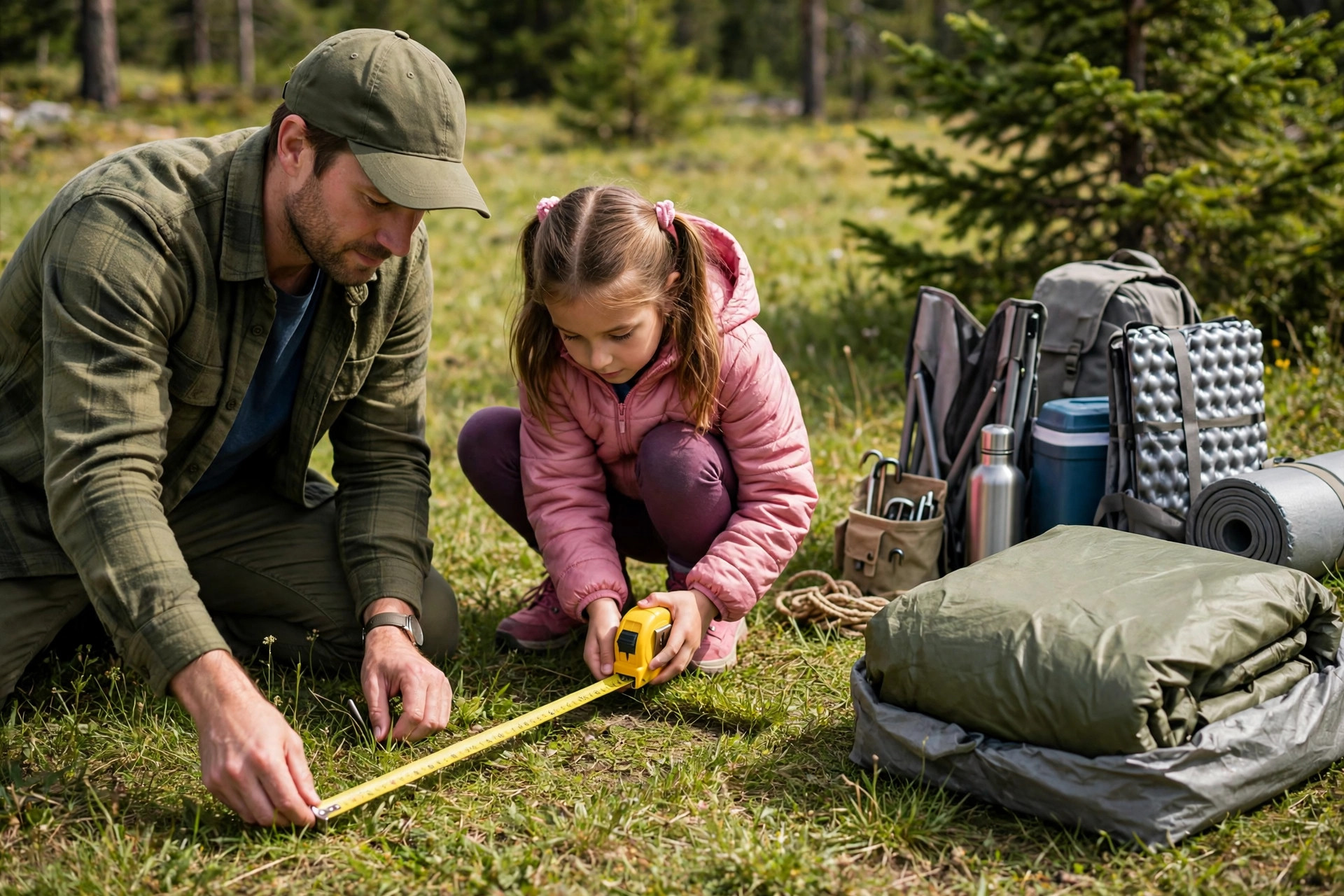
Do this at home before you spend a cent. It takes five minutes and it is the most reliable sizing method there is.
- Measure your sleep setup. Lay your sleeping pads, air mattresses, or cots on the living-room floor exactly as they would sit in the tent. Measure the rectangle they cover.
- Add a gear lane. Add 18–24 inches along one side for bags, shoes, and clothes. If gear goes inside, add a full 24 inches.
- Compare with the tent’s floor dimensions. Look for the actual floor measurements (for example, 10 x 12 feet), not the person rating. Your rectangle plus the gear lane must fit inside it with room to spare.
- Check the peak height. Anyone over 5’8″ should look for at least 6 feet of peak height, and taller campers need 6’4″ or more to stand comfortably.
- Test the layout on paper. Sketch the floor plan: who sleeps where, where the door is, and where the dog sleeps. If someone has to climb over three people to reach the door at night, the layout — or the size — is wrong.
Cabin vs. Dome: Shape Matters as Much as Size
Two tents can share the same floor area and feel completely different inside. The shape decides how much of that area you can actually use.
Cabin tents have near-vertical walls and a tall peak, so almost the whole floor is usable and adults can stand up. They are the best choice for most families: easy to move around in, easy to fit cots and air mattresses against the walls, and usually available with room dividers. The trade-off is weight and wind — they are heavier and catch more wind, so they suit car camping, not backpacking.
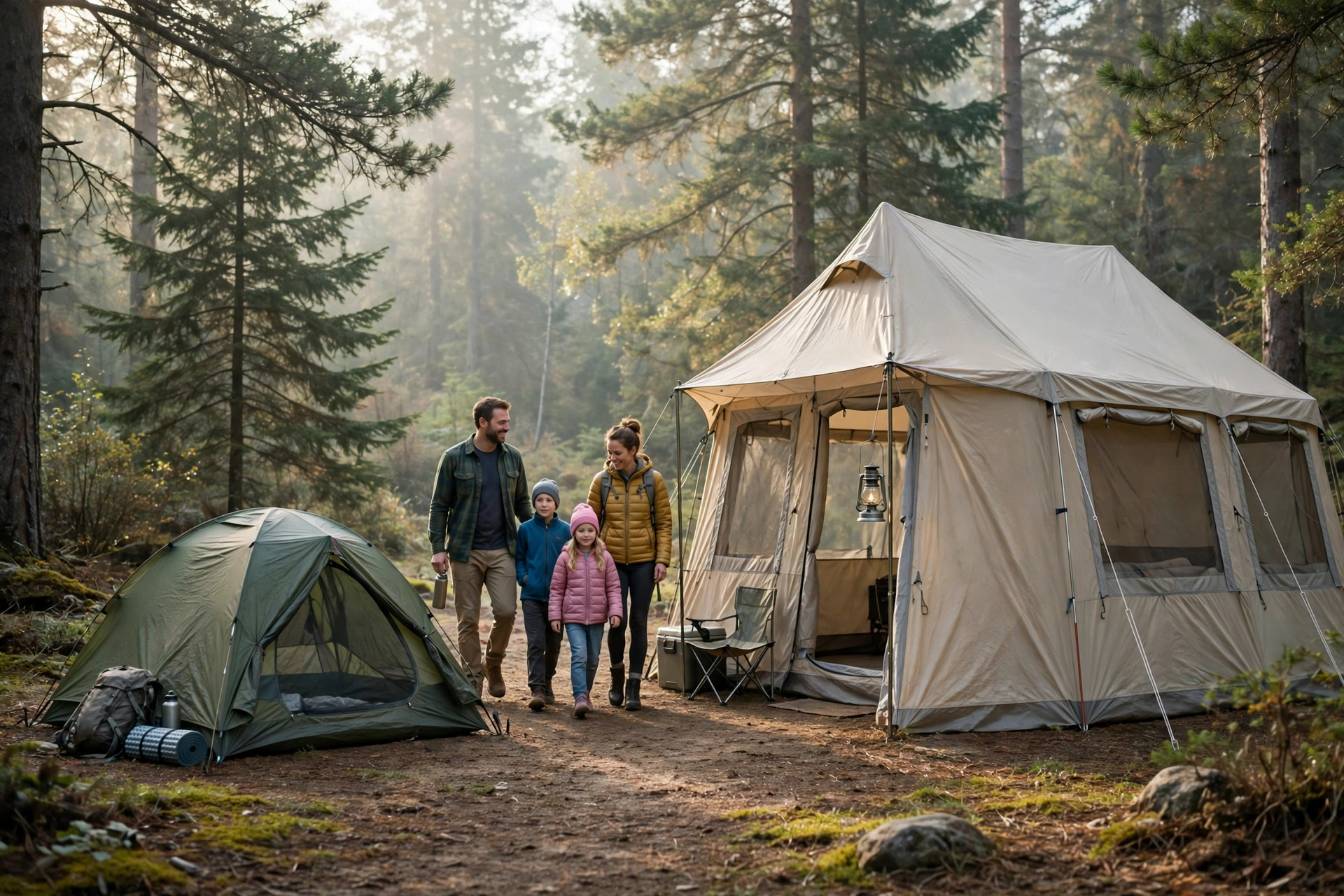
Dome tents have sloping walls that steal floor space at the edges, and a lower peak height. They handle wind better and pack smaller, which makes them great for couples or small families. For a family of four or more, though, a dome tent usually needs to be one size larger than a cabin tent to feel equally roomy.
How to choose: if you car camp with kids, pick a cabin tent in the size the chart recommends. If you camp in exposed, windy places, consider a dome tent one size up. Either way, check the rainfly coverage — a good rainfly is what keeps a family-size tent dry in a real storm. Our guide on what a tent rainfly is explains what to look for.
Common Mistakes Families Make When Choosing a Tent Size
- Trusting the person rating. The number on the box counts sleeping pads, not people with gear. Always size by floor area.
- Forgetting the air mattress. Families who switch from pads to air mattresses often discover their tent shrank overnight. Measure the mattresses, not the people.
- Ignoring peak height. A tent you cannot stand up in turns every clothing change into a wrestling match — and with toddlers, you change clothes a lot.
- Buying for this year only. Kids grow fast. A tent that fits your family when the kids are four and six will feel tight when they are eight and ten. Buy one size up if you plan to keep the tent for several seasons.
- Skipping the living-room test. A tent that looks huge online can feel small once your actual gear is inside. The five-minute floor test above prevents this completely.
- Choosing weight over space for car camping. When the car carries the tent, an extra five pounds buys an enormous amount of comfort. Save the ultralight thinking for backpacking trips.
Frequently Asked Questions
What does “8-person tent” actually mean?
It means eight standard sleeping pads can fit on the floor edge to edge, with no room for gear. In practice, an 8-person tent comfortably sleeps five to six people with their gear — a family of four with a dog, or two adults and three kids.
What size tent do I need for a family of 4?
A 6-person tent is the sweet spot for most families of four. It fits two adults and two kids on pads with room for gear. Size up to an 8-person tent if you use air mattresses, bring a large dog, or camp in rainy weather where everyone spends more time inside.
Is a 6-person tent big enough for 6 people?
Only if all six sleep on narrow pads and keep their gear outside the tent. For real comfort, a 6-person tent fits four to five people. Six adults — or a family with teenagers and gear — will be much happier in an 8-person tent.
How many square feet per person should a family tent have?
Allow 20–25 square feet per adult and 15–20 square feet per child for comfortable sleeping with gear inside. Add 10–15 square feet more if you sleep on air mattresses or cots, since they take up more floor space than sleeping pads.
Are cabin tents better than dome tents for families?
For most families, yes. Cabin tents have vertical walls and standing height, so the whole floor is usable and adults can stand to dress kids or wait out rain. Dome tents handle wind better and pack smaller, but you usually need one size larger to get the same usable space.
Should I buy a tent one size bigger than I need?
For car camping with kids, usually yes. The price and weight difference between sizes is small, but the comfort difference is large — and kids grow. The one exception is if you also backpack, where every pound matters. For more trip-planning help, check the National Park Service camping pages for campground rules and reservation windows, and Recreation.gov to book sites in advance.
The Bottom Line
Family-size tent labels are a starting point, not a promise. The number that matters is the floor area: about 20–25 square feet per adult, 15–20 per child, plus room for mattresses, cots, and gear. For most families of four, that means a 6-person tent — and an 8-person tent if you use air mattresses, bring a dog, or camp where rain keeps everyone inside. Measure your real sleep setup on the living-room floor, compare it with the tent’s actual dimensions, and buy one size up if your kids are still growing.
Still deciding between models? Start with the size from the chart above, then compare real layouts in our best family camping tents roundup. And if you want a second opinion on the math, the CleverHiker tent size guide is a solid independent reference for floor-area-per-person figures.
