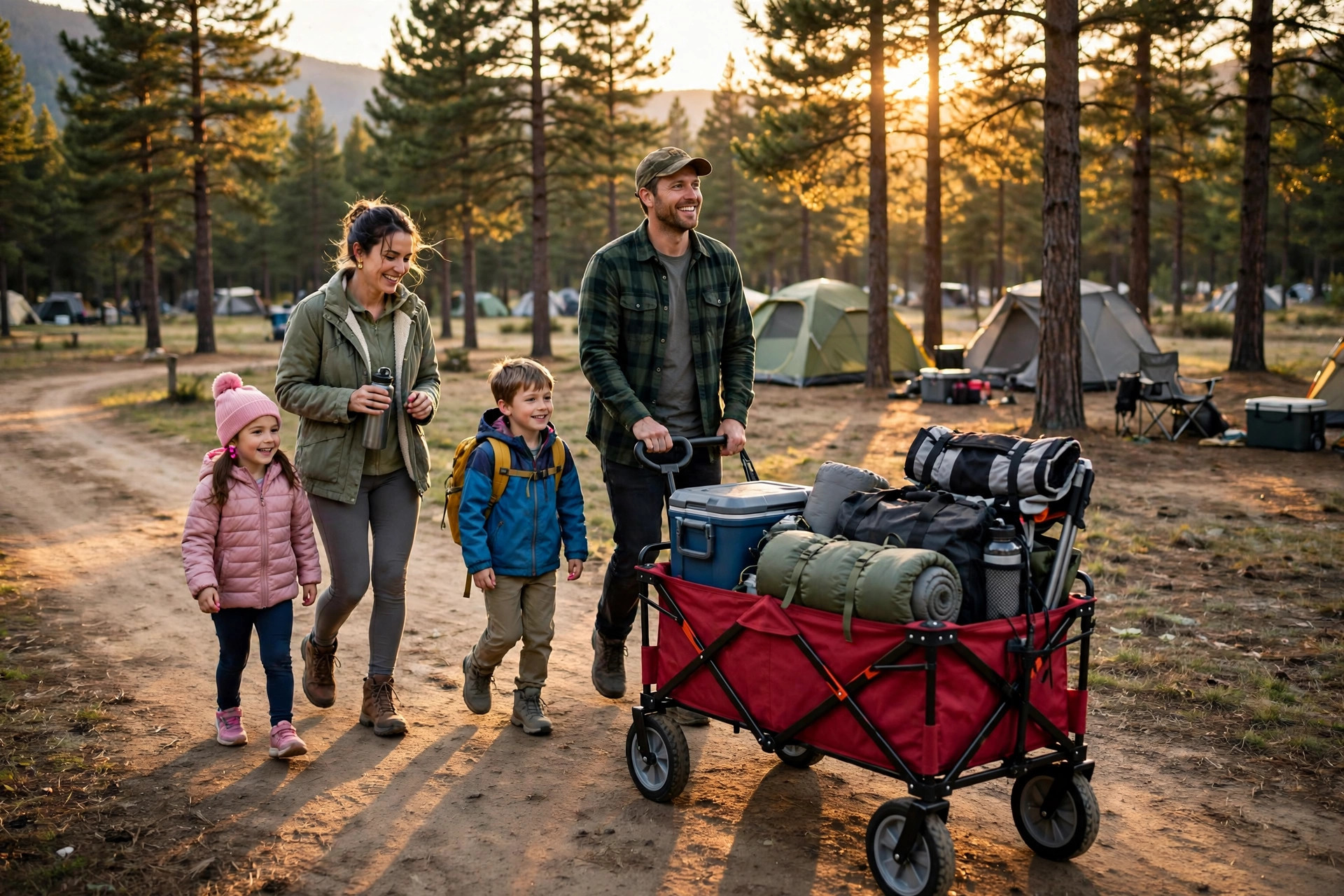
The walk from the parking lot to your campsite is only 200 yards — until you are carrying a tent, a cooler, two sleeping bags, a camp kitchen box, and a four-year-old whose legs have quit. That is the problem the best camping wagon for kids solves: one sturdy, folding cart that hauls your gear in one trip and, if you pick the right kind, gives tired little legs a safe ride back.
But not every wagon sold as a “camping wagon” is safe for carrying children. Some are gear-only haulers with no seat belts and a real tip-over risk on uneven ground. Others are built like strollers, with harnessed seats and canopies, but can barely hold a cooler once the kids are seated. This guide covers the difference between a gear hauler and a kid carrier, how to choose in five steps, and the six wagons that fit family camping best in 2026 — based on manufacturer specs and what camping parents report, with no sponsored picks or invented test claims.
First, Decide: Gear Hauler or Kid Carrier?
Every camping wagon falls into one of two families, and mixing them up is the most common buying mistake.
Gear haulers are open-bed utility wagons built to move stuff: deep fabric beds, steel frames, big wheels, high weight ratings. What they do not have is any restraint system for children — no seat belts, no harness, no padded seat — and the manufacturer will say so plainly.
Kid carriers (stroller wagons) are built the other way around: harnessed bucket seats, a canopy, push-and-pull handles, and brakes. They are designed for children first and gear second — once two kids are seated, there is often room for little more than a small cooler and a diaper bag.
So ask one question before you shop: what is it mostly for? Mostly gear, kids walk — buy a gear hauler. Mostly kids — buy a stroller wagon with real harnesses. Both, every trip — you need a large stroller wagon plus a second gear run, or two wagons. Many experienced camping families end up with both.
How to Choose the Best Camping Wagon for Kids in 5 Steps
Step 1: Check the weight rating — honestly
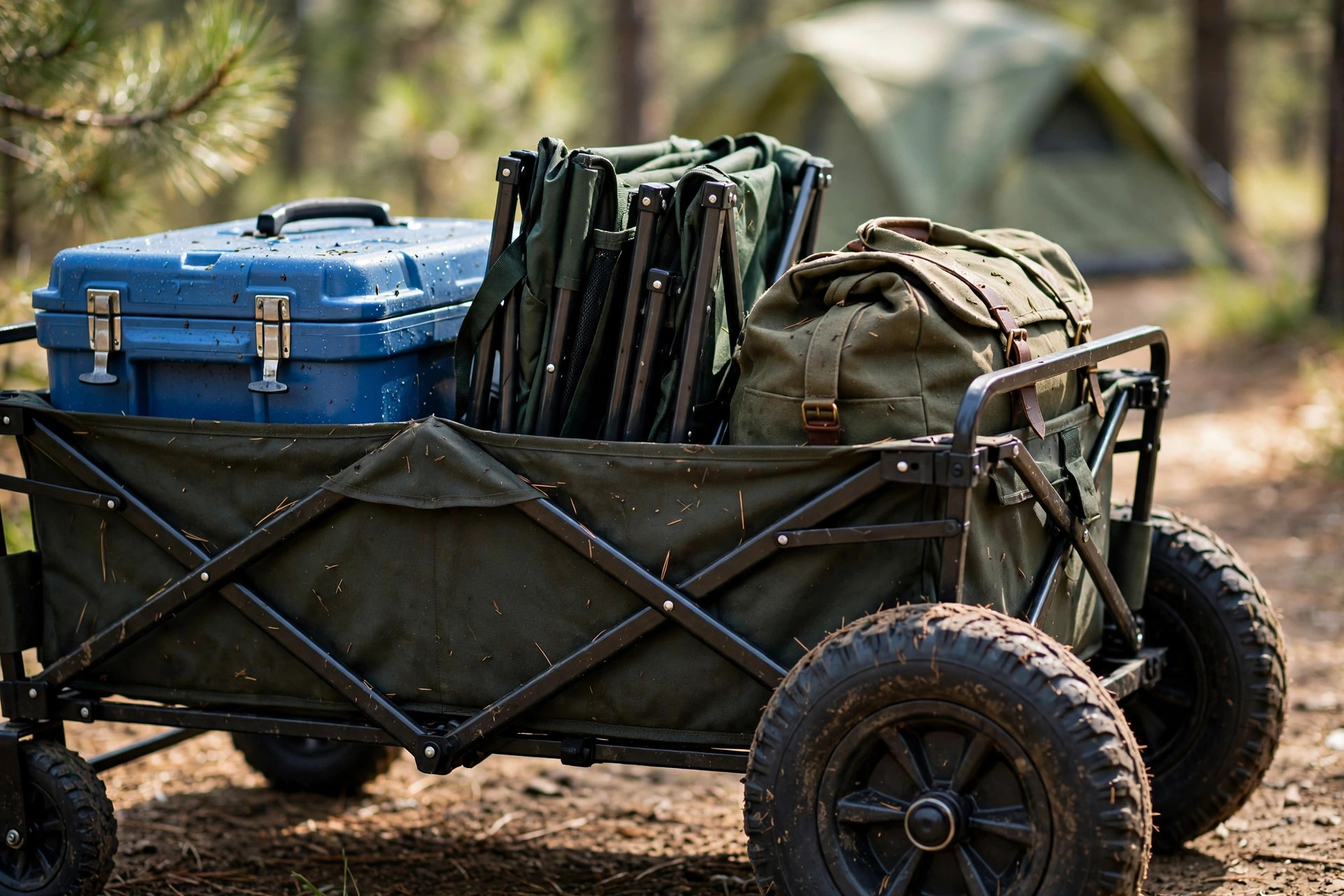
Add up your real load: cooler (30–40 lbs full), tent bag, chairs, sleeping bags, kitchen box. Most family loads land between 80 and 150 lbs. A wagon rated well above your load lasts longer and pulls easier — if the rating is close to your load, size up.
Step 2: Look at the wheels before anything else
Small hard plastic wheels are fine on pavement, useless on a campsite. For grass, gravel, sand, and dirt, you want wide wheels — the bigger and wider, the better. Wheels are the single best predictor of whether you will love or hate your wagon after the first trip.
Step 3: Measure the folded size against your trunk
A wagon that does not fit in your car is a garage decoration. Compare the wagon’s folded dimensions with your trunk — not the open ones — and remember you still need room for the family camping tent and the rest of your gear.
Step 4: Decide how kids will ride — or if they will at all
If children will ride, only buy a wagon the manufacturer rates for carrying children, with a harness or seat belt system, and check the per-seat weight limit and age range. Never put a child in a gear-only wagon on uneven ground: no restraints plus a high centre of gravity is a tip-over waiting to happen.
Step 5: Check the handle, brakes, and canopy
A telescoping pull handle saves your back on long walks; a push handle helps on hills. Brakes matter the moment you park on a slope. And if kids will nap in the wagon, a canopy is worth every penny.
The 6 Best Camping Wagons for Families (2026)
1. Mac Sports Heavy Duty Collapsible Wagon — Best Overall Gear Hauler
The default pick in campgrounds: a heavy-duty steel frame, a deep bed that swallows a cooler plus camp chairs, and oversized wheels that handle dirt paths far better than budget carts. It folds flat and sets up in seconds. Best for: moving a full camp load in a single trip. Watch out for: it is a gear hauler, not a kid carrier — no harness, no seats, so children should not ride in it.
2. Radio Flyer Odyssey Stroller Wagon — Best All-Rounder for Kids + Gear
Two seats with safety harnesses, a canopy, and enough cargo space for the essentials. Rated to carry up to about 120 lbs — two small children plus a light load — and it folds with the seats in place. Best for: families with one or two toddlers who want one wagon that does both jobs reasonably well. Watch out for: once both kids are seated, large gear like a camp kitchen box needs a second trip.
3. Veer Cruiser Stroller Wagon — Best for Rough Terrain with Kids
Built for dirt trails, roots, and gravel: big all-terrain wheels, a rugged frame, and harnessed seats rated at about 55 lbs per seat. — the closest thing to a hiking stroller that still folds into a wagon. Best for: active families who camp at walk-in or primitive sites. Watch out for: premium price and real weight — heavier to lift into the car than a basic folding wagon.
4. Hikenture Stroller Wagon — Best for Hauling Toddlers Safely
The pick most roundups miss: two harnessed bucket seats, a fold-down canopy, and a buckle system that keeps a wiggly toddler in place on uneven ground. Best for: parents of toddlers who want a safe, shaded ride to the playground, the lake, or the campfire. Watch out for: storage is limited once kids are seated — plan on two trips, or pair it with a cheap gear hauler.
5. Gorilla Carts Folding Wagon — Best Budget Gear Hauler
The honest budget pick: a steel mesh bed, a folding frame, and a price that leaves money for the rest of your kit. It handles paved loops and flat grass well and folds small. Best for: car campers on developed sites moving gear from car to tent pad. Watch out for: smaller wheels struggle on sand and deep gravel, and it is gear-only — no kid seating.
6. Sekey Folding Wagon — Best Big-Capacity Value Pick
For families who pack heavy: a deep bed, chunky wide wheels, and room for a full camp load with space to spare. Best for: big families and long stays where every trip from the car counts. Watch out for: the manufacturer states it is not suitable for carrying children — gear only — and big capacity means a bigger fold, so check your trunk.
| Wagon | Best for | Kids ride? | Terrain | Price tier |
|---|---|---|---|---|
| Mac Sports Heavy Duty | Full camp load | No — gear only | Dirt, gravel, grass | Mid-range |
| Radio Flyer Odyssey | Kids + gear | Yes — harnessed | Paved, grass, light dirt | Mid-range |
| Veer Cruiser | Rough trails with kids | Yes — harnessed | Trails, gravel, sand | Premium |
| Hikenture Stroller Wagon | Toddlers, safe rides | Yes — harnessed | Paved, grass, light dirt | Mid-range |
| Gorilla Carts Folding | Budget gear hauling | No — gear only | Paved, flat grass | Budget |
| Sekey Folding Wagon | Big loads, value | No — gear only | Grass, dirt, gravel | Budget–mid |
Prices change constantly, so check the current price before you buy.
What Terrain Can a Camping Wagon Actually Handle?
Honest answer: less than the ads promise, more than you fear — if the wheels match the ground. Paved loops: any wagon works. Grass and packed dirt: wheels at least 7 inches wide with some tread. Gravel and roots: wide all-terrain wheels and a steel frame — the Veer Cruiser and Mac Sports handle this best. Soft sand is the hardest surface: wide wheels help, but even good wagons sink — for beach camping with kids, pack light and expect to pull harder. Steep hills and mud: carry the load, or make two trips — a loaded wagon on a muddy slope is how ankles get twisted and gear gets dumped.
A wagon pays for itself fastest at walk-in sites, where a five-minute walk from parking to tent pad turns four sweaty trips into one. If you book walk-in sites on Recreation.gov, it is close to essential; at drive-up sites, it is a convenience.
Can Kids Ride in a Camping Wagon? Safety Rules That Matter
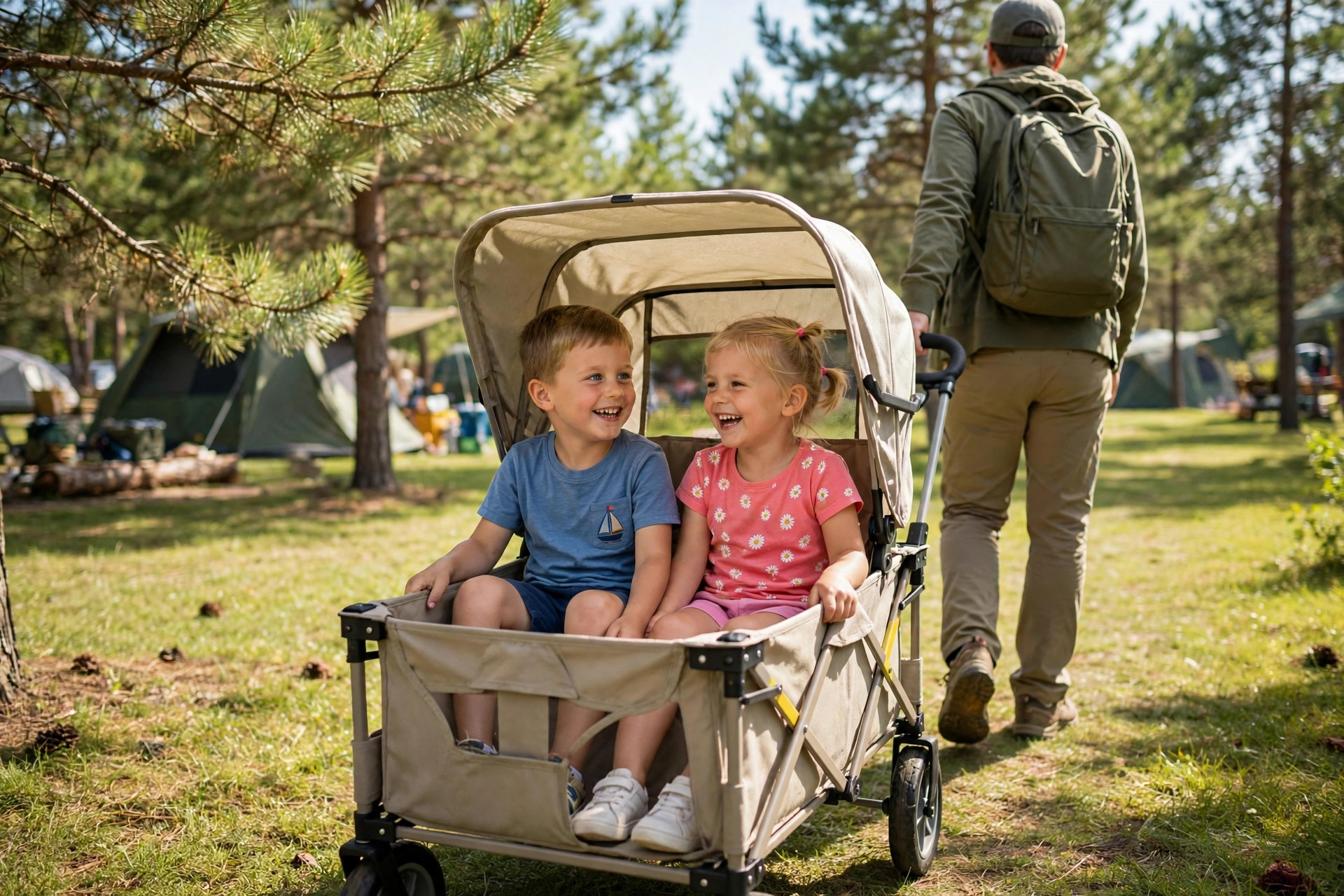
Yes — but only in a wagon built for it, and only with rules:
- Only ride in a wagon with a harness or seat belt. If the manufacturer says “not suitable for carrying children,” believe them.
- Stay under the per-seat weight limit. A seat rated for 55 lbs is not a suggestion, and overloaded seats change the wagon’s balance.
- Keep speeds at a walk — no running while pulling, no downhill rides, no towing behind a bike.
- Use the canopy and sunscreen. a child sitting still in a wagon gets far more sun than one running around.
- Never leave a child unattended in a wagon, not even “just for a minute” while you pitch the tent.
- Lock the brakes when parked — even on ground that looks flat, a loaded wagon with kids inside can creep.
A wagon does not protect food in bear country — you still need proper storage at camp. The National Park Service’s bear safety guidance is the authority: store food in bear boxes or hard-sided vehicles, never in a tent, and never leave a loaded wagon of food out overnight.
What to Pack in Your Wagon
Load heaviest items low and centred. A good default load: bottom layer — cooler, water jug, camp kitchen box; middle layer — tent bag, sleeping bags, camp chairs; top layer — kids’ jackets, first-aid kit, snacks, sunscreen; side pockets — phone, keys, headlamp, bug spray; strapped on top — rolled sleeping pads, a camp blanket.
Keep the first-aid kit accessible, not buried — if a child scrapes a knee, you want it in your hand in ten seconds. Our family camping first aid kit guide covers what to include. And if a little one fades mid-afternoon, a wagon with a canopy doubles as a shady nap spot — one more reason it helps with getting kids to sleep while camping.
4 Mistakes Families Make with Camping Wagons
1. Buying for the fantasy trip, not the real one. If you camp at developed sites with paved loops, you do not need a premium all-terrain wagon — match the wagon to the campsites you actually book.
2. Ignoring the folded size. Measure the trunk before you buy — a wagon that only fits with the seats down and the cooler on someone’s lap stays home.
3. Overloading past the rating. Overloaded wagons pull badly, wear out fast, and tip more easily — if your load regularly exceeds the rating, you need a bigger wagon, or a second trip.
4. Letting kids ride in a gear-only wagon. It happens at every campground, and it is the one mistake with real injury risk — if kids ride, the wagon needs harnesses.
Frequently Asked Questions
What is the best camping wagon for kids?
For carrying children, a stroller wagon with harnessed seats is the only safe choice — the Radio Flyer Odyssey is the best all-rounder, the Veer Cruiser handles rough terrain best, and the Hikenture is the best toddler carrier. For gear only, the Mac Sports and the Sekey are the best value picks.
Can I use a regular camping wagon to carry my kids?
Only if the manufacturer rates it for carrying children, with a harness or seat belt system. A standard gear wagon has no restraints and can tip on uneven ground. When in doubt, do not let kids ride.
How much weight can a camping wagon hold?
Most family wagons are rated between about 100 and 300 lbs — gear haulers at the top end, stroller wagons lower because of per-seat limits. Add up your real load and pick a wagon rated comfortably above it.
Are folding wagons good for the beach?
They help, but soft sand is the hardest surface for any wagon. Wide wheels perform best and a lighter load pulls much easier — pack light and use packed sand near the waterline.
What age can kids ride in a wagon?
Most stroller wagons are rated from about 6 months (with an infant adapter) or 1 year up to around 4–5 years, with per-seat limits around 50–55 lbs. Always check the manufacturer’s rating for the exact model you buy.
The Bottom Line
The best camping wagon for kids matches your real trips: a gear hauler like the Mac Sports or Sekey to move a full camp in one load, a harnessed stroller wagon like the Radio Flyer Odyssey, Veer Cruiser, or Hikenture for tired toddlers. Buy the wheels for your terrain, measure the fold against your trunk, never put a child in a wagon not built to carry one. Get those three decisions right, and the walk from the car to the campsite stops being the hardest part.
