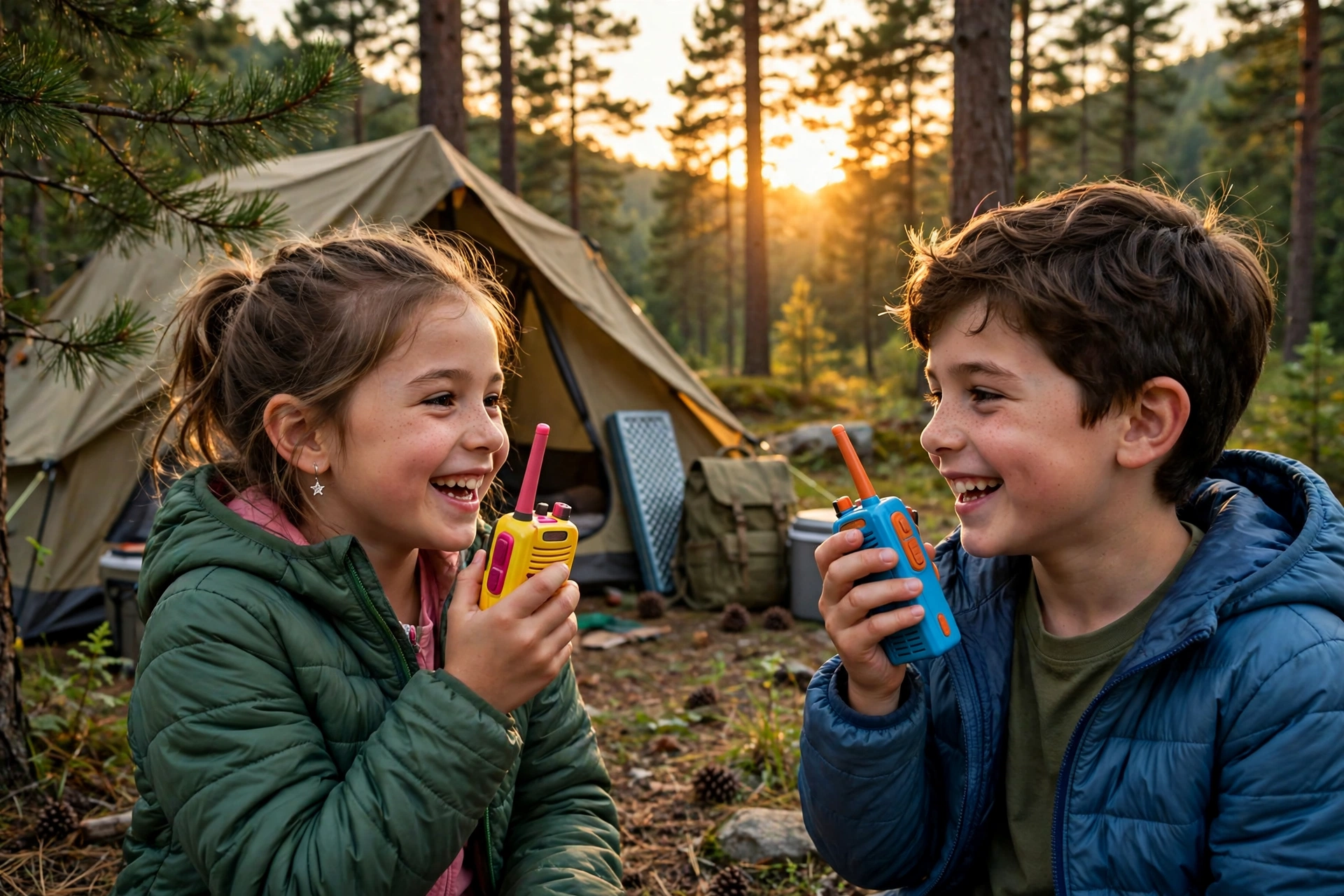
Walkie talkies are one of the cheapest, simplest ways to give your kids a little freedom at the campground — and give yourself a lot of peace of mind. A child who can press one button and say “Mom, I’m at the playground” is a child who can explore safely, and a parent who can actually relax at the picnic table.
But they only work well if kids know how to use them — and if you set a few ground rules first. This guide covers the right age to start, how the radios actually work, the safety rules, a simple communication plan, and games for the trip.
Why Walkie Talkies Belong in Your Camping Kit
At a campground, phones are a poor tool for keeping track of kids. Cell signal is often weak or nonexistent, phones are expensive to lose or drop in a creek, and a young child can’t work a phone reliably. A walkie talkie solves all three problems: it works without cell signal, it costs a fraction of a phone, and using it takes exactly one button.
For kids, a walkie talkie is also something a phone never will be: fun. It turns a walk to the camp store into a mission and a check-in call into something they actually want to do.
Walkie talkies shine in a few specific campground situations:
- Playground and camp store runs: your child can report where they are and when they will be back, without you walking over every time.
- Split-group hikes: when one parent takes the older kids up a trail and the other stays at camp with the toddler, radios keep both groups in touch where phones have no bars.
- Older kids exploring: a 9- or 10-year-old on a bike loop around the campground can check in at every turn.
- Emergencies: if a child gets lost or hurt on a trail, a radio call reaches you instantly — no signal required.
What Age Can Kids Really Use a Walkie Talkie?
Most kids can handle a basic walkie talkie from around age 4, when the push-to-talk rhythm — press, wait a second, talk, release to listen — finally clicks. Younger children tend to hold the button down and talk over the other person.
Ages 3–4: Toy Radios Only
At this age, walkie talkies are a toy, not a safety tool. Simple one-channel toy sets with big buttons work for backyard play and hide-and-seek around the tent. Do not rely on a 3-year-old to radio for help — stay within sight and earshot.
Ages 5–7: Simple Real Radios
This is the sweet spot for a first real set. Kids this age can learn the push-to-talk rhythm, remember a channel number, and follow a simple rule like “call me when you get to the playground.” Choose a set with two or three buttons maximum, a belt clip, and a rugged body that survives drops onto gravel.
Ages 8–12: Full Campground Freedom
Older kids can manage a full-featured family radio: changing channels, using privacy codes, and following a check-in schedule. This is the age where walkie talkies become a genuine safety tool. Give them a defined roaming area, a check-in interval, and the “call before you move” rule.
Teens: A Real Communication Tool
Teenagers may roll their eyes at a “kid” walkie talkie, but a compact real radio earns their respect — especially on hikes and split-group days. For ideas on keeping older kids engaged outdoors, see our guide to camping with teenagers.
How Walkie Talkies Actually Work (The 2-Minute Version)
You do not need to be a radio expert to use walkie talkies with your kids. But three facts save parents a lot of confusion:
They Use FRS Channels — No License Needed
Nearly every walkie talkie sold for kids runs on FRS (Family Radio Service) channels. FRS is license-free in the United States: there are 22 shared channels, and any FRS radio can talk to any other FRS radio on the same channel. You do not need a license, a subscription, or a cell signal. One warning: some radios also transmit on GMRS frequencies at higher power, and GMRS legally requires an FCC license. For kids, stick to FRS-only sets — check the box before you buy.
The Range on the Box Is Not the Range at Camp
A box that promises “3 miles” measured that range over open water with nothing in the way. In the real world, trees, hills, RVs, and buildings cut range dramatically. Expect roughly half a mile to a mile in open campground terrain and a few hundred feet through dense trees. Our guide to how far walkie talkies really reach breaks down real-world range by terrain.
Privacy Codes Do Not Make a Channel Private
Many kids’ radios advertise “privacy codes” — and many parents assume that means nobody else can hear their child. That is not how they work. A privacy code only quiets other people’s chatter on your radio; anyone on the same channel can still hear everything your child says. Teach your kids this from day one: the radio is a public channel, so never share your name, campsite number, or plans on air.
Teaching Your Kids to Use a Walkie Talkie
Spend ten minutes practicing at home before you need the radios for real — it pays off all weekend.
Step 1: The Push-to-Talk Rhythm
Show your child the one button that matters. The rule is simple: press and hold, wait one second, talk, release to listen. The one-second pause matters — the first syllable gets clipped if they talk the instant they press. Practice with a simple call-and-response: you say “Base to Explorer, over,” they answer “Explorer here, over.”
Step 2: The Word “Over”
Teach kids to end each message with “over” so the other person knows it is their turn. “Over and out” means the conversation is finished. It sounds old-fashioned, but it stops the two-kids-talking-at-once problem that makes radios unusable.
Step 3: Keep Messages Short
Radio messages should be one or two sentences. “I’m at the playground. Over.” beats a three-minute story about a squirrel. Short messages keep the channel free, save battery, and make it much more likely the other person heard the important part.
Step 4: Practice the Check-In Call
Before your kids roam, rehearse the exact check-in call: where they are, where they are going, and when they will call again. “Mom, I’m leaving the playground and going to the camp store. I’ll call when I get there. Over.” If they can say that sentence, they are ready for real campground freedom.
A Campground Communication Plan That Keeps Kids Safe
Before your kids head off with a radio, agree on these five things as a family:
- One channel, one code: pick a channel for your family before the trip (channel 7 is a fine default) and set the same privacy code on every radio. Write it on tape on the back of each handset.
- A defined roaming area: walk the boundary with your child on the first day. “You can go as far as the playground, the camp store, and the bathhouse — but not past the creek.” A boundary they have seen beats a boundary you described.
- Check-in times: agree on a rhythm — every 30 minutes, or every time they change location, whichever comes first. Younger kids check in more often.
- Call before you move: the golden rule. Before leaving any spot, the child radios where they are, where they are going, and when they will call next. If a child misses two check-ins, a parent walks to their last known spot.
- One radio stays with a parent: at least one adult always carries a radio with the volume up. A radio in a backpack at the bottom of a tent helps nobody.
This plan pairs naturally with the safety habits in our guide to what to do if a child gets lost while hiking — the radio is the tool, but the plan is what actually keeps kids safe.
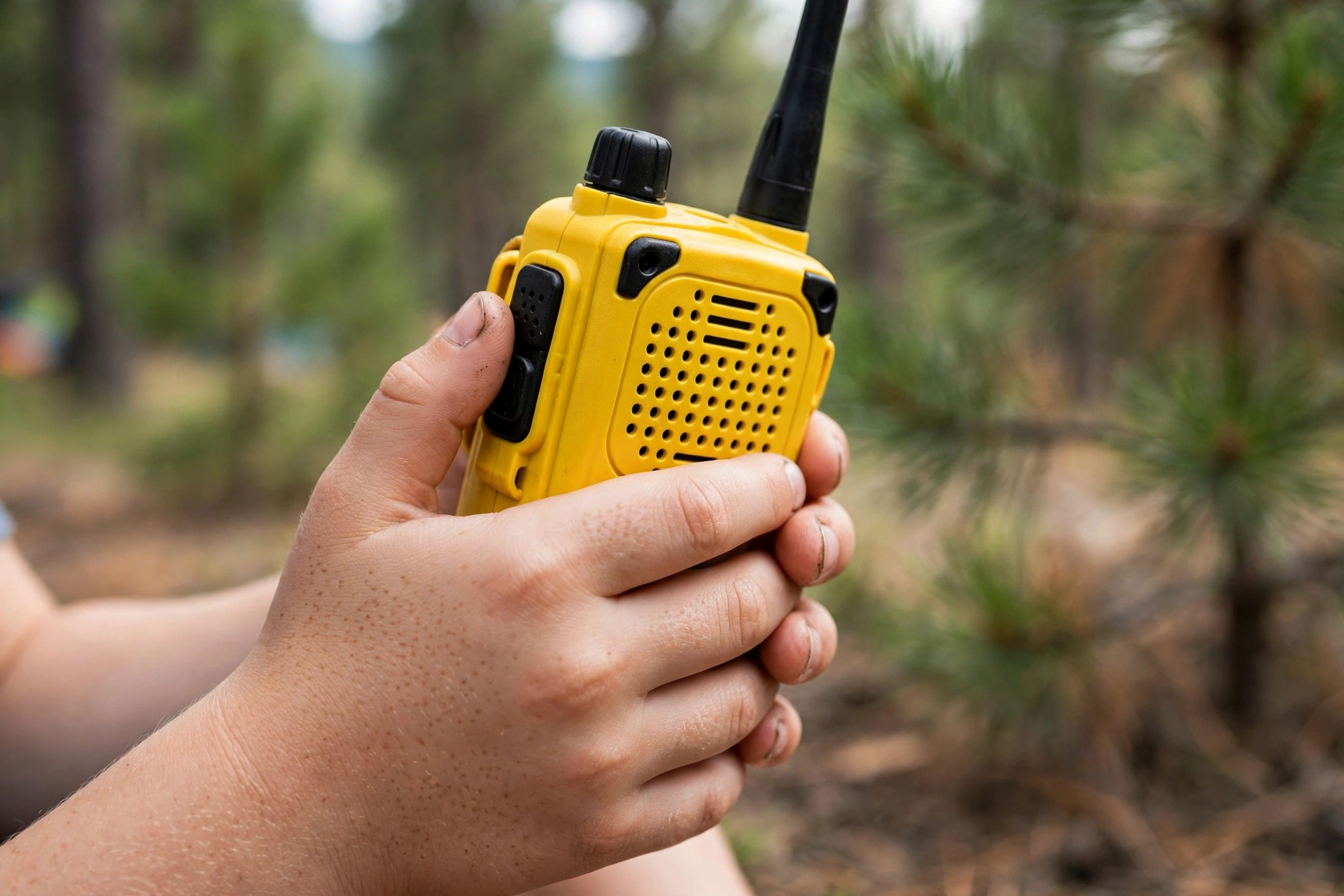
Walkie Talkie Safety Rules Every Kid Must Know
Walkie talkies are public radios. Anyone within range on your channel can listen — and anyone can talk back. These rules keep that from becoming a problem:
- Never share personal information on air: no full names, no campsite numbers, no “we’re staying in site 42 until Sunday.” A first name and a call sign (“Explorer One”) are enough.
- If a stranger talks to you, don’t answer — tell a parent: an unknown voice on the radio is a “tell a grown-up” moment, not a conversation.
- Keep the radio on and the volume up: a radio switched off “to save battery” is a child you cannot reach. Use fresh or fully charged batteries each morning instead.
- Agree on an emergency word: pick a word your family uses only for real trouble — for example, “red flag.” If a child says it, every adult drops what they are doing and responds. Practice it once so kids are not afraid to use it.
- Radios stay out of the water and off the ground: a dropped radio in a puddle ends the game. Belt clips and lanyards are worth the small cost.
6 Walkie Talkie Games Kids Love at Camp
Once the safety basics are covered, radios become the best toy at the campground. These games need nothing but two or more radios and a little space:
- Radio Hide-and-Seek: the hider radios one clue every minute (“I’m near something tall and green”) while seekers triangulate from the clues.
- Scavenger Hunt by Radio: one team hides, the other radios directions. Combine it with our camping scavenger hunt for kids list for a full afternoon of play.
- Secret Agent Missions: parents radio “missions” — find a pinecone shaped like a star, count the red tents — and kids report back.
- Trail Reporter: one child walks ahead on a trail and radios back what they see, like a nature reporter. Great for reluctant hikers — see our camping games for kids that need no equipment for more trail ideas.
- Night Patrol: after dark, kids take turns being “night patrol” and radioing reports from around the tent. A headlamp and a radio make any 8-year-old feel like a ranger.
- 20 Questions by Radio: the classic game works perfectly over a radio — and the push-to-talk rhythm keeps everyone from talking over each other.
How to Choose the Right Set for Your Family
Choose by your child’s age and your campground, not by the biggest range number on the box:
| Feature | What to look for | Why it matters at camp |
|---|---|---|
| Simplicity | 2–3 buttons, big push-to-talk | Kids use it without asking for help |
| Durability | Rubberized body, survives drops | Gravel, rocks, and creek banks are unforgiving |
| Battery | Rechargeable (USB) preferred | No drawer of dead AAs; charge overnight at camp |
| Channels | 22 FRS channels + privacy codes | Find a quiet channel when the campground is busy |
| Size and weight | Fits a small hand, has a belt clip | A radio left in the tent is a radio not used |
| Extras | Flashlight, NOAA weather alerts | Useful, but never the deciding factor |
For specific product recommendations by age and budget, see our companion guide to the best walkie talkies for kids, which compares the sets that hold up best at real campgrounds. One thing not to buy: a GMRS-only or high-power radio for a young child. The license requirement, the extra power, and the extra complexity are all wrong for a kid’s first set.
Frequently Asked Questions
What age is best for a first walkie talkie?
Most kids are ready around age 4 or 5, when they can manage the press-talk-release rhythm. Before that, toy radios are fine for play, but not as a safety tool.
Do walkie talkies need cell signal or Wi-Fi?
No. Walkie talkies communicate radio-to-radio on FRS channels, so they work in dead zones, deep in national parks, and anywhere phones show “no service.”
Do I need a license for kids’ walkie talkies?
Not for FRS radios — they are license-free in the United States. Avoid GMRS radios for kids unless an adult in the household holds the FCC GMRS license, which costs $35 and covers the whole family for ten years.
Can strangers hear my child on a walkie talkie?
Yes. FRS channels are public, and privacy codes only filter out other people’s chatter on your radio — they do not encrypt or hide your child’s voice. Teach kids never to share names, campsite numbers, or plans on air, and to tell a parent if an unknown voice talks to them.
How far will kids’ walkie talkies really reach at a campground?
Expect roughly half a mile to a mile in open campground terrain, and a few hundred feet through dense trees or around RVs and buildings. The “3 miles” on the box was measured over open water with a clear line of sight.
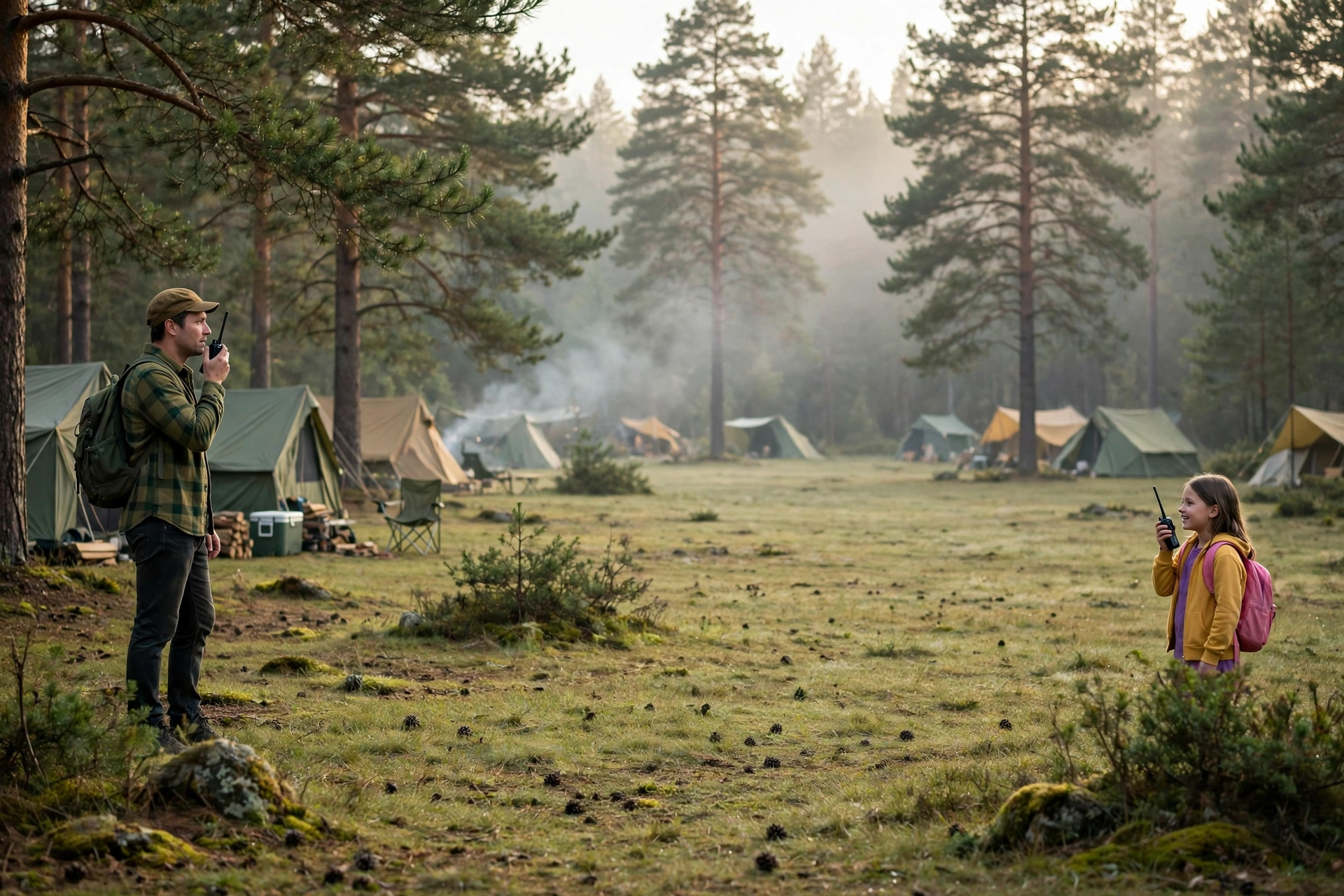
Walkie talkies won’t replace supervision, but they extend it — a child with a radio and a plan can explore with real independence while you stay one button-press away. Pack a set and spend ten minutes teaching the basics.
