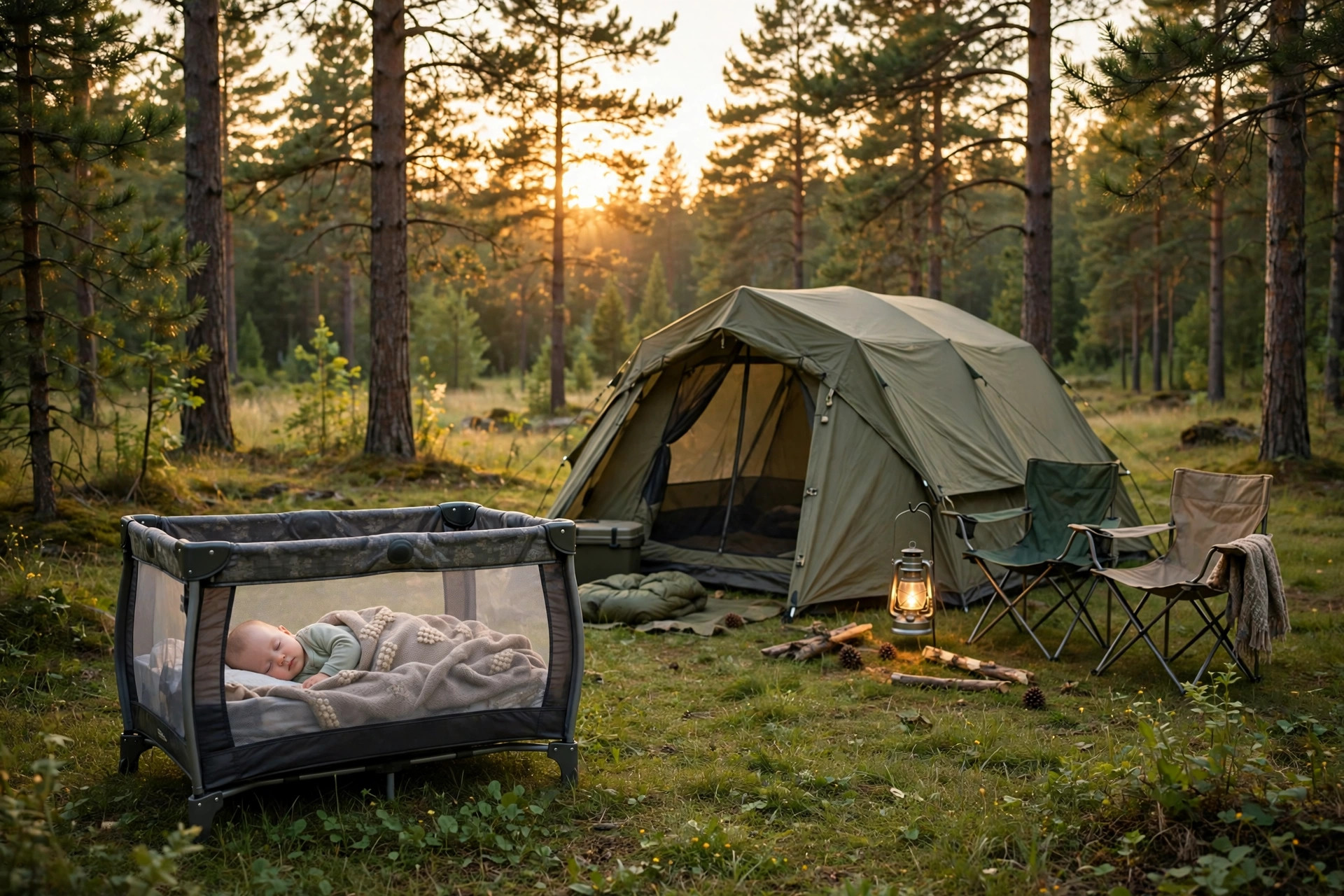
Your baby’s first camping trip should be about fresh air and starry skies — not lying awake wondering where your little one will sleep. A regular crib stays home, and the tent floor is not a safe sleep surface for a baby.
But not every travel crib survives a campsite. Hotel-friendly cribs can be too heavy, too bulky, or too open to bugs and cold ground. The best portable travel crib for camping is light enough to carry, small enough to fit inside your tent, and built for uneven ground, insects, and chilly nights. This guide compares the strongest options for 2026.
Why a Regular Pack ‘n Play Doesn’t Cut It at Camp
A standard play yard works in a hotel room, but a campsite is a different world:
- Weight and bulk: Many full-size play yards weigh 20 pounds or more and fold into a long package that eats half your trunk.
- Open tops: An open-top play yard invites mosquitoes and flies, and offers no protection from a surprise drizzle.
- Cold ground: Tent floors sit directly on the earth. Without insulation underneath, a baby loses body heat fast, even on a mild night.
- Tent fit: A big rectangular play yard can swallow the entire floor of a 4-person tent, leaving no room for you.
You don’t need the most expensive crib — you need one chosen for camping, not for grandma’s spare bedroom. If you are still planning the trip itself, our camping with a newborn safety guide covers the nine rules that matter most before you ever pitch the tent.
What Makes a Travel Crib Camping-Ready?
Use this checklist before you buy. A crib that ticks all six boxes will handle real campsite conditions.
1. Weight under 15 pounds
You are already carrying a tent, sleeping bags, food, and a baby. A camping crib should be light enough to carry one-handed. Under 10 pounds is ideal.
2. A small folded footprint
Check the folded dimensions, not just the weight. A crib that folds flat like a yoga mat slides behind a car seat; one that folds into a long tube may not fit your trunk at all.
3. Mesh sides for airflow and bug protection
Full mesh sides keep air moving on warm nights and, with a zippered cover, keep mosquitoes out.
4. A firm, flat sleep surface
Babies under 12 months should sleep on a firm, flat surface, free of soft bedding, pillows, and loose blankets, per the U.S. Consumer Product Safety Commission. Skip inclined sleepers and soft, saggy mattresses.
5. Ground insulation or room for a mat underneath
The crib should sit on a foam camping mat or a folded sleeping pad. Cold ground is the most underestimated camping risk for babies.
6. Simple, fast setup
You will set this up at dusk, possibly in the rain, with a tired baby on your hip. Pop-open designs beat cribs with a dozen poles and a manual.
The Best Portable Travel Cribs for Camping in 2026
No crib is perfect for every family — match the pick to your baby’s age, your tent size, and how you travel. We have not lab-tested these ourselves; the notes below reflect manufacturer specifications and what camping parents report.
Best Overall for Camping: Guava Family Lotus Travel Crib
The Lotus is the crib most camping families recommend: around 13 pounds, folds into a backpack, and sets up in about 15 seconds. The mesh sides zip down so it doubles as a daytime play space, and the mattress is firm and flat.
Best for: Babies from newborn to about age 2, families who car-camp and want one crib for hotels, visits, and the campsite. Not ideal for: Very small tents — measure your tent floor first. It has no built-in bug net, so pair it with a mesh cover for buggy sites.
Best for Tent Camping: KidCo Peapod Camp Travel Bed
The Peapod is less a crib and more a pop-up tent for your baby. It weighs under 4 pounds, pops open instantly, and has a zippered mesh enclosure that blocks bugs and offers UV protection. It sits directly on the ground, so there are no legs to wobble on uneven terrain.
Best for: Babies and small toddlers, beach days, and small tents. Not ideal for: Babies who need a raised, framed crib. The pop-open spring is strong, so always open it away from your baby’s face.
Best for Infants and Small Tents: Brica Fold ‘n Go Travel Bassinet
For babies under about 15 pounds, a folding travel bassinet is the lightest option of all — around 2 to 3 pounds. It folds flat, fits inside a suitcase, and many models include a mesh canopy that keeps insects off a sleeping newborn.
Best for: Newborns on their first trips and anyone whose tent barely fits the adults. Not ideal for: Babies who can push up on hands and knees — once your baby outgrows the bassinet’s limits, move up to a full travel crib.
Best Premium Pick: BabyBjörn Travel Crib Light
At about 11 pounds, the Travel Crib Light packs into a carry bag and unfolds in one motion — no assembly at all. The mesh sides give excellent airflow, the mattress is firm, and the whole fabric set is machine-washable, which matters after a muddy weekend.
Best for: Families who want the easiest setup and will also use the crib for flights and hotels. Not ideal for: Tight budgets — it is premium-priced — and it has no bug net, so add one for mosquito-heavy sites.
Best Versatile Pick: Baby Delight Go with Me Nod Deluxe Portable Crib
This one earns its place because of its shape: it is narrower than most play yards, so it fits inside tents where a square crib will not. It is water-resistant with a waterproof mattress, and the zippered side door lets you lay a sleeping baby down without waking them.
Best for: Crawling and early-walking babies, families with 3- or 4-person tents, and rainy campsites. Not ideal for: Families who need the absolute lightest option — it is a mid-weight pick, not an ultralight one.
Best Budget-Friendly Option: Regalo My Cot Portable Toddler Bed
For toddlers who have outgrown a crib, a portable cot is a smart step. The Regalo cot folds like a camping chair, holds up to about 75 pounds, and costs far less than a premium travel crib.
Best for: Toddlers aged 2 and up and families on a budget. Not ideal for: Babies under 12 months — a cot is not a safe sleep surface for infants. Use a proper crib or bassinet until your child is at least a year old.
Which Crib Fits Your Tent? A Quick Comparison
Measure your tent’s usable floor area and compare it with the crib’s footprint before you buy.
| Crib | Approx. weight | Best for | Watch out for |
|---|---|---|---|
| Guava Lotus Travel Crib | ~13 lbs | All-round camping + travel | Full-size footprint; needs a mesh cover for bugs |
| KidCo Peapod Camp | Under 4 lbs | Small tents, beach, backpacking | Size limits; strong pop-open spring |
| Brica Fold ‘n Go Bassinet | ~2–3 lbs | Newborns, tiny tents | Outgrown quickly; infants only |
| BabyBjörn Travel Crib Light | ~11 lbs | Easy setup, travel + camp | Premium price; no bug net included |
| Baby Delight Nod Deluxe | Mid-weight | Crawlers, narrow tents, rain | Heavier than ultralight picks |
| Regalo My Cot | ~7 lbs | Toddlers 2+, budget trips | Not safe for babies under 12 months |
Weights are approximate manufacturer figures. One adult sleeping bag plus one travel crib fits a 4-person tent; two adults plus a full-size crib usually needs a 6-person tent.
How to Set Up a Safe Sleep Spot in Your Tent
- Pick the flattest spot inside the tent. Clear sticks and stones under the tent floor first.
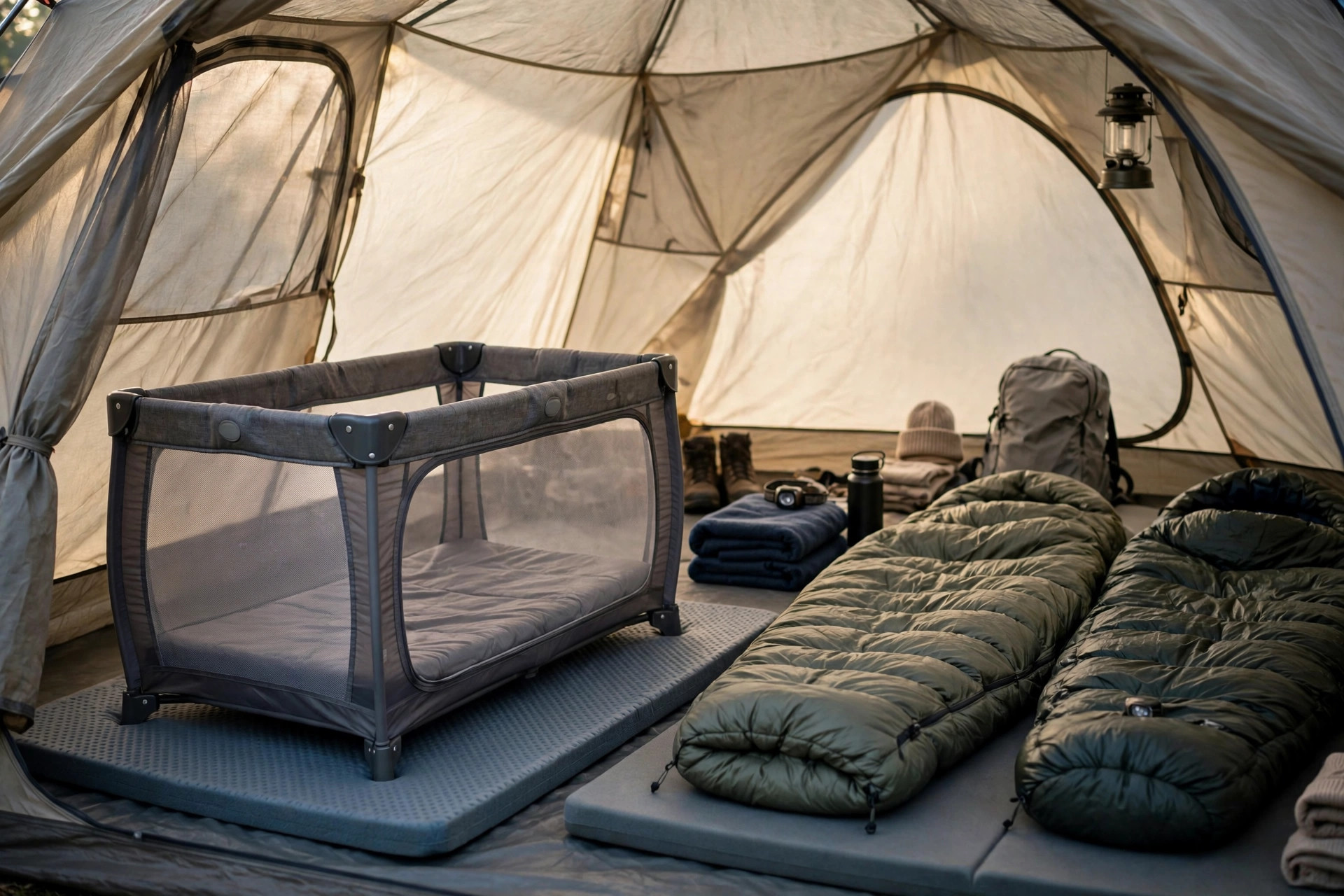
- Insulate from the ground. Lay a closed-cell foam mat or folded sleeping pad under the crib.
- Keep the crib away from tent walls. Condensation collects on tent walls overnight.
- Use a fitted sheet only. Dress your baby in a sleep sack for the temperature instead of loose blankets. No pillows, stuffed animals, or loose bedding in the crib.
- Set up before dark. Assemble the crib while there is still light, and practice at home first.
- Keep it familiar. Bring the same fitted sheet and sleep sack your baby uses at home.
- Check the temperature before bed. Feel your baby’s chest or the back of their neck — not their hands, which are always cooler.
For white noise, wake-ups, and keeping the schedule, our guide on how to get kids to sleep while camping has 15 parent-tested tips.
Camping Crib Safety Checklist
Run through this list every trip, not just the first one:
- ✅ Crib is not on a current recall list
- ✅ Mattress is firm, flat, and snug with no side gaps
- ✅ No soft bedding, pillows, bumpers, or stuffed animals inside
- ✅ Mesh sides are intact — no tears, holes, or broken zippers
- ✅ Crib is insulated from the ground with a foam mat or pad
- ✅ Crib sits away from tent walls and the tent door
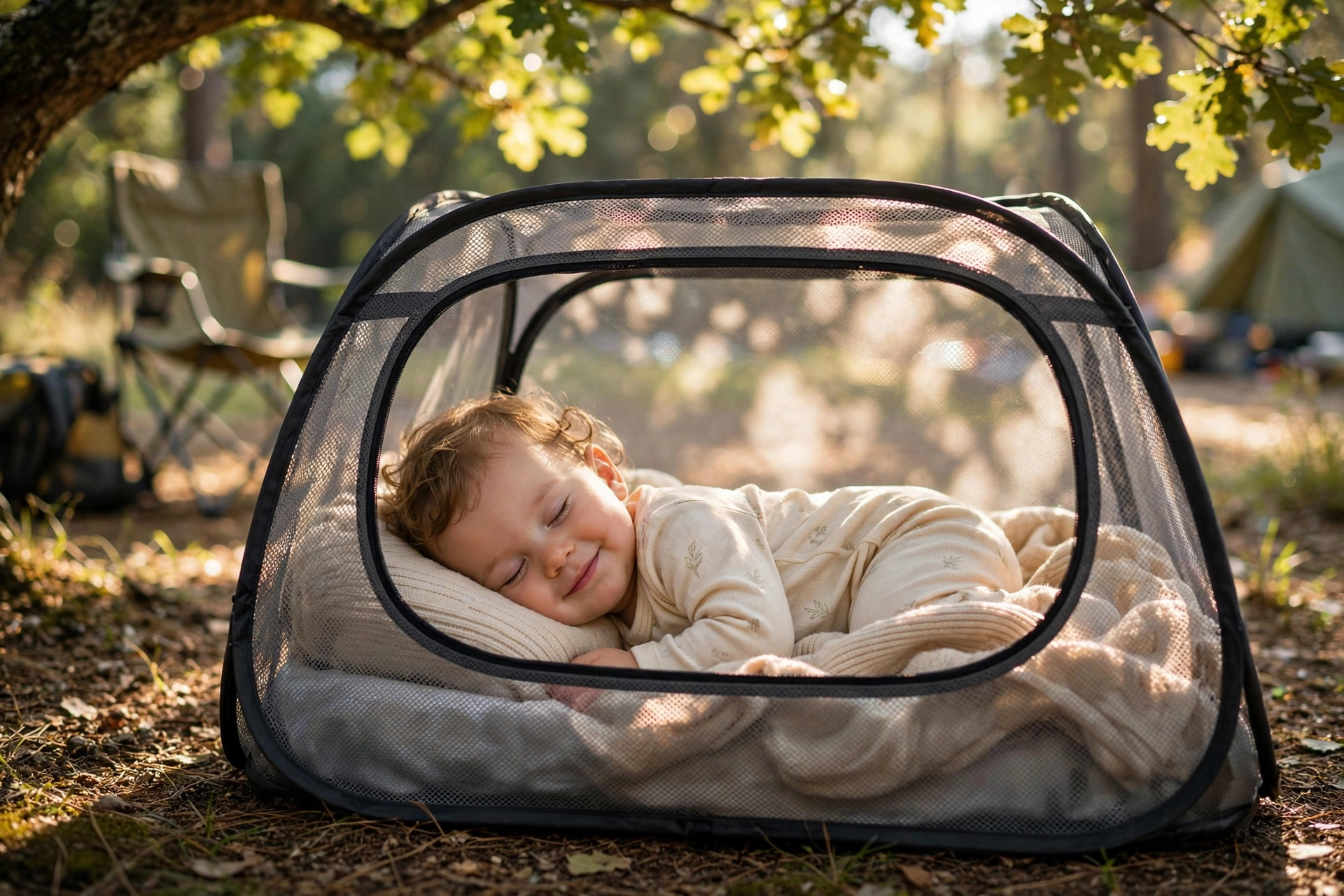
- ✅ Bug net or mesh cover is on for evening and overnight sleep
- ✅ Baby is dressed for the night temperature in a sleep sack, not loose blankets
- ✅ You have practiced setup at home at least once
- ✅ When in doubt, ask your pediatrician before the trip
Common Mistakes to Avoid
Buying for the hotel, not the campsite. A crib that is perfect for a hotel room can be useless at a campsite if it is heavy, bulky, or open-topped.
Skipping the practice run. A crib nobody has ever set up before is the number one cause of a miserable first night. Practice in your living room first.
Forgetting ground insulation. Parents pack extra blankets for the baby and forget the cold coming up from below. A foam mat under the crib does more than any blanket on top.
Using an inclined sleeper or a car seat for overnight sleep. Car seats and inclined sleepers are for travel, not overnight sleep. Both the CPSC and the AAP advise a flat, firm surface for overnight infant sleep — see the AAP’s parent’s guide to safe sleep.
Choosing by price alone. The cheapest crib is not a bargain if it does not fit your tent or your baby outgrows it in a month. Match the crib to your baby’s age and your tent size first, then compare prices. Pack a spare fitted sheet, a sleep sack, and a small battery white-noise machine alongside the crib — our full family camping checklist covers the rest. If your toddler is graduating to a cot, our best camping cots for kids guide compares the options.
Frequently Asked Questions
Can a baby sleep in a Pack ‘n Play while camping?
Yes, as long as you insulate it from the cold ground, keep it away from tent walls, and use only a fitted sheet with a sleep sack. The main downsides are weight and tent footprint, which is why lighter travel cribs are popular for camping.
What age can a baby use a travel crib for camping?
Most travel cribs work from birth to about age 2 or 3. Travel bassinets are usually limited to babies under about 15 pounds or until the baby can push up on hands and knees. Always follow the manufacturer’s weight, height, and developmental limits.
How do I keep my baby warm in a travel crib while camping?
Insulate from below with a foam mat under the crib, then dress your baby in a sleep sack rated for the night temperature. A sleep sack plus a warm base layer beats loose blankets, which are not safe for babies under 12 months.
Do I need a bug net on a travel crib?
If your crib has zippered mesh sides, that is usually enough. Open-top cribs need a separate mesh cover in mosquito country.
Will a travel crib fit in a 4-person tent?
A compact crib like the Peapod or a folding bassinet fits easily. A full-size crib like the Lotus takes up roughly one adult sleeping bag’s space, so two adults plus a full-size crib in a 4-person tent will be tight.
Is it safe for a baby to sleep in a tent?
Yes, with the right setup: a firm, flat sleep surface, insulation from the ground, no loose bedding, and a parent sleeping in the same tent. Avoid camping with a baby under 3–4 months in extreme heat or cold, and ask your pediatrician if your baby has health concerns.
The Bottom Line
The best portable travel crib for camping is the one that fits your tent, your baby’s age, and the way you travel — light enough to carry without thinking, simple enough to set up in the dark, and safe enough to let you actually sleep. For most camping families, that means the Guava Lotus for all-round use or the KidCo Peapod when weight and tent space matter most. Whichever you choose, practice the setup at home, insulate from the ground, and keep the sleep surface firm, flat, and free of loose bedding.
Pick the right crib, pack the checklist, and go enjoy the campfire.
