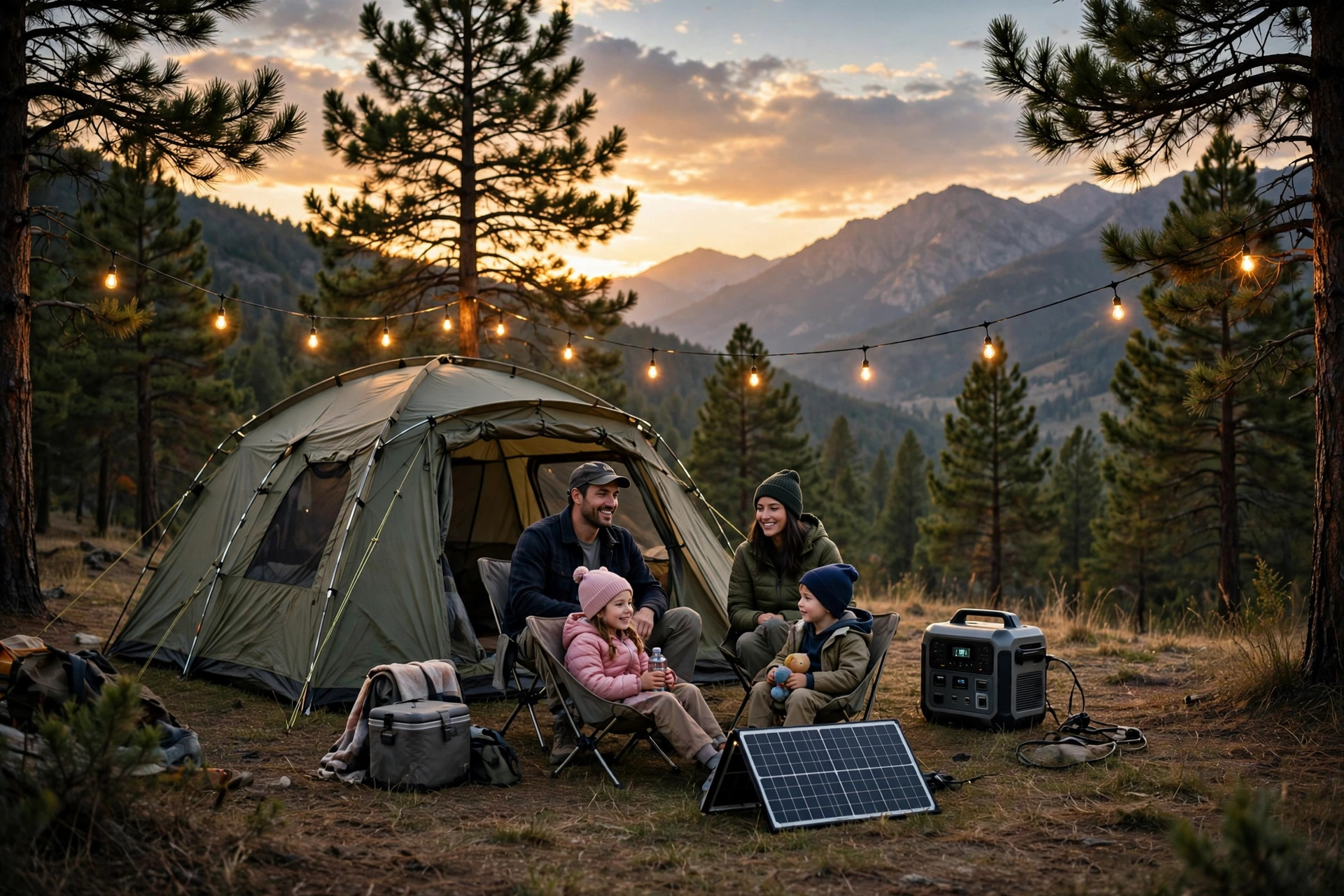
Finding the best portable power station for family camping is not the same as picking one for a solo backpacker. A family trip has a very specific power problem: a bottle warmer at 2 a.m., a white-noise machine running all night, two tablets, a 12-volt cooler that must stay cold for three days, and phones that drain faster outdoors than at home. Most roundups ignore that — they rank by specs alone.
This guide fixes that: a simple worksheet to size your power needs, the five stations that fit real family trips best in 2026, how to recharge at camp without a hookup, and the safety rules for sharing a tent with a big battery. No prices are listed on purpose — they change constantly, so judge each model on capacity, weight, and outputs.
What Makes a Power Station “Family-Ready”?
A good family power station is not simply the biggest one. It matches your family’s real loads, someone can carry it from the car to the tent, and it keeps working through a long weekend. Four things matter most:
- Enough capacity (watt-hours, Wh) for your whole trip — not just one night. A station that dies on Saturday morning is worse than none.
- The right mix of outputs — USB-C for tablets and phones, USB-A for older devices, AC outlets for a bottle warmer or cooler, and a 12-volt socket for a portable fridge. Count your plugs before you buy.
- Weight you can actually carry — 28 pounds is fine beside the car, but a problem if your site is a 10-minute walk from parking and you are also carrying a toddler.
- Fast, flexible recharging — wall charging before you leave, car charging on the drive, and solar at camp. A station that only charges from a wall outlet is a one-weekend device.
Also worth paying for: a long-life LiFePO4 battery (far more charge cycles) and a pure sine wave inverter (clean power for sensitive electronics).
How Much Power Does Your Family Actually Need?
Skip the guesswork. Follow these four steps before you look at any model:
Step 1: List everything you will plug in
Walk through a normal camping day and list every device. For most families it looks like this:
| Device | Typical draw | Hours per day | Energy per day (approx.) |
|---|---|---|---|
| 2 smartphones | 10–15 W while charging | 2–3 h | 30–45 Wh |
| 2 tablets | 15–20 W while charging | 2–3 h | 40–60 Wh |
| White-noise machine | 3–5 W | 8–10 h overnight | 30–50 Wh |
| Bottle warmer | 100–150 W | 15–20 min per use | 25–50 Wh per bottle |
| 12-volt portable cooler | 35–45 W (cycles on/off) | 24 h | 250–400 Wh |
| LED lanterns + string lights | 5–10 W | 4–5 h | 25–50 Wh |
These are planning estimates from typical manufacturer ratings, not lab measurements. The pattern is what matters: the cooler is almost always the biggest load, and the small kid devices (white noise, bottle warmer, tablets) add up to roughly 100–200 Wh per day on their own.
Step 2: Add it up for one day
A family of four with a cooler, two tablets, phones, white noise, and lights typically uses 400–600 Wh per day. Without a cooler, the same family usually lands at 150–250 Wh per day. That single difference decides your size class.
Step 3: Multiply by trip length, then add a buffer
Multiply your daily total by nights, then add about 20% for hot weather, rainy-day screen time, and inverter losses. A three-night trip at 500 Wh per day needs about 1,800 Wh — a 2,000 Wh station, or a 1,000 Wh station plus daytime solar.
Step 4: Match the total to a size class
- 250–500 Wh: device-only weekends — phones, tablets, lights, white noise. No cooler or bottle warmer.
- 500–1,000 Wh: the family sweet spot — everything above plus a 12-volt cooler for a long weekend.
- 1,000–2,000 Wh: longer trips, bigger families, or a cooler plus a bottle warmer plus a laptop.
- 2,000 Wh and up: base-camp trips of a week or more, or families who also want home backup power.
For the sleep side of the plan, our guide to getting kids to sleep while camping covers white noise, routines, and tent sleep.
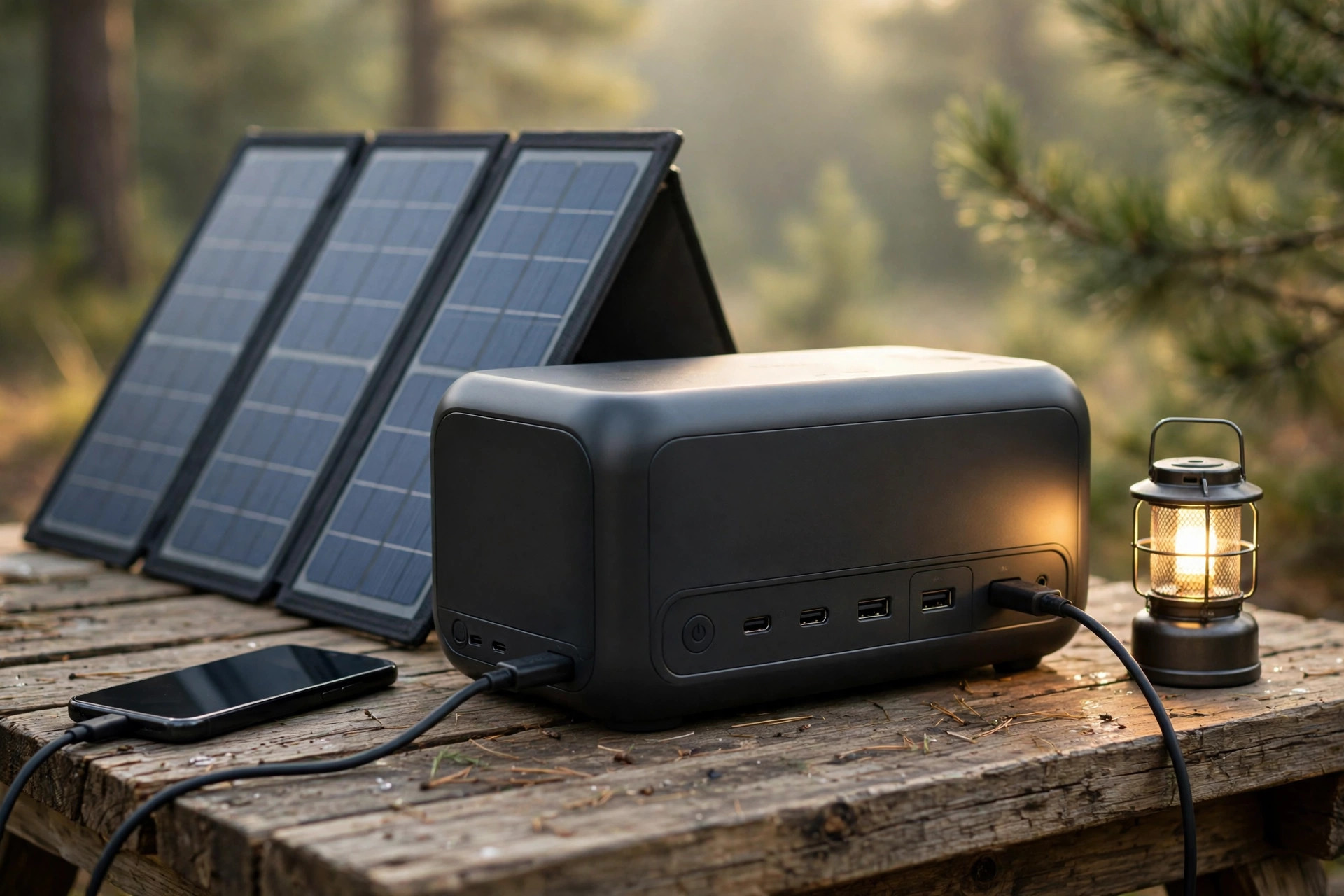
The 5 Best Portable Power Stations for Family Camping (2026)
Every pick below is a widely sold model with a strong track record among camping families. We have not lab-tested these units; capacities and weights are the manufacturers’ published specifications.
| Model | Capacity | AC output | Weight | Best for |
|---|---|---|---|---|
| EcoFlow DELTA 3 Plus | 1,024 Wh | 1,800 W | ~28 lb | Best overall family station |
| Jackery Explorer 1000 v2 | 1,070 Wh | 1,500 W | ~24 lb | Lightest 1 kWh option |
| Anker SOLIX C1000 Gen 2 | 1,056 Wh | 2,000 W | ~27 lb | Best value 1 kWh station |
| EcoFlow RIVER 2 / Jackery Explorer 300 | 256–292 Wh | 300 W | ~7–8 lb | Light, device-only weekends |
| BLUETTI Elite 200 V2 | 2,073 Wh | 2,600 W | ~53 lb | Long trips + big families |
1. EcoFlow DELTA 3 Plus — Best Overall for Families
With 1,024 Wh and 1,800 W of output, it covers the classic family load — cooler, tablets, phones, white noise, lights — for a long weekend, and recharges from a wall outlet in under an hour. Best for: one station that does everything and doubles as home backup. Not for: walk-in sites — at ~28 pounds, car camping only.
2. Jackery Explorer 1000 v2 — Lightest 1 kWh Option
A 1,070 Wh battery with 1,500 W of output in a body of about 24 pounds — the lightest in the 1 kWh class, which matters when it must be carried, not rolled, from the car to the tent. It runs a 12-volt cooler and a bottle warmer easily. One quirk: Jackery says it works only with Jackery solar panels. Best for: families who carry gear a real distance from the car. Not for: owners of other brands’ solar panels.
3. Anker SOLIX C1000 Gen 2 — Best Value 1 kWh Station
1,056 Wh and a strong 2,000 W of output — the most headroom of the three 1 kWh picks for moments like a bottle warmer and a cooler compressor starting at once. Best for: maximum output per dollar in the 1 kWh class. Not for: ultralight trips — still a 27-pound box.
4. EcoFlow RIVER 2 / Jackery Explorer 300 — Best Small and Light Picks
For short trips with a traditional ice cooler and only phones, tablets, white noise, and lights to charge, a small station is the smarter buy. The RIVER 2 (256 Wh) and Explorer 300 (292 Wh) both weigh around 7–8 pounds and recharge in about an hour. Best for: device-only weekends, walk-in sites, families with babies. Not for: a 12-volt cooler or more than a bottle or two.
5. BLUETTI Elite 200 V2 — Best for Long Trips and Big Families
At 2,073 Wh and 2,600 W, the Elite 200 V2 is the base-camp option: a week-long trip, a family of five or six, a cooler plus a fan plus a laptop. Its LiFePO4 battery is rated for thousands of cycles. The trade-off is obvious at ~53 pounds: wheel it from the car to a fixed spot, then leave it there. Best for: long trips, large families, serious home backup. Not for: short weekends or anyone carrying it far.
How to Recharge a Power Station at Camp
A power station is only as good as its recharge plan. Three options cover almost every family trip:
- Before you leave: charge to 100% from a wall outlet. Most 1 kWh stations recharge in about an hour. Do it the night before.
- On the drive: top up from the car. A 12-volt car charger adds useful charge on a two- or three-hour drive.
- At camp: solar panels. A 100–200 W foldable panel in good sun typically adds 400–800 Wh over a full day. Our guide to solar power at camp walks through panel sizes and common mistakes.
Warning: never assume one brand’s solar panel works with another brand’s station. Check the input port, voltage range, and compatibility list — and test the pairing at home, not at a dark campsite at 9 p.m.
Power Station Safety with Kids at the Campsite
A portable power station is a big battery, and a campsite full of curious kids needs a few firm rules:
- Keep it dry and ventilated. Never use or charge it in the rain, and never seal it inside a closed tent while charging.
- Put it where kids cannot trip over it. Set it against a tent wall or under a table, cables along the ground.
- Teach one rule: ask before unplugging. A bottle warmer mid-cycle or a white-noise machine at midnight is not a toy.
- Let kids carry the cables, not the battery. A 25-pound station is an adult job.
- Inspect before every trip. Look for cracked casing, damaged cables, swelling, or a strange smell. If anything looks wrong, do not use it.
If your baby sleeps in a portable crib at camp, pair this plan with our guide to the best portable travel cribs for camping.
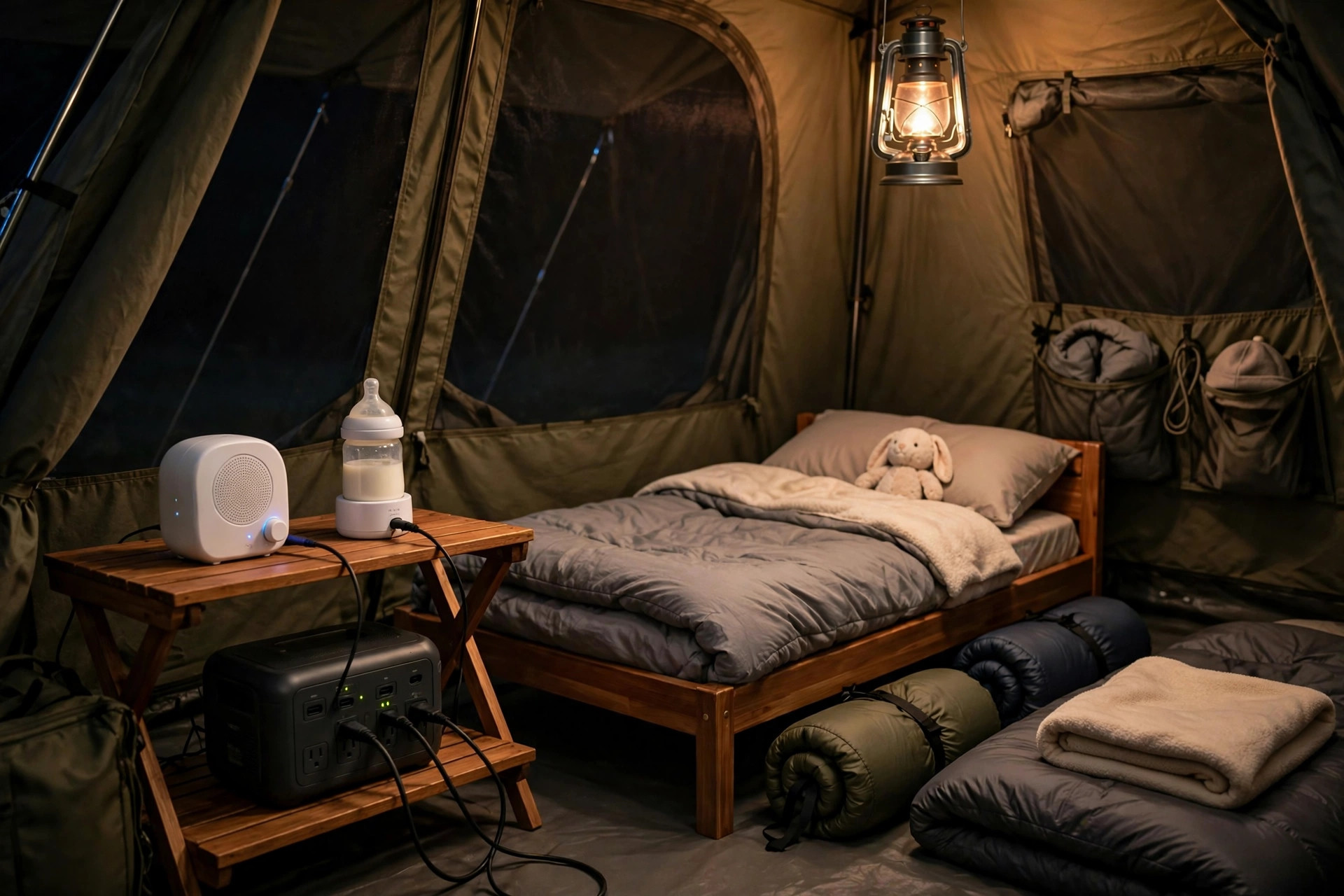
What a Power Station Cannot Do
Honest expectations prevent the most common disappointment. A portable power station will not run an electric space heater, a full-size air conditioner, a hair dryer, or a microwave for more than a few minutes — those draw 1,000–1,500 W continuously and drain even a 2 kWh station in about an hour. For heat, bring warm layers and a good sleeping bag; for cooling, bring a fan and shade. If your comfort depends on a heater or air conditioner, you need an electric-hookup campsite.
It also will not replace a cooler on a long trip by itself: on a five-day trip without solar, even a big station runs dry.
Quick Decision Guide: Which Size Is Right for Your Family?
| Your trip | What you power | Pick this size |
|---|---|---|
| One-night, walk-in site | Phones, tablets, lights, white noise | 250–300 Wh (RIVER 2 / Explorer 300) |
| Long weekend, car camping | Above + 12-volt cooler | 1,000 Wh (any of the three picks above) |
| Long weekend + bottle warmer | Cooler, warmer, tablets, white noise | 1,000 Wh + 100 W solar panel |
| Week-long trip, big family | Cooler, fan, laptop, devices | 2,000 Wh (Elite 200 V2) + solar |
| Mostly day trips + home backup | Phones, laptops, lights at home | 1,000 Wh — the best all-rounder |
Still building your gear list? Start with our family camping checklist and add the power station beside the cooler. Our best family camping tents guide pairs naturally — tent size decides where the station and cooler live.
Frequently Asked Questions
How big a power station do I need for family camping?
For most families, a 500–1,000 Wh station is the sweet spot — phones, tablets, white noise, lights, and a 12-volt cooler for a long weekend. Add up your daily watt-hours with the worksheet, multiply by nights, add 20%.
Can a portable power station run a baby bottle warmer?
Yes, but only briefly per use: a bottle warmer draws 100–150 W for 15–20 minutes per bottle, using roughly 25–50 Wh each time. A 1,000 Wh station handles several warmings per day; a 250 Wh station struggles beyond a couple.
Are portable power stations allowed at campgrounds?
Almost always, yes. Unlike gas generators, power stations are silent and produce no exhaust, so they are welcome at nearly all campgrounds, including national parks. Check the campground’s rules when you book — the National Park Service camping pages confirm rules for your park, and Recreation.gov lists site-specific rules when you reserve.
How long does it take to recharge a power station with a solar panel?
It depends on panel size and sun. A 100 W panel in good sun typically adds 400–600 Wh over a full day, so a 1,000 Wh station takes about two sunny days to refill from empty — but you rarely start from empty. A panel keeps it topped up through a long weekend if you start full.
Is it safe to keep a power station inside the tent overnight?
Yes, if you follow the manufacturer’s guidance: keep it dry, give it airflow, do not cover it, and do not charge it while sealed inside a closed tent. Many families keep it in the vestibule or just outside the door.
Should I buy a power station or just bring a cooler with ice?
For one or two nights, a good cooler with ice is simpler and cheaper, and it cannot run out of power. A power station earns its place on longer trips, when you also need to charge devices and run white noise or a bottle warmer. Many families end up with both.
The Bottom Line
The best portable power station for family camping matches your family’s real loads — cooler included, bottle warmer counted, white noise running all night — and someone can carry it from the car. For most families that means a 1,000 Wh station with a LiFePO4 battery, fast wall charging, and a solar panel for top-ups: the EcoFlow DELTA 3 Plus as the best all-rounder, the Jackery Explorer 1000 v2 if you carry gear a long way, or the Anker SOLIX C1000 Gen 2 for the most output for the money.
