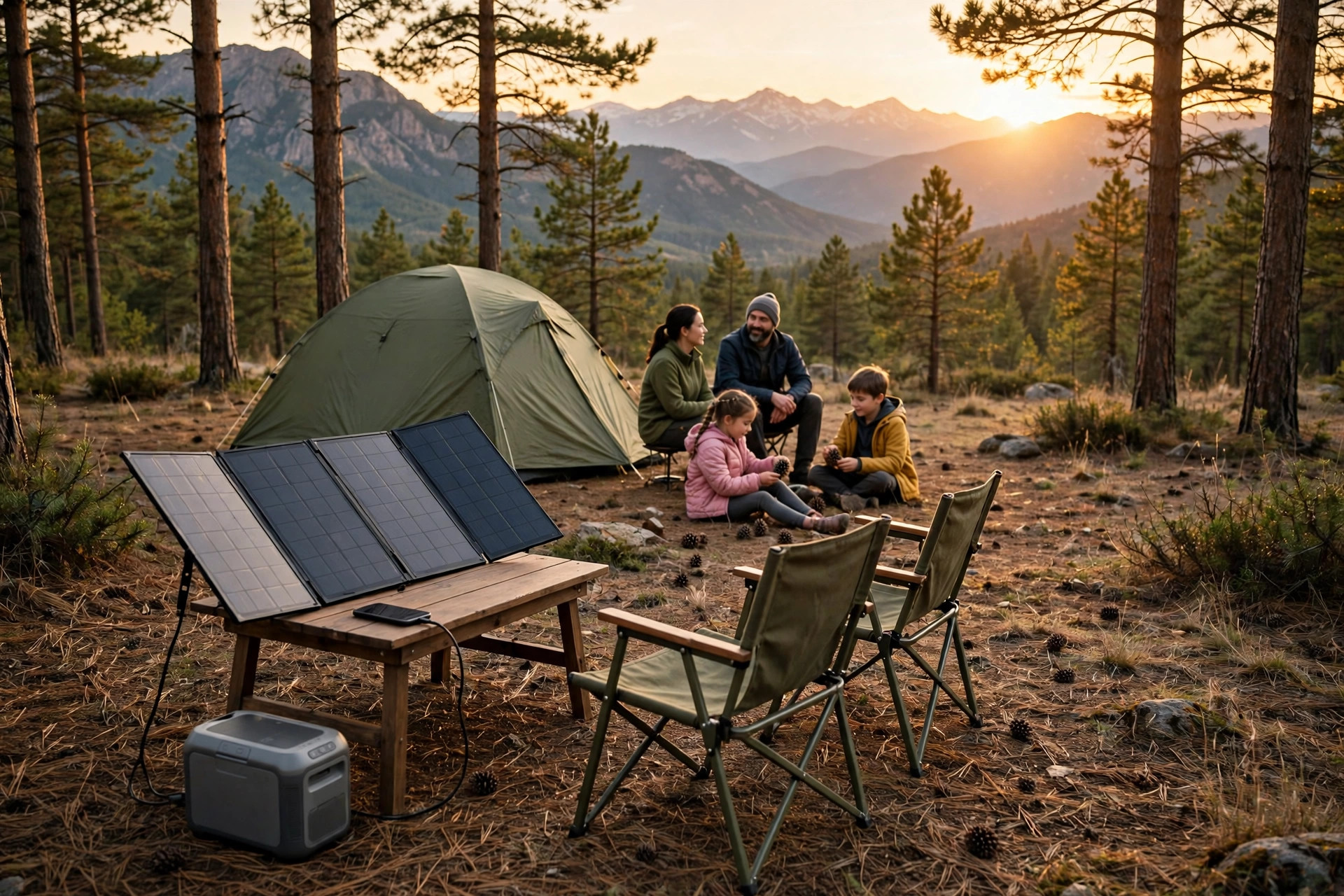
There is a moment on almost every family camping trip when someone holds up a phone with 4% battery and asks, “Can we charge this anywhere?” Today the answer is a small solar panel, a portable power station, and about ten minutes of setup — a practical, affordable way for families to keep phones, lights, fans, and even a small fridge running without a noisy generator or a hookup.
This guide covers how much power your family needs, which gear to buy, how to set it up at camp, and how to keep it safe with kids around. If you can plug in a phone charger at home, you can run solar at camp.
How Much Power Does a Family Actually Need at Camp?
Before you buy anything, work out what you are powering. Most family camping power needs are surprisingly small. A phone, a couple of lanterns, and a tablet for the kids’ bedtime story add up to far less than a hair dryer or a coffee maker — and those two are exactly what solar at camp is not for. Here is a realistic daily budget for a family of four:
| Device | Power draw | Daily use | Energy needed |
|---|---|---|---|
| 2 smartphones | ~10W each while charging | 1 full charge each | ~30 Wh |
| 1 tablet | ~12W | 1 full charge | ~30 Wh |
| LED lantern (x2) | ~5W each | 3 hours | ~30 Wh |
| USB fan | ~5W | 4 hours | ~20 Wh |
| Headlamps (x4) | ~3W each | 1 hour top-up | ~12 Wh |
| Portable speaker | ~5W | 2 hours | ~10 Wh |
| Total | ~130 Wh/day |
That 130 watt-hours is the key number. A 100-watt solar panel in decent sun produces roughly 300–400 Wh per day, which covers a family’s basics with room to spare. Add a 12V car fridge and you jump to 400–600 Wh a day — that is when you need a bigger panel and a bigger power station. The point: write down your own list, add it up, and buy for that number, not for a vague idea of “a lot of power.”
The 3 Pieces of a Camp Solar Setup
A complete setup has three parts. You can buy them separately or as a bundle, but understanding each piece stops you overspending on the wrong one.
1. The solar panel
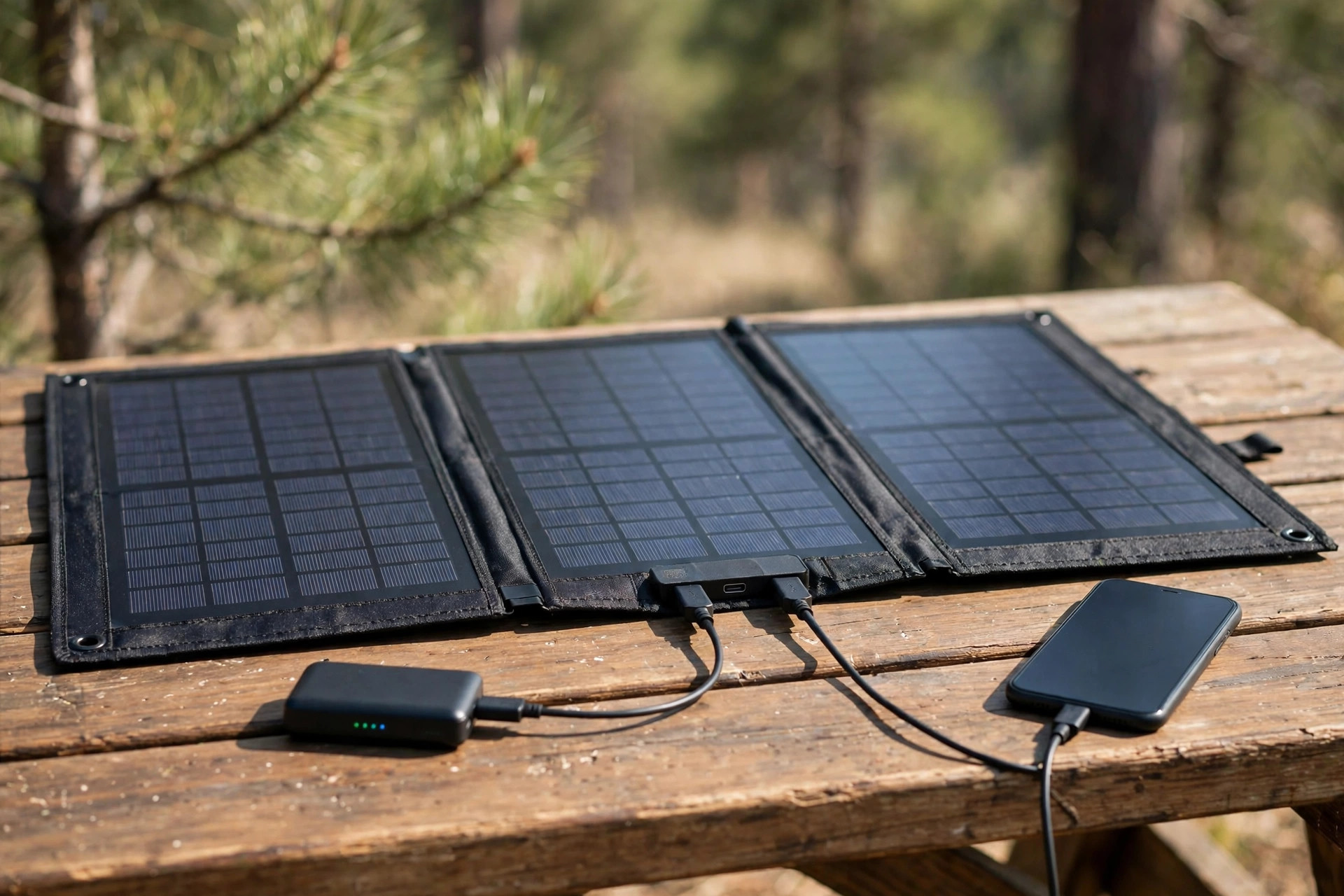
The panel turns sunlight into electricity. For family camping, folding portable panels in the 60–120 watt range are the sweet spot: they pack flat, weigh 2–4 kg, and lean against a tree or lie on a picnic table. Rigid rooftop panels make sense only if you camp from an RV or a roof tent. Look for a panel with built-in USB ports (handy for direct phone charging) and a weather-resistant coating — morning dew is a fact of camp life.
2. The portable power station
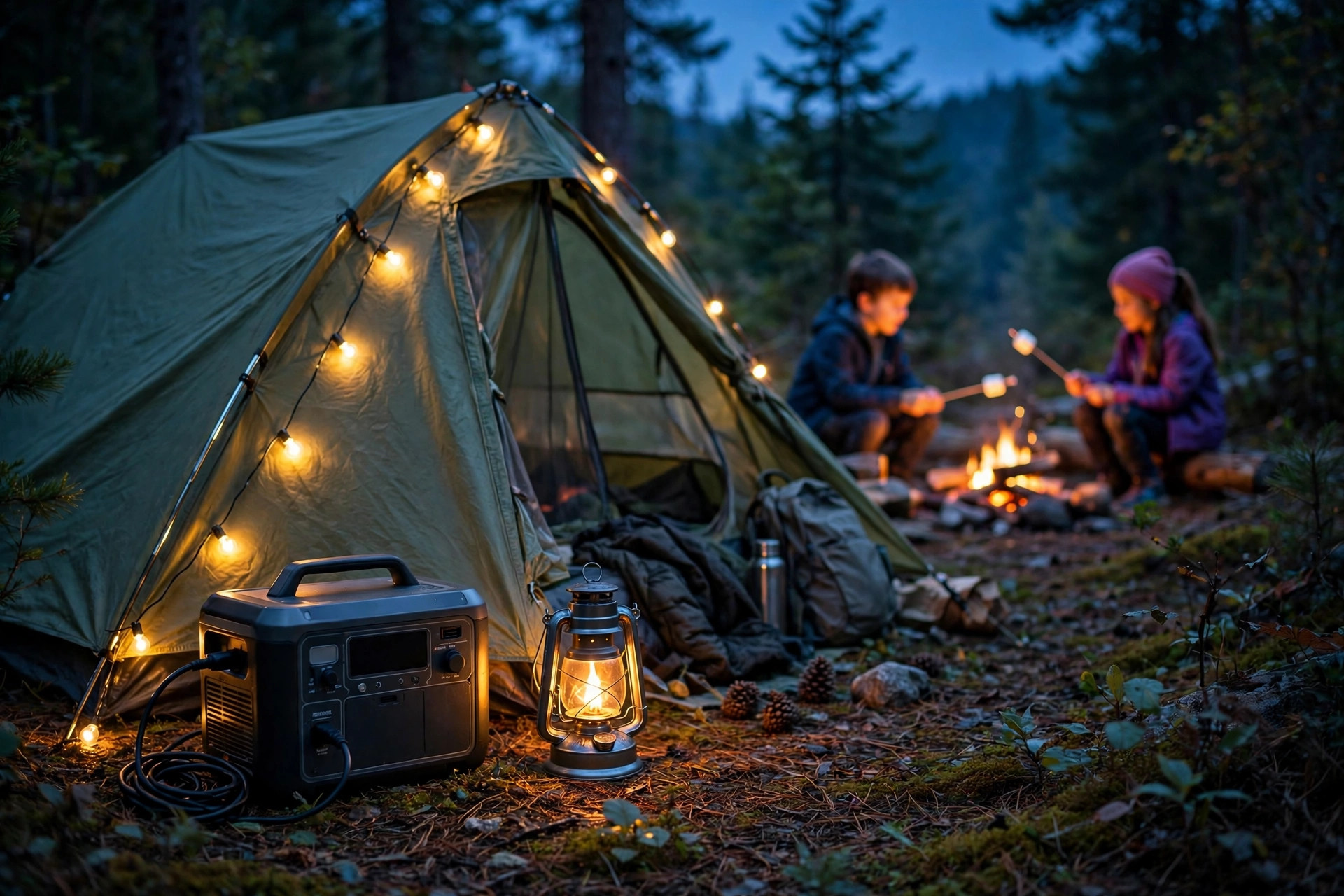
Think of this as a big rechargeable battery with outlets. It stores the panel’s energy during the day so you can use it at night. For most families, a station rated at 300–500 Wh is plenty: it will charge phones for days, run lanterns all evening, and power a USB fan through a hot night. Bigger stations (1,000 Wh and up) are for fridges and CPAP machines, not for charging tablets. Also check the station’s solar input wattage — a station that only accepts 60W of solar will waste half of a 120W panel’s output.
3. Cables and adapters
The unglamorous part that ruins trips when forgotten. You need the cable from the panel to the station (usually included, but check the connector type — MC4, DC 8mm, and Anderson plugs are all common and not interchangeable), plus your normal USB cables for each device. Pack one spare USB-C and one spare USB-A cable, and a short extension cord so the panel can sit in the sun while the station stays in the shade.
Choosing the Right Solar Panel Size
Match the panel to your trip, not to your ambitions — bigger panels charge faster but are heavier and harder to angle. A practical starting point:
| Trip style | Panel size | Power station | Good for |
|---|---|---|---|
| 1–2 night car camp | 40–60W | 150–300 Wh | Phones, lanterns, headlamps |
| 3–4 night family camp | 100W | 300–500 Wh | Above + tablet, fan, speaker |
| Week-long / base camp | 120–200W | 500–1,000 Wh | Above + 12V fridge, camera batteries |
| Backpacking with kids | 20–30W | 10,000 mAh power bank | Phones only, emergency top-ups |
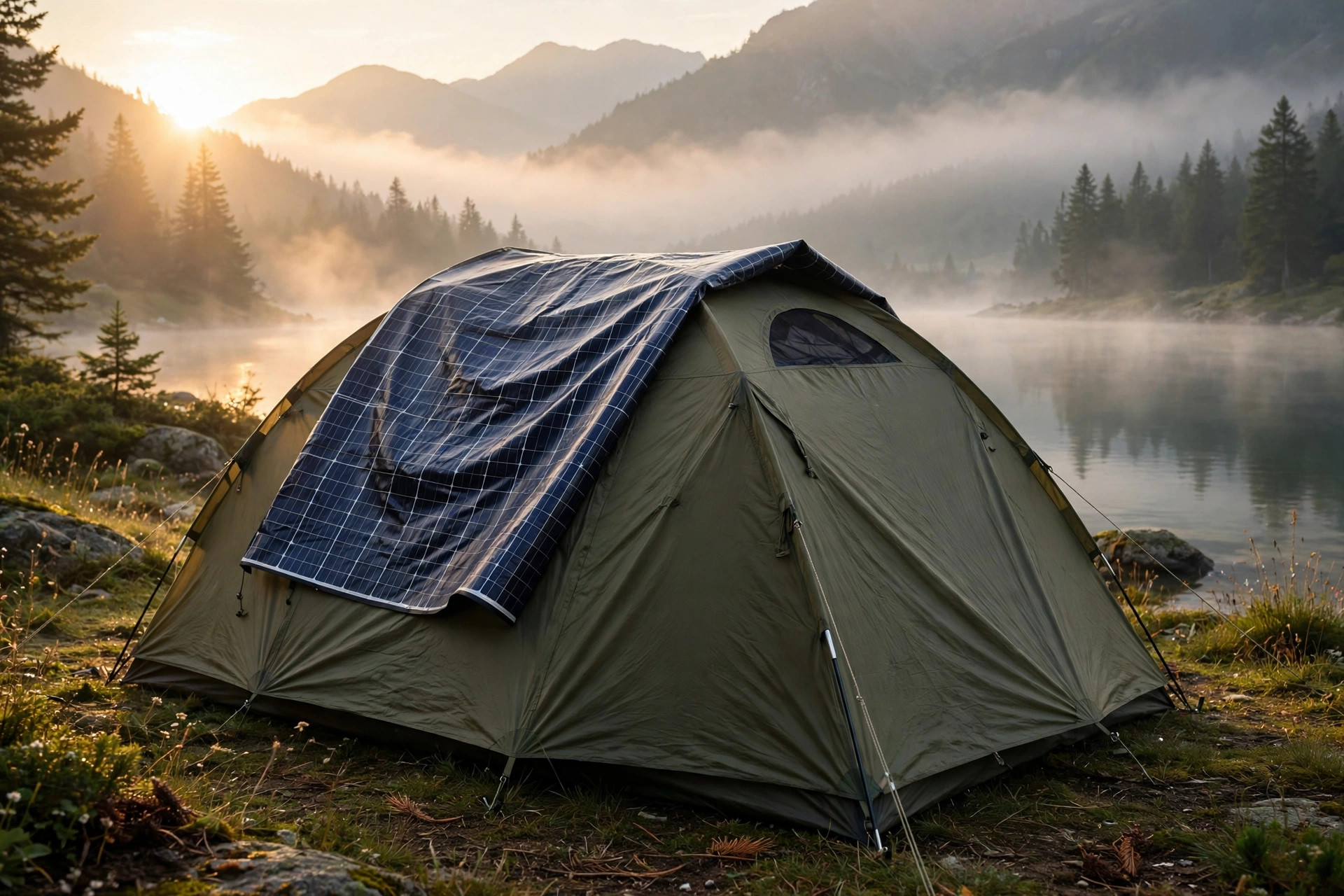
A note on wattage claims: a “100W” panel produces 100 watts only in perfect lab conditions — direct noon sun, cool air, perfect angle. In real camp conditions, expect 60–80% of the rated output. That is normal, and it is why the table above builds in headroom. Where you put the panel matters as much as its size: a panel angled toward the morning sun on a tent roof or a camp table catches far more light than one left flat in the shade.
Step-by-Step: Setting Up Solar at Your Campsite
Setup takes about ten minutes once you have done it twice. Do a trial run in your backyard first — finding a missing cable at home is a story; finding it at a remote campsite is a ruined evening.
- Pick the sunniest spot. Walk the site at midday and find the patch of ground that stays sunny the longest. Avoid spots under trees that will shade the panel by mid-afternoon.
- Angle the panel toward the sun. Tilt it to face the sun directly, roughly 30–45 degrees in summer — a flat panel loses up to 20% of its output.
- Connect the panel to the power station. Plug in the solar cable, then check the station’s display: it should show incoming watts. No watts means a loose connection or the panel is in shade — re-seat the cable and re-angle the panel.
- Keep the station in the shade. Batteries charge slower and age faster when hot, so keep the station under the picnic table or in the tent vestibule, with the panel cable running out to the sunny spot.
- Charge devices from the station, not the panel. Panels fluctuate with every cloud; the station delivers steady power. Plug phones and tablets into the station’s USB ports and let the panel refill the station.
- Re-angle twice a day. Move the panel at midday and again in the late afternoon to follow the sun — this one habit can add 30% more energy.
- Pack it away before dark. Dew and overnight rain are the enemy. Fold the panel, disconnect the cable, and store both in the tent or the car.
Charging Safely with Kids Around
Electricity at camp is safe if you respect a few simple rules — and kids are the reason to take them seriously.
Keep cables tidy and visible
A charging cable stretched across a walkway is a trip hazard for a running child. Route cables along the edge of the picnic table or tent, and use a brightly coloured cable or a strip of tape so little feet can see it. Never run cables through the middle of the play area.
Keep the power station dry and upright
Power stations are not waterproof. A spilled water bottle or a rain shower can damage one, so keep it off the ground on a camp table or a dry bag, and never charge devices in the rain. If the station gets wet, unplug everything and let it dry completely before using it again.
Teach kids the one rule
Kids love plugging things in — make it a game with one clear rule: only adults touch the power station’s buttons and plugs. Let them own a simpler job instead, like being the “sun spotter” who checks whether the panel is still in the sun. When you are planning the rest of your gear, our family camping checklist covers the full packing picture, including power gear.
Watch the heat
Solar panels get hot in direct sun — hot enough to be uncomfortable to touch. Teach kids not to sit or stand on the panel, and do not place it where a toddler can crawl onto it. The power station can also get warm while charging a big device; if it feels very hot, unplug and let it cool.
What Solar Cannot Do (Honest Limits)
Solar is wonderful, but it is not magic:
- Cloudy days cut output hard. Thick cloud can drop a panel to 10–25% of its rated power. On a grey weekend, charge everything fully before you leave home and treat solar as a bonus, not the plan.
- It will not run heating or cooking appliances. Kettles, hair dryers, electric grills, and portable air conditioners draw 800–1,500W — far beyond a camp setup. For cooking, stick with a camp stove; our camp kitchen setup guide shows how a good stove station works without any electricity at all.
- Shade is the silent killer. Even partial shade on one corner of a panel can cut its output by half. If your site is heavily treed, a longer cable so the panel can reach the one sunny patch is worth more than a bigger panel.
- Winter sun is weak. Short days and a low sun angle mean a 100W panel might deliver only 150 Wh on a winter day. Plan your winter power budget accordingly — and read up on cold-weather camping generally before a winter trip.
Power-Saving Habits That Double Your Battery
The cheapest watt is the one you never use:
- Airplane mode is your best friend. A phone searching for signal in a dead zone burns battery fast. Switch phones to airplane mode and use them as cameras and e-readers instead.
- Charge during the day, use at night. Top up the power station while the sun is out, then run lanterns and fans from it after dark.
- Dim the lights. A lantern on its lowest setting still lights a tent — and uses a quarter of the power. Our headlamps vs lanterns guide explains which light is best for each job at camp.
- Bring a paper backup. A paper map, a paper book, and a card game mean nobody needs a charged tablet to have fun — and the battery lasts for the things that actually matter.
Packing Checklist: Camp Solar Kit
Print this list and tick it off before every trip:
- Solar panel (size matched to your trip) + carry case
- Portable power station, fully charged at home
- Panel-to-station cable (check the connector fits!)
- USB-C and USB-A cables for every device, plus one spare of each
- Short extension cord for the panel
- Small dry bag for the power station
- Velcro cable ties or a cable organiser
- Headlamp batteries (rechargeable) as a non-solar backup
- Paper map and book — the no-battery backup plan
If you are still choosing the shelter all this gear lives under, the family tent buying guide will help you pick a tent with a vestibule big enough to keep the power station dry and out of the way.
Frequently Asked Questions
Can a solar panel charge a phone directly?
Yes — most folding panels have USB ports and will charge a phone directly in good sun. But charging stops every time a cloud passes. Charging the power station from the panel, and the phone from the station, is steadier and faster overall.
How long does it take a 100W panel to charge a power station?
A 100W panel delivers roughly 60–80W in real conditions, so a 300 Wh station takes about 4–5 hours to fill from empty. Start in the morning and it will be full by mid-afternoon on a sunny day.
Do solar panels work on cloudy days?
Yes, but much more slowly — expect 10–25% of rated output under thick cloud and 50–70% under light cloud. Keep panels out even on overcast days; just do not count on a full charge.
Is it safe to leave a solar panel out overnight?
Panels produce nothing at night, and dew or rain can damage connectors over time. Fold the panel and store it under cover each evening. It also stops it becoming a trip hazard in the dark.
Can I charge an e-bike or a CPAP machine from a camp power station?
Only with a large station (1,000 Wh or more) and a 200W panel or bigger. For medical devices like CPAP, always test the full setup at home first and carry a backup battery.
Are solar panels allowed in national parks?
Yes — portable solar panels are generally allowed at developed campgrounds in US national parks, and they are a quiet, clean alternative to generators, which many parks restrict to certain hours or ban outright. Always check the specific campground’s rules before your trip; the National Park Service camping page is the place to start, and Recreation.gov lists the rules for each reservable campground. For how the technology works, the US Department of Energy’s solar technology basics is a solid reference.
Solar power turns the dead-battery panic into a non-event. Start small — a 100W folding panel and a 300 Wh station cover most family weekends — practise the setup once at home, and give the kids the sun-spotter job. The first evening your lanterns glow and the phones are full while the stars come out, you will wonder why you ever camped without it.
