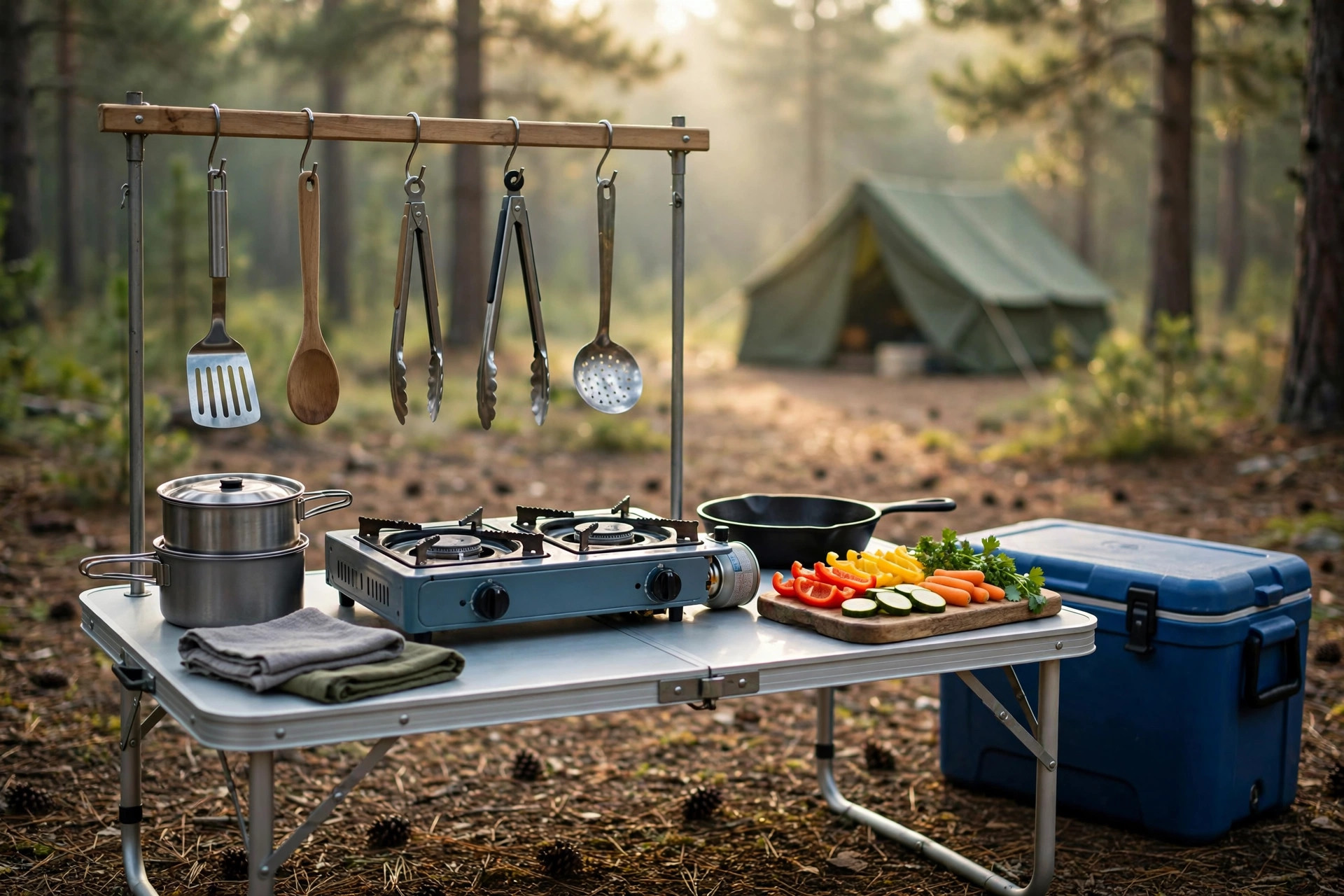
There is a particular kind of chaos that descends on a campsite at 6 p.m. The kids are hungry, someone has spilled the juice, the stove is buried under a pile of gear in the trunk, and dinner — the glorious outdoor dinner you imagined — is becoming a packet of crackers eaten standing up. A proper camp kitchen setup for families is what stands between that chaos and the golden-hour pancakes of your dreams.
Over six summers of camping with our kids — from a newborn’s first trip to wrangling hungry school-age children — our family learned that cooking outdoors isn’t really about fancy gear. It’s about layout, zones, and a system so simple that even a tired parent can run it.
Whether you’re car camping for a long weekend or planning a full week under the stars, this setup scales to your family. Let’s build it step by step.
Why a Dedicated Camp Kitchen Changes Family Camping
At home, your kitchen works because everything has a place. At a campsite, without intention, everything ends up in one tangled pile — and mealtime becomes a scavenger hunt. A dedicated camp kitchen gives your family three things that matter more outdoors than anywhere else:
- Speed. When kids are hungry, a 30-minute meal becomes a 15-minute meal because you’re not hunting for the spatula.
- Safety. A defined cooking area keeps little hands away from hot stoves and sharp knives.
- Calm. One organized station is infinitely easier to pack up, clean, and keep wildlife-proof than gear scattered across the site.
If you’re still building out your basic gear, our family camping checklist of 47 essentials pairs perfectly with this guide — it covers everything beyond the kitchen too.
The Camp Kitchen Triangle: Cooking, Prep, and Cleanup
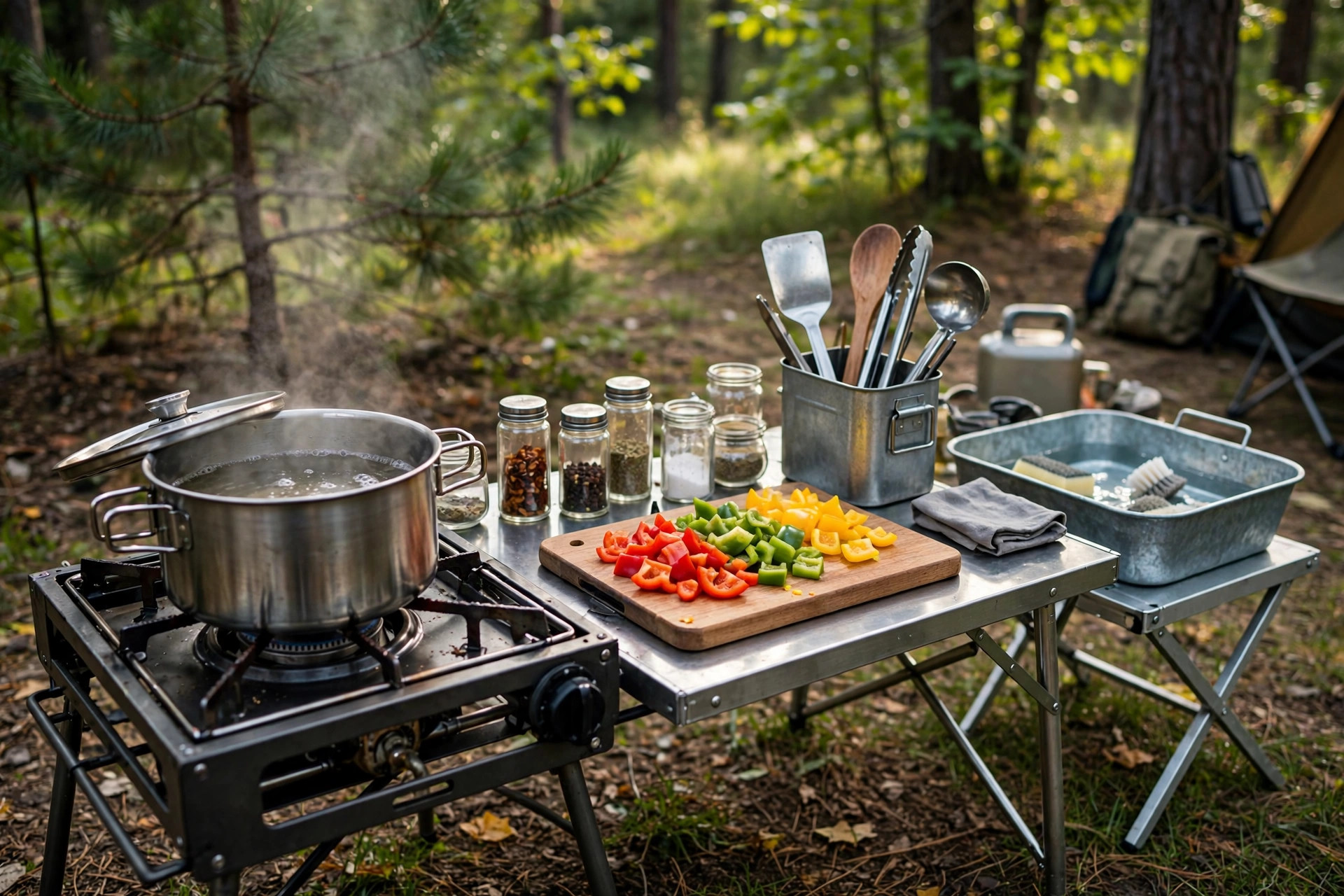
Restaurant kitchens are designed around workflow, and your camp kitchen should be too. Think of it as a triangle with three zones arranged a few steps apart:
The Cooking Zone
This is where your stove and fuel live, set on a stable, level surface away from tents, dry grass, and anything flammable. The cooking zone is adults-only while the stove is on — we’ll cover the “hot zone” rule below.
The Prep Zone
A folding table or tailgate where ingredients get chopped, mixed, and plated. This is also where the family gathers — kids can stir, assemble, and taste without getting near the heat.
The Cleanup Zone
A separate spot, slightly downhill and away from where you sleep and eat, with your wash basins and drying rack. Keeping cleanup away from the eating area is also one of the simplest ways to keep campsite smells from drifting into your tent at night.
Keep the three zones close enough to walk between easily, but distinct enough that a pot of boiling water never has to travel through the play area.
Essential Camp Kitchen Gear for Families
You don’t need a garage full of equipment. Here is the core kit that handles 95% of family camp meals, based on what has actually survived years in our own bins:
| Gear | Why you need it | What to look for |
|---|---|---|
| Two-burner camp stove + fuel | Cooks for a family in one go | Stable legs, windscreen, at least 10,000 BTU per burner |
| Folding camp table | Prep surface and serving station | Height-adjustable, easy-clean top, folds flat |
| Camp cookware set | Pots, pan, and lids that nest | Nonstick or hard-anodized; nesting to save space |
| Cutting board + chef knife | All meal prep | Flexible boards (pack flat) and a knife with a sheath |
| Cooler + ice | Food safety for perishables | 5-day ice retention for multi-day trips |
| Collapsible water jug | Cooking, drinking, and dishwashing water | At least 2 gallons; BPA-free |
| Three wash basins | Wash, rinse, sanitize system | Collapsible or nesting; one dark for hot wash water |
| Utensils, plates, cups, mugs | Eating without waste | One set per person plus two spares; unbreakable |
| Trash and recycling bags | Leave No Trace cleanup | Heavy-duty; bring twice what you think you need |
| Biodegradable soap + sponge | Dishes and hands | Unscented; a few drops go a long way |
Nice-to-haves that earn their space once you’ve got the basics: a camp lantern with a hook over the prep table, a hanging camp organizer for utensils and spices, and a folding camp pantry shelf for trips longer than three nights.
For a deeper gear rundown from an authoritative source, REI’s camp kitchen checklist is an excellent cross-reference to make sure nothing is missing.
Setting Up the Cooking Zone Safely
Choosing and placing your stove
A two-burner propane stove is the sweet spot for families: one burner for the main dish, one for heating water or warming sides. Set it on a stable camp table — never on the ground, and never inside a tent or under a low tarp, since propane stoves produce carbon monoxide.
Give the stove three feet of clear space on all sides, with the controls facing you so curious little hands can’t reach the knobs from the side. Always pack a spare fuel canister; discovering you’re out of propane at breakfast is a lesson you only want to learn once.
Campfire safety with kids around
If your site allows campfires, treat the fire ring with the same respect as the stove: build fires only in designated rings, keep water or an extinguisher within arm’s reach, and never leave the fire unattended. Recreation.gov’s campfire safety tips are worth reading before your first trip of the season.
Create a “hot zone” rule
This is the single most important safety habit in our family camp kitchen: while any burner or fire is on, the cooking zone is adults-only. Mark the boundary with something visual — our kids know the red camp rug means “hot zone, ask before entering.” Toddlers and preschoolers can have important jobs nearby (washing fruit, setting the “table”), just not inside the triangle of heat. For more on keeping the youngest campers safe, see our guide to camping with toddlers essentials.
The Prep Zone: Where Family Meals Come Together
Your prep zone is the heart of the operation: a folding table near (but not in) the cooking zone for chopping, mixing, and plating. Set it upwind of the stove so smoke doesn’t blow across your food.
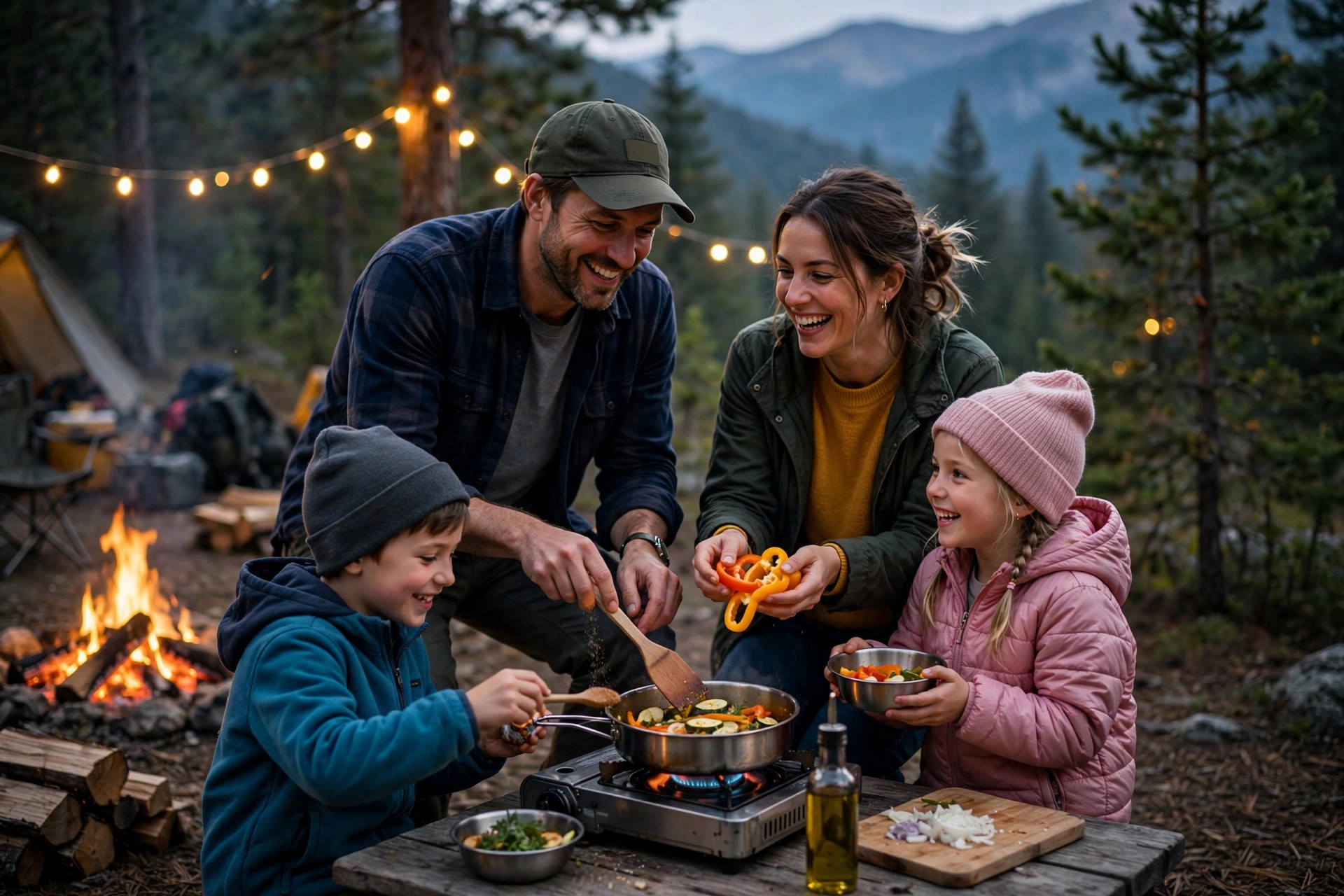
This is where kids genuinely contribute. A four-year-old can tear lettuce, a six-year-old can stir pancake batter, and an eight-year-old can read the recipe card. Real jobs keep kids happily occupied during the risky cooking minutes — and make them far more likely to eat what they helped make.
Prep as much as possible at home: dice onions, marinate chicken, mix pancake batter dry ingredients into a labeled bag. Our 3-day family camping meal plan with shopping list is built around this pre-prep philosophy and takes a huge amount of campsite stress off your shoulders.
The Cleanup Zone: Camp Dishes Without the Drama
Dish duty is where camp kitchens go to die. The three-basin system is the classic solution used by scout troops and outfitters for good reason:
- Wash: hot water with a few drops of biodegradable soap. Scrape dishes first — a spatula scrape and a paper-towel wipe saves gallons of water.
- Rinse: clean water, ideally with a splash of hot water from the kettle.
- Sanitize: cool water with a capful of bleach or a sanitizing tablet, then air-dry on a rack or clean towel.
Set up the cleanup zone at least 200 feet from any lake, stream, or river, and scatter your strained dishwater broadly over a wide area — never pour it straight into the water. Strain out food particles with a small mesh strainer and pack them out with your trash.
Packing It All: The Camp Kitchen Bin System
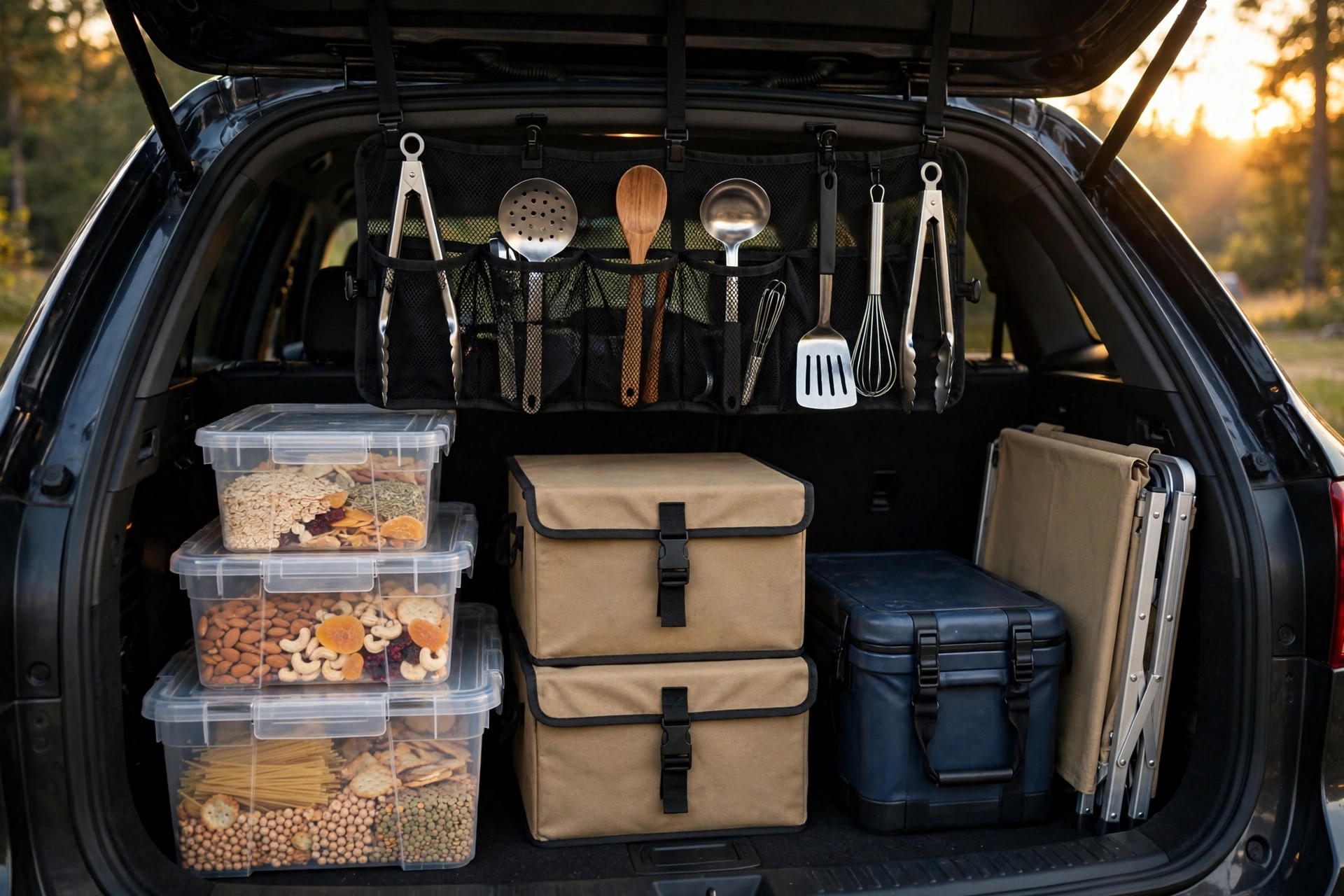
The difference between a family that loves camp cooking and one that dreads it usually comes down to packing. Our system uses two clear plastic bins that live in the garage year-round:
- Bin 1 — Cooking gear: stove, fuel, cookware, utensils, cutting board, knife, can opener, lighter, lantern.
- Bin 2 — Pantry: spices, oil, pancake mix, coffee, tea, salt and pepper, soap, sponge, trash bags, paper towels.
The cooler and water jug ride separately. Label the bins, keep an inventory taped inside the lid, and restock the pantry bin when you unpack — future you, arriving at camp at dusk with hungry kids, will be enormously grateful.
Easy Family Camp Meal Ideas
The best camp meals share three traits: minimal ingredients, one pot or one pan, and something the kids will actually eat. Our go-tos:
- Walking tacos: single-serve chip bags + taco meat + toppings. Zero dishes beyond the skillet.
- Pancakes and sausage: the undisputed king of camp breakfasts. Pre-mix the dry ingredients at home.
- Foil packet dinners: chicken, potatoes, and veggies sealed in foil and cooked over coals. Kids love opening their own packets.
- One-pot pasta: pasta, jarred sauce, and frozen meatballs — 15 minutes, one pot.
- Breakfast burritos: scrambled eggs, cheese, and beans in tortillas. Wraps eat cleanly on a trail morning.
Between meals, keep the snack situation handled — our list of the best snacks for camping has 30 kid-approved ideas that buy you quiet cooking time.
Camp Kitchen Tips When Camping With Toddlers
Cooking with toddlers underfoot requires a few extra adaptations, but it is absolutely doable:
- Time meals around naps. A hangry, overtired toddler plus a hot stove is a combination to avoid at all costs. Start dinner 30 minutes earlier than you think you need to.
- Set up a safe play spot. A blanket with toys within your sightline — but outside the hot zone — keeps little ones close and safe.
- Serve dinner in courses. Hand toddlers something to eat the moment the first dish is ready instead of waiting for the whole meal. Appetizer-as-strategy works wonders.
- Keep a dedicated “toddler drawer.” A small bin with their unbreakable plate, cup, spoon, and bib means you’re never digging through the big bins mid-meal.
New to this whole adventure? Our guide to the 15 mistakes to avoid on your first camping trip with kids will save you from the most common rookie errors.
Frequently Asked Questions
How do I keep food safe from animals at a campsite?
Store all food, scented toiletries, and trash in your locked car or a provided bear box — never in your tent. Clean your cooking zone thoroughly after every meal. The National Park Service’s food storage guidelines explain the details for bear country, but the habit protects your food from raccoons and rodents everywhere else too.
What is the easiest camp kitchen setup for a family of five?
A two-burner stove, one folding table, a nesting cookware set, a cooler, and the three-basin wash system will comfortably feed five. The real upgrade for bigger families isn’t more gear — it’s the prep work: pre-chop vegetables, pre-mix batters, and pre-portion spices at home so campsite cooking is mostly assembly.
Can I still cook if it rains all weekend?
Yes — a pop-up canopy or large tarp pitched over your cooking zone keeps you dry, just keep the stove itself well-ventilated and never cook inside a tent. Propane stoves need airflow. Rainy trips are also a great excuse for one-pot meals that simmer happily under cover.
How do I wash dishes at a campsite without plumbing?
Use the three-basin method: hot soapy wash, clean rinse, sanitizing soak. Heat wash water on your stove, do dishes at least 200 feet from water sources, strain out food particles and pack them out, and scatter the strained greywater over a wide area away from camp.
What stove is best for a family camp kitchen?
For car camping, a classic two-burner propane stove remains the best all-rounder for families: affordable, reliable, easy to find fuel for, and powerful enough to cook for four to six people.
Do I really need a full camp kitchen for a weekend trip?
Even for one night, the zone system pays off. You can scale the gear down — a single-burner stove and one bin instead of two — but keeping cooking, prep, and cleanup in defined spots still makes the trip smoother, safer, and more fun. The system is the point, not the size of it.
Start Simple, Then Make It Yours
A family camp kitchen doesn’t have to be elaborate to be wonderful. Start with the triangle — cooking zone, prep zone, cleanup zone — add the core gear from the table above, and pack it all into two labeled bins. After your first trip, you’ll know exactly what to add and what to leave behind.
The goal was never restaurant-quality plating: a kid with pancake batter on their chin, a parent actually sitting down to eat while it’s hot, and a kitchen that packs up in twenty minutes flat. Build the setup once, and every trip after that gets a little easier — and a lot more delicious. Happy camping — and happy cooking!
