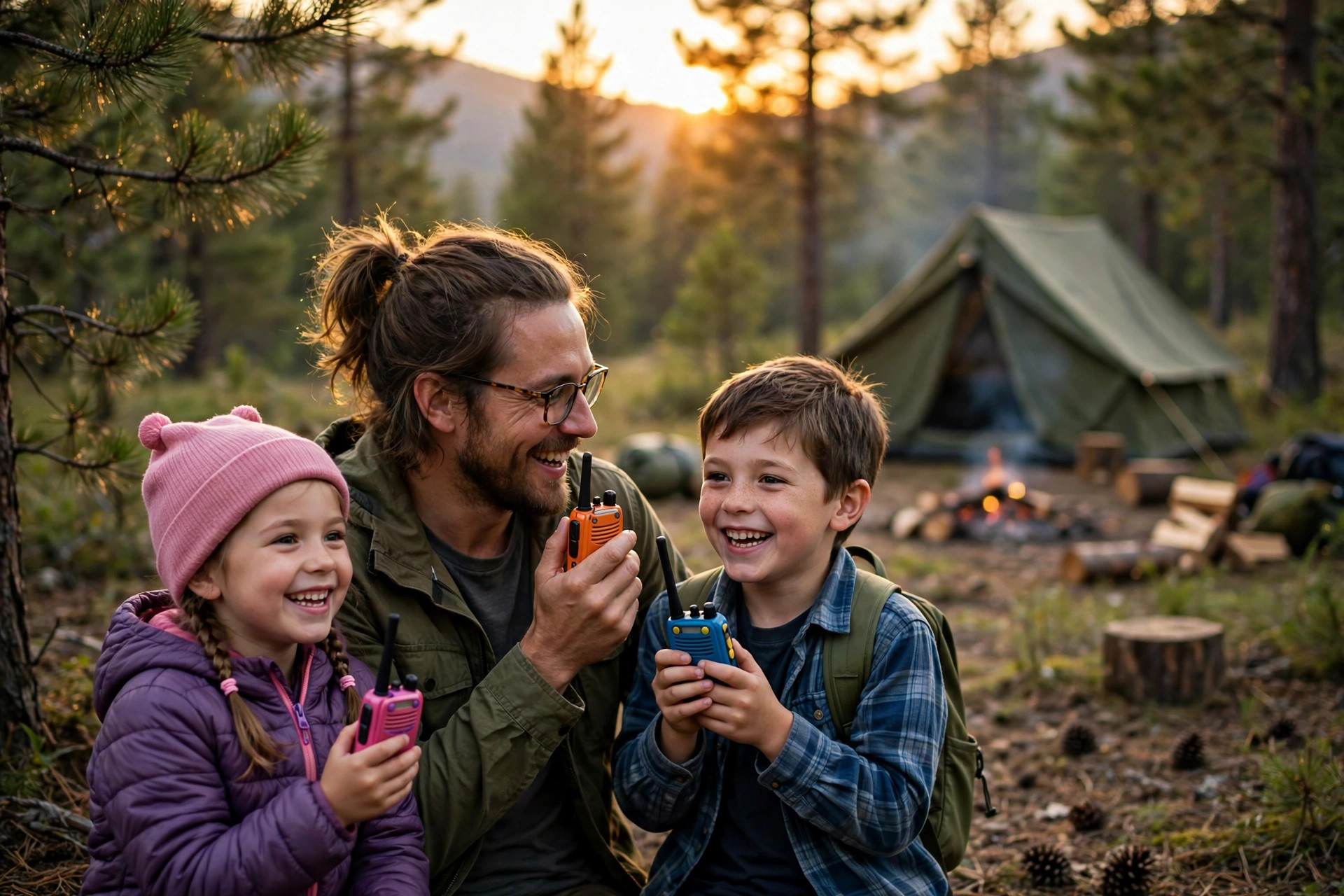
Your kids are racing around the campground with their walkie talkies when one of them asks the question every parent eventually hears: “What frequency are we on?” You glance at the little screen, see “CH 4,” and realize you have no idea what that means — or whether it matters.
It does matter, a little. The frequency is the invisible lane your family’s radios drive in: set it up the same way on every handset, and your kids can call you from the playground, the lake, or the trailhead. Get it wrong, and you’ll hear strangers — or nothing at all.
This guide explains it all in plain English — the frequency walkie talkies use, what FRS and GMRS mean, the 22 channels, what privacy codes do, and the exact setup for your next family camping trip.
The Short Answer: What Frequency Do Walkie Talkies Use?
Most walkie talkies sold for families in the US use UHF frequencies between 462 and 467 MHz, shared by two services: FRS (Family Radio Service) and GMRS (General Mobile Radio Service).
Your radio divides that band into 22 channels, one frequency each. Two radios on the same channel — and the same privacy code, if one is set — can talk; on different channels, they cannot hear each other at all. When your child’s radio says “CH 4,” it is tuned to 462.6375 MHz — numbers you never need to memorize, but they explain why some channels behave differently.
What Is a Radio Frequency, in Plain English?
Think of frequencies like lanes on a highway: your family’s walkie talkies, the campground office’s radios, a trucker’s CB, and your local FM station all drive on the same highway — just in different lanes. Frequency is measured in megahertz (MHz); a higher number means a higher frequency, not a stronger signal. In the US, the Federal Communications Commission (FCC) hands each stretch to a different use — family walkie talkies got 462–467 MHz, which is why nearly every kids’ radio works there.
FRS vs GMRS: The Two Services Your Family Radio Uses
Almost every walkie talkie in a toy aisle or camping store is an FRS radio, a GMRS radio, or both. The two services share the same 22 channels but play by different rules.
| FRS (Family Radio Service) | GMRS (General Mobile Radio Service) | |
|---|---|---|
| License | None needed — just buy and use | FCC license required (no test; covers your whole family for 10 years) |
| Power limit | Up to 2 watts | Up to 5 W handhelds; 50 W base/mobile |
| Channels | 22 shared channels | Same 22, plus 8 extra repeater channels |
| Range (real world) | About 1–2 miles in open country; much less in forest or hills | A little further with repeaters |
For most families, FRS is all you need — every radio labeled “FRS” works straight out of the box with no paperwork. GMRS only becomes worth it when your family regularly needs more range across a large campground, a ski area, or a convoy of cars. If you have not bought radios yet, our guide to the best walkie talkies for kids explains which features actually matter for young users: simple controls, light weight, and durability beat fancy specs every time.
The 22 FRS Channels and Their Frequencies
Here is the channel plan for FRS and GMRS radios in the US, grouped by power — handy when two brands need matching up, or when you want a quieter channel. (Channel 1 is 462.5625 MHz; channel 22 is 462.7250 MHz.)
| Channels | Frequency range (MHz) | Max power | Notes |
|---|---|---|---|
| 1–7 | 462.5625 – 462.7125 | 2 W | Full power. Channel 1 is the default on most radios — usually the busiest. |
| 8–14 | 467.5625 – 467.7125 | 0.5 W | Low power only — shorter range; fine around the site, poor for hikes. |
| 15–22 | 462.5500 – 462.7250 | 2 W | Full power — usually quieter than channels 1–7. |
Two details matter. First, channels 8–14 are low-power, so they reach less far. Second, channel 1 is the default on nearly every radio — at a busy campground it can sound like a party line. A higher channel, say 16 or 19, usually buys a quieter conversation. The FCC publishes the full list on its Family Radio Service page.
What Are Privacy Codes (CTCSS/DCS)?
Most family radios offer “privacy codes,” “sub-channels,” or “CTCSS/DCS tones” — numbers, usually 1–38, added on top of a channel. But privacy codes do not make your conversation private: anyone on the same channel can still hear you with no code set, or the same code.
What a code actually does is act like a filter: your radio only plays sound when the incoming signal carries the same code. If another family chats on channel 4 with no code while yours uses code 12, your radios stay silent — no noise, no false alarms. But two radios on the same channel with different codes cannot hear each other at all — the most common reason a family thinks their radios are broken. If one radio goes quiet, check the privacy code first.
VHF vs UHF: Why Your Kid’s Radio Uses UHF
You will see two more terms on radio packaging: VHF and UHF — two neighborhoods of the frequency highway.
| VHF (Very High Frequency) | UHF (Ultra High Frequency) | |
|---|---|---|
| Range | 136–174 MHz | 400–512 MHz (family radios: 462–467 MHz) |
| Best at | Open ground, fields, water, rolling hills | Trees, buildings, camp structures |
| Weak at | Walls and dense forest | Long open-ground distances |
Family walkie talkies use UHF because campgrounds are full of trees, RVs, bathhouses, and hills — exactly the obstacles UHF handles best. VHF travels further across open water or flat fields, which is why boats and pilots use it. If a radio is sold as an FRS/GMRS family radio, it is UHF already.
Range is where most families get surprised: the “up to 30 miles” on the box is a laboratory number measured across open water with a clear line of sight. In a real forest, expect well under a mile — our guide on how far walkie talkies can actually reach explains what really controls distance.
Which Channel Should Your Family Use at the Campground?
There is no single “best” channel, but this quick method works when you arrive:
- Start on a higher channel, not channel 1. Channels 15–22 are full-power and usually quieter — most people never change the default.
- Listen for 30 seconds. If you hear other voices, move up a channel or two until it is quiet, then add a privacy code — say 12 — on every radio. Write the channel and code on paper taped inside the tent, so anyone can re-set a bumped radio.
- Agree one channel as “home.” Everyone returns to it after exploring other channels — kids forget, and a home channel means nobody gets lost on the dial.
One more thing to teach the kids: there is no official emergency channel on FRS the way channel 9 works on CB radio. If a child is lost or needs help, switch to channel 1 — the channel most other campers listen on — and call clearly: “This is [name], I need help at [campsite or landmark].” Practice it once at the site, the same way you practice the lost-on-a-hike safety plan.
Step-by-Step: Setting Up Your Family’s Walkie Talkies
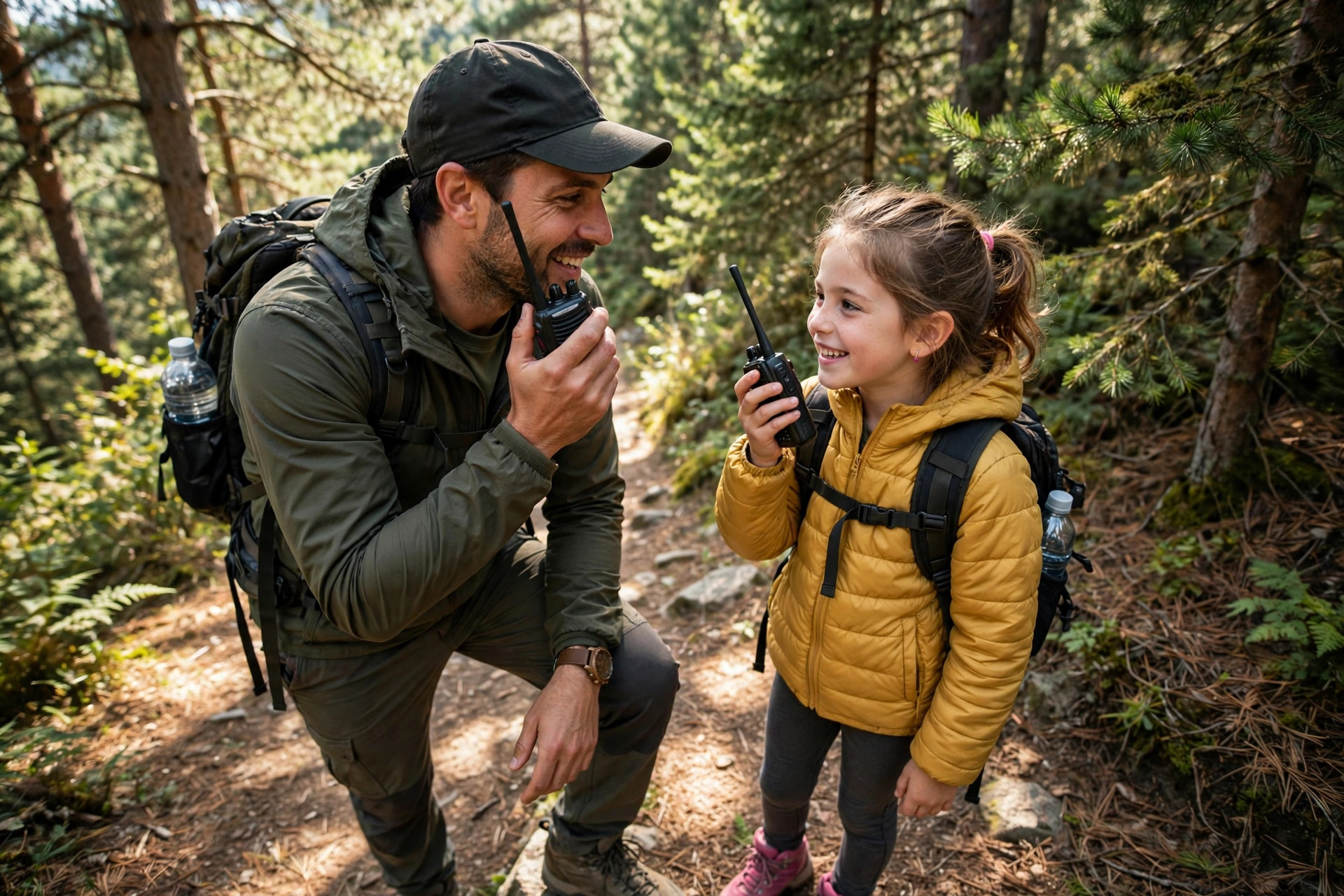
Do this once at home before the trip — the campground setup then takes two minutes instead of twenty.
- Charge or fit fresh batteries in every radio. Pack spares — a dead radio is the most common “failure” of all.
- Set the same channel on every radio and confirm the same number shows on every screen.
- Set the same privacy code on every radio. Find “CTCSS” or “privacy code” in the menu and set the same number everywhere. If one radio lacks codes, set the code to “off” on all of them — mismatched codes mean silence.
- Test at home. Send one child to the far end of the house and do a radio check: “Can you hear me? Over.”
- Teach the push-to-talk rule. Press the button, wait half a second, then speak. Say “over” when finished. Only one person can talk at a time — the hardest rule for excited kids.
Our full walkie talkies for kids guide covers choosing the right model and radio manners — including games that make practice fun, like the radio scavenger hunt that pairs with our no-equipment camping games for kids.
Troubleshooting: Why Can’t We Hear Each Other?
When family radios go quiet, the cause is almost always one of these:
| Problem | Most likely cause | Fix |
|---|---|---|
| One radio hears nothing | Different privacy code set | Match the channel AND the code on all radios |
| Works close up, not across camp | Low-power channel (8–14) or obstacles | Switch to a full-power channel (1–7 or 15–22) |
Do You Need a License to Use a Walkie Talkie?
For the radios most families buy, no. FRS radios need no license in the US — that is the whole point of the Family Radio Service.
GMRS is different: same channels, higher power, and the FCC requires a license — no test, covering your whole immediate family for 10 years. If you bought a “GMRS” radio but only use the shared FRS channels at low power, you are effectively using it as an FRS radio; the license applies the moment you use GMRS-only channels or higher power. Check the FCC’s Family Radio Service page and General Mobile Radio Service page for the current rules and fee.
Outside the US the rules change: in Europe, family radios use PMR446 (446 MHz, 16 channels, no license), so buy radios there for a trip abroad — a US FRS radio is not legal to transmit on in Europe, and vice versa.
Can Walkie Talkies Talk to Other Radios?
Sometimes — it depends on whether the other radio drives in the same lane. Brand does not matter: a Motorola can talk to a Midland if channel and code match.
| Other radio | Can they talk? | Why |
|---|---|---|
| Another FRS/GMRS radio | Yes | Same band, same channel, same code |
| CB radio | No | CB uses 27 MHz |
| European PMR446 radio | No | PMR446 uses 446 MHz, not the same channels |
The practical takeaway: if grandparents or another family bring their own radios, spend two minutes matching the channel and privacy code before anyone wanders off.
Quick Safety Rules for Kids with Radios
Radios give kids freedom, and freedom needs a few ground rules — repeat them on every trip until they stick.
- Radios are for family only. Do not answer strangers on your channel, and never share your full name, campsite number, or where you are going.
- Check in on a schedule. “Radio check every 30 minutes” is a rule even young kids can follow. And static means “walk back” — if the radio starts crackling, the child is too far away.
- One channel, one code. Nobody changes the channel without telling the group. A child on the wrong channel is a child you cannot reach.
Frequently Asked Questions
What frequency do walkie talkies use?
Most family walkie talkies in the US use UHF frequencies between 462 and 467 MHz, shared by the FRS and GMRS services, divided into 22 channels — channel 1 is 462.5625 MHz, channel 22 is 462.7250 MHz. In Europe, family radios use PMR446 at 446 MHz.
What is the best channel for walkie talkies at a campground?
Channels 15–22 are a good starting point: full-power and usually quieter than channel 1, the default on most radios. Listen for 30 seconds, move up if you hear others, and add a privacy code so your family only hears each other.
Do I need a license for a walkie talkie?
Not for FRS radios — no license is needed in the US. GMRS radios do require an FCC license (no test, covers your whole family for 10 years). In Europe, PMR446 radios need no license.
What is a privacy code on a walkie talkie?
A privacy code (CTCSS/DCS) is a sub-tone added to a channel: your radio only plays sound when the incoming signal carries the same code, so you stop hearing other families on the same channel. It does not make your conversation private — anyone on the same channel without a code can still hear you.
Why can’t my two walkie talkies hear each other?
Usually a mismatched privacy code: same channel, different code, total silence. Check that the channel and code match exactly on both radios, then check the batteries. On a low-power channel (8–14), switch to a full-power channel for more range.
The Bottom Line
Walkie talkie frequencies sound technical, but for a family they boil down to three things: your radios use 462–467 MHz, they talk on one of 22 channels, and everyone needs the same channel and code. Pick a quiet higher channel when you arrive, set the same code on every handset, teach the kids to press, pause, and speak — and the radios will do the rest. Pack them with the rest of your gear using our family camping checklist: your kids get a little independence, and you keep a little peace of mind.
