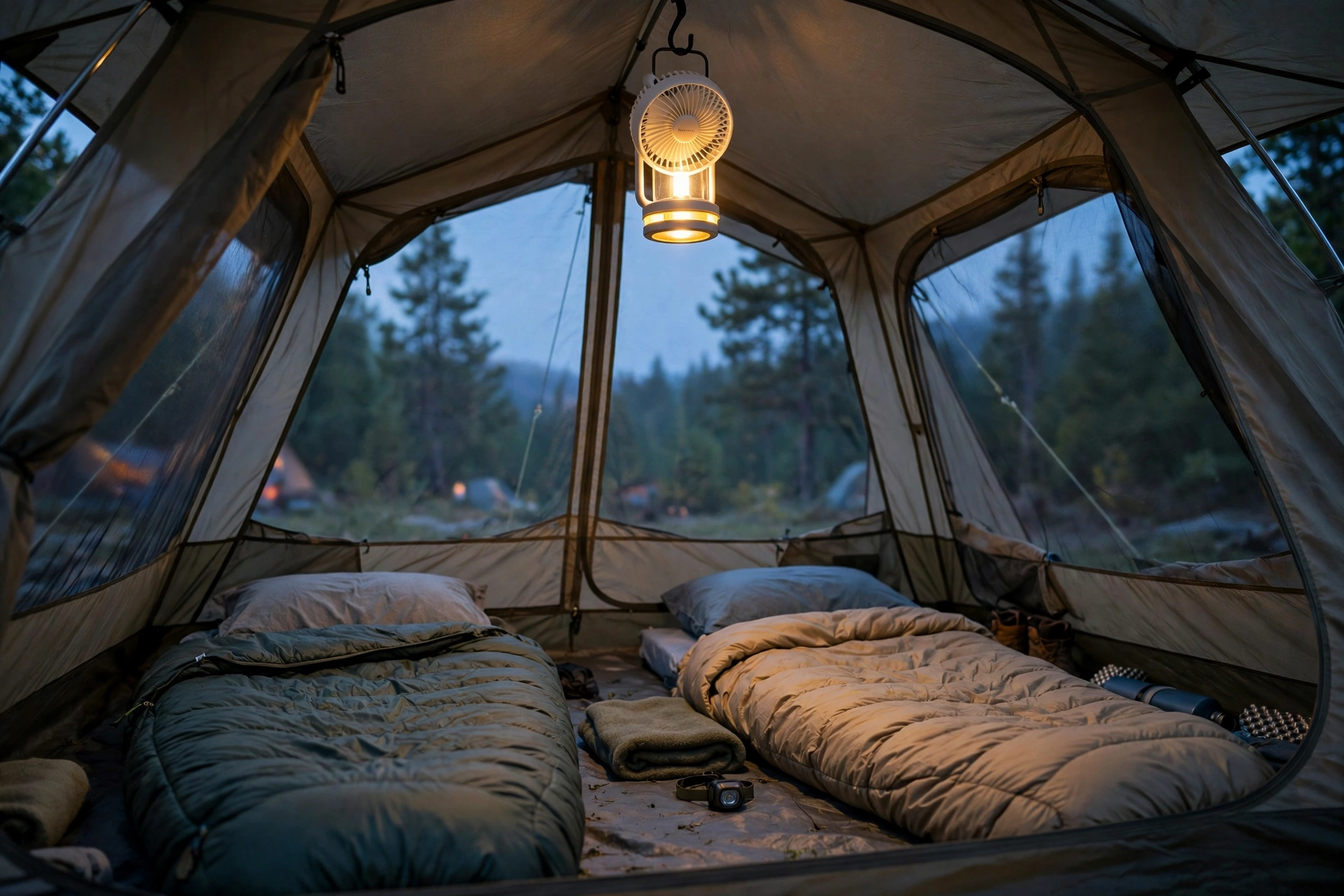
A hot tent is the fastest way to ruin a family camping trip — the kids are sticky and nobody can fall asleep. A good portable fan will not turn your tent into an air-conditioned bedroom — but the right one, set up the right way, moves enough air to drop how hot the tent feels, dry out the humidity, and give everyone a real chance at sleep.
This guide is written for families, not gear collectors. Every pick below is judged on what actually matters at a campsite with kids: battery life on a low overnight setting, noise next to a sleeping toddler, how the fan mounts inside a tent, and safety around small children. Battery and runtime figures are the makers’ own listed figures — best-case numbers, so plan for about two-thirds of the claim on a real trip.
First, Understand What a Tent Fan Can (and Cannot) Do
A fan cools people, not air. It moves air across skin, which speeds up sweat evaporation, and pushes hot, stale air out of the tent while pulling cooler night air in. That is why a fan pointed at a closed-up tent does almost nothing, while the same fan with two vents open can transform the night.
There is also a real limit worth knowing before you buy. The CDC warns that when indoor temperatures climb above 90°F (32°C), a fan can actually increase body temperature rather than lower it, because it is blowing hot air over the body faster than sweat can cool it. In that kind of heat, a fan is not a safety device — shade, hydration, and getting out of the heat are. The National Weather Service’s heat safety guidance and the National Park Service’s guide to heat illness both stress the same point: know the warning signs and cool down early. A tent fan is a comfort tool for warm evenings, roughly in the 70–88°F range — not a plan for triple-digit heat.
How to Choose a Portable Fan for a Family Tent
1. Battery life matters more than airflow
A fan that dies at 1 a.m. is worse than no fan. Look at the runtime on the low setting — the speed you will actually sleep with. For a family tent, aim for at least 8 hours on low from a single charge, and check whether the fan can run while charging from a power bank. A 10,000mAh battery or larger usually clears that bar.
2. Mounting: hanging beats sitting on the floor
Inside a tent, a fan on the floor blows air at sleeping bags and stirs up dust. A fan hung from the ceiling loop pushes air down over everyone, the way a ceiling fan does at home. Look for a built-in hook, a hanging loop, or a tripod socket. Clip-on fans are the exception — clamped to a cot frame or tent pole, they aim air exactly where one sleeper needs it.
3. Noise: quiet on low is non-negotiable
Most makers quote noise in decibels, but the numbers are measured differently and are hard to compare. The practical rule: a fan you can hold a normal conversation over on low is fine; a fan that whines or rattles will keep light sleepers awake. Brushless motors tend to run quieter, and a gentle fan hum can help kids who sleep with white noise at home — test it in the backyard first, not on night one of a trip.
4. Light, power bank, and safety around small kids
Many tent fans double as LED lanterns — one device, one charge, light for bedtime stories and air for sleeping. A USB output that charges a phone is a nice bonus, and a remote control is worth more than it sounds when you are zipped into a sleeping bag. For safety, choose a fan with a finger-safe grille, keep cords short and out of reach, and never use a fan with exposed blades around children.
Best Portable Fans for Camping Tents (2026): Quick Comparison
| Fan | Best for | Battery | Runtime (low) | Mounting | Light? |
|---|---|---|---|---|---|
| FRIZCOL 3-in-1 Camping Fan | Most families — best all-rounder | 24,000mAh | Up to 60 hours | Hook / tabletop | Yes, LED + remote |
| Odoland LED Lantern + Ceiling Fan | Budget and backup | 2 D-cell batteries | Up to 37 hours (light) | Collapsible hook | Yes, 18 LEDs |
| Nitecore NEF10 | Light sleepers, small tents | 10,000mAh | Up to 27 hours | Hook + tripod socket | Yes, ring light |
| Claymore V600+ | Premium build, quiet running | 7,800mAh | Up to 32 hours (low) | Tripod mount / hook | No |
| Koonie 8-Inch Clip-On Fan | Cots and baby sleep setups | 10,000mAh | Up to 24 hours | Clip-on | No |
| DEWALT 20V Jobsite Fan | Big family tents, car camping | 20V tool battery (not included) | Depends on battery | Tabletop / floor | No |
Runtime figures are the makers’ listed numbers, measured on the lowest speed. Expect less on a real trip — plan for roughly two-thirds of the claim.
1. FRIZCOL 3-in-1 Camping Fan — Best Overall for Families
The FRIZCOL is the easiest recommendation for most families because it gets the three things that matter most right at once: a very large 24,000mAh battery, a hook for hanging it from the tent ceiling, and a built-in LED light with a remote control. The maker lists up to 60 hours on low across four speeds — enough for a full weekend of nights.
2. Odoland LED Lantern + Ceiling Fan — Best Budget Pick
The Odoland is the cheapest fan on this list and the simplest: two D-cell batteries, two speeds, a collapsible design that packs flat, and an 18-LED lantern. There is no charging to remember — you just bring spare D-cells. For a family that camps twice a summer, that simplicity is a feature. The trade-off is weaker airflow for one or two sleepers, not a whole family tent, and D-cells add up in cost over a season.
Best for: budget-conscious families, emergency backup, and anyone who wants no charging to remember.
3. Nitecore NEF10 — Best for Small Tents and Light Sleepers
The Nitecore NEF10 is a 10,000mAh fan with a three-level LED ring light, a hanging hook, and a ball-head tripod in the box. The maker lists up to 27 hours on low, and its USB-A output can top up a phone while it runs. It is the quietest-feeling fan in this roundup on its lowest setting — our pick for families with babies or light sleepers, though one NEF10 will not cool a big 8–10 person tent on its own.
Best for: 2–4 person tents, parents of babies and toddlers, and anyone who values quiet over maximum airflow.
4. Claymore V600+ — Best Premium Pick
Claymore is the quality pick: solid build, a brushless motor that runs noticeably quieter than budget fans, a tripod mount, and a 7,800mAh battery the maker rates for up to 32 hours on low. It costs more than the FRIZCOL and has a smaller battery, but it feels like a tool that will last five seasons instead of two.
5. Koonie 8-Inch Clip-On Fan — Best for Cots and Kids’ Sleep Setups
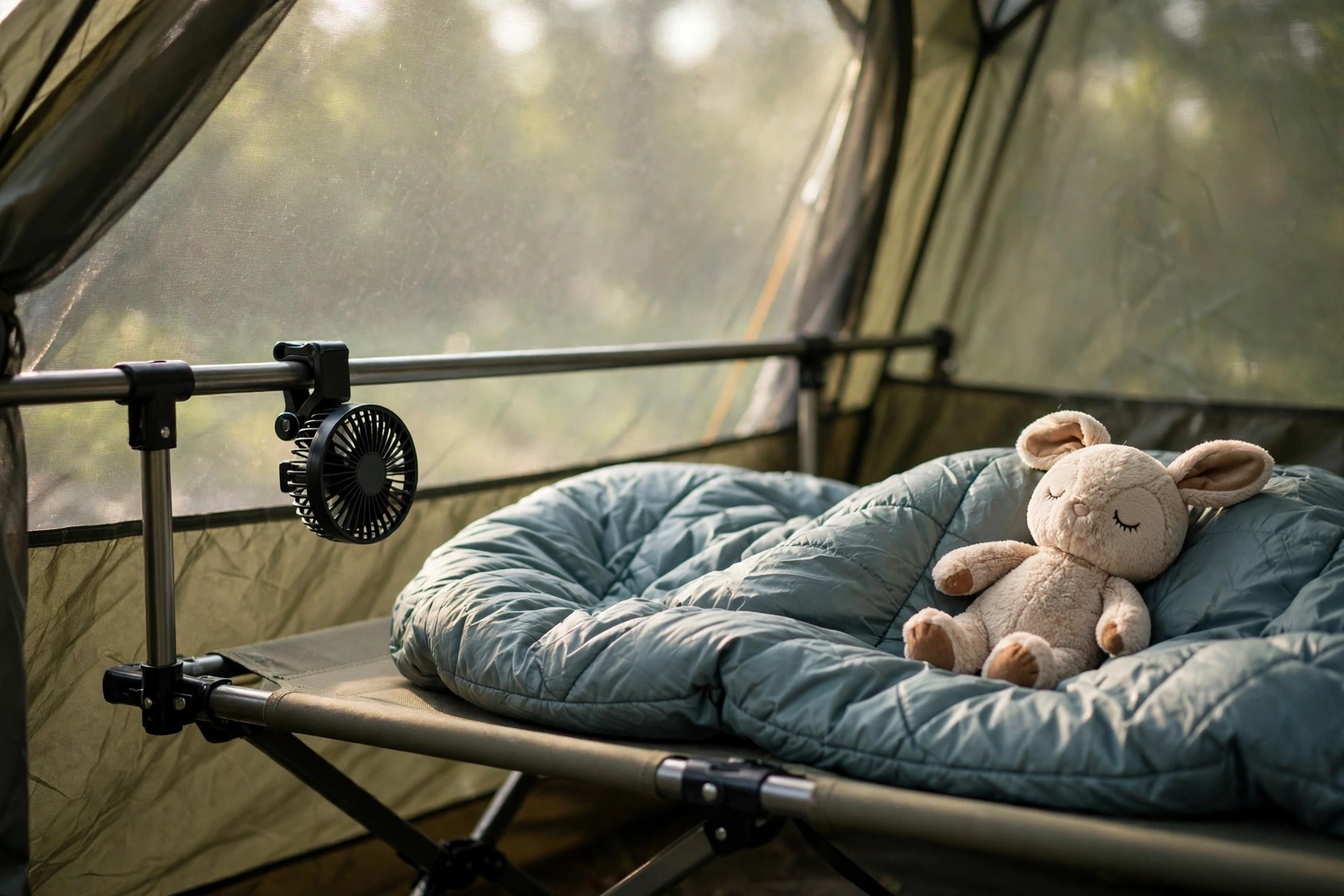
Sometimes the problem is not the whole tent — it is one hot sleeper. The Koonie clips directly to a cot frame, a stroller handle, or a tent pole and aims air exactly where it is needed. Its 10,000mAh battery is listed for up to 24 hours, and because it sits inches from the sleeper, even its low speed feels effective. Best for a toddler on a camping cot or a baby’s sleep corner.
6. DEWALT 20V Jobsite Fan — Best for Big Tents (If You Own the Batteries)
If your family tent is a 10-person cabin tent and you already own DEWALT 20V tools, this is the most powerful option here — the maker rates it at up to 650 CFM, many times the airflow of the small rechargeable fans. It is heavy, loud on high, and useless without the batteries, which are sold separately — but for drive-up campsites with a big tent, nothing else on this list moves this much air.
How to Set Up a Tent Fan So It Actually Works
Buying the fan is half the job. The setup is the other half, and it is where most families go wrong.
- Open two vents on opposite sides of the tent. Air has to flow through the tent. Open a low vent on the cool side and a high vent or door mesh on the other side.
- Hang the fan high and in the center. Use the ceiling loop or a gear loft — hot air rises, so a fan at the top pulls the hottest air down and out.
- Point it slightly toward the open vent, not straight down. You want a slow circulation loop: cool air in, warm air out.
- Run it on low all night, not high for an hour. Low speed for 8 hours beats high speed for 2 hours, and it is quieter. Save high speed for the first 20 minutes while everyone settles in.
- Charge during the day. Plug the fan into a portable power station or a USB power bank while you are out hiking, so it is full again by bedtime.
- Keep the rainfly vented. A fully closed rainfly traps humidity even with a fan running. If rain is not falling, leave a gap at the fly’s vents.
Keeping Kids Cool (and Safe) in a Hot Tent
Kids overheat faster than adults and are worse at telling you about it, so the fan is only one part of the plan. Dress children in light, loose sleep clothes, offer water before bed, and keep a water bottle within reach overnight. If your child wakes up flushed, sweaty, or unusually cranky, get them into cooler air, offer fluids, and cool their neck and wrists with a damp cloth.
Pair the fan with shade and timing. Pitch the tent where it will be in shade by late afternoon, and hike in the morning so everyone is back and resting during the hottest hours. For a full heat-safety plan, see our desert camping with kids guide. If your kids are light-sensitive sleepers, pair the fan with a blackout tent setup — our sleep guide covers the whole bedtime routine.
What About Battery Life on a Multi-Night Trip?
A single fan charge will not last a four-night trip — plan for it. A 20,000mAh power bank recharges a 10,000mAh fan roughly twice, and a small portable power station can run a fan for several nights while also charging phones and lanterns. The simplest system: one big fan, one power bank as backup, and a charging routine every afternoon. For longer trips, Recreation.gov is the place to check whether your campground has electrical hookups before you count on them.
FAQ: Portable Fans for Camping Tents
Do portable fans actually cool a tent?
Yes, with the right setup. A fan moves air across skin, which cools you through evaporation, and pushes hot air out through open vents. It will not lower the air temperature the way an air conditioner does, but in a vented tent on a warm night it makes a real difference. Above about 90°F, a fan alone is not enough — prioritize shade, hydration, and cooler hours.
How long should a camping fan run on one charge?
Look for at least 8 hours on the lowest speed — enough for a full night’s sleep. Fans with 10,000mAh batteries or larger usually manage this; 5,000mAh fans often do not. Makers’ runtime figures are best-case numbers measured on low; plan for roughly two-thirds of the claim.
Are camping fans safe to leave on overnight with kids?
Yes, if you choose the right fan and set it up well. Pick a fan with a finger-safe grille, hang it securely from the tent ceiling loop where small hands cannot reach it, keep cords short and out of the way, and never use a fan with exposed blades around children.
Should I get a hanging fan or a clip-on fan?
For a whole family tent, a hanging fan is better — it circulates air over everyone. A clip-on fan is better for one specific sleeper, like a toddler on a cot. Many families end up with both: a hanging fan for the tent and a clip-on for the child who runs hottest.
Can I charge a camping fan from a power bank?
Most rechargeable tent fans charge over USB-C or USB-A and work fine with a standard power bank. Some can even run while charging, so you can plug the fan into a power bank overnight and never worry about it dying. Check the maker’s specs first — not every fan supports pass-through charging.
Do I still need a fan if my tent has good ventilation?
Good ventilation helps, but on a still, humid night, even a well-vented tent can feel stuffy. A fan creates airflow when nature does not provide it. Think of ventilation as the foundation and the fan as the boost — you want both, especially with kids in the tent.
