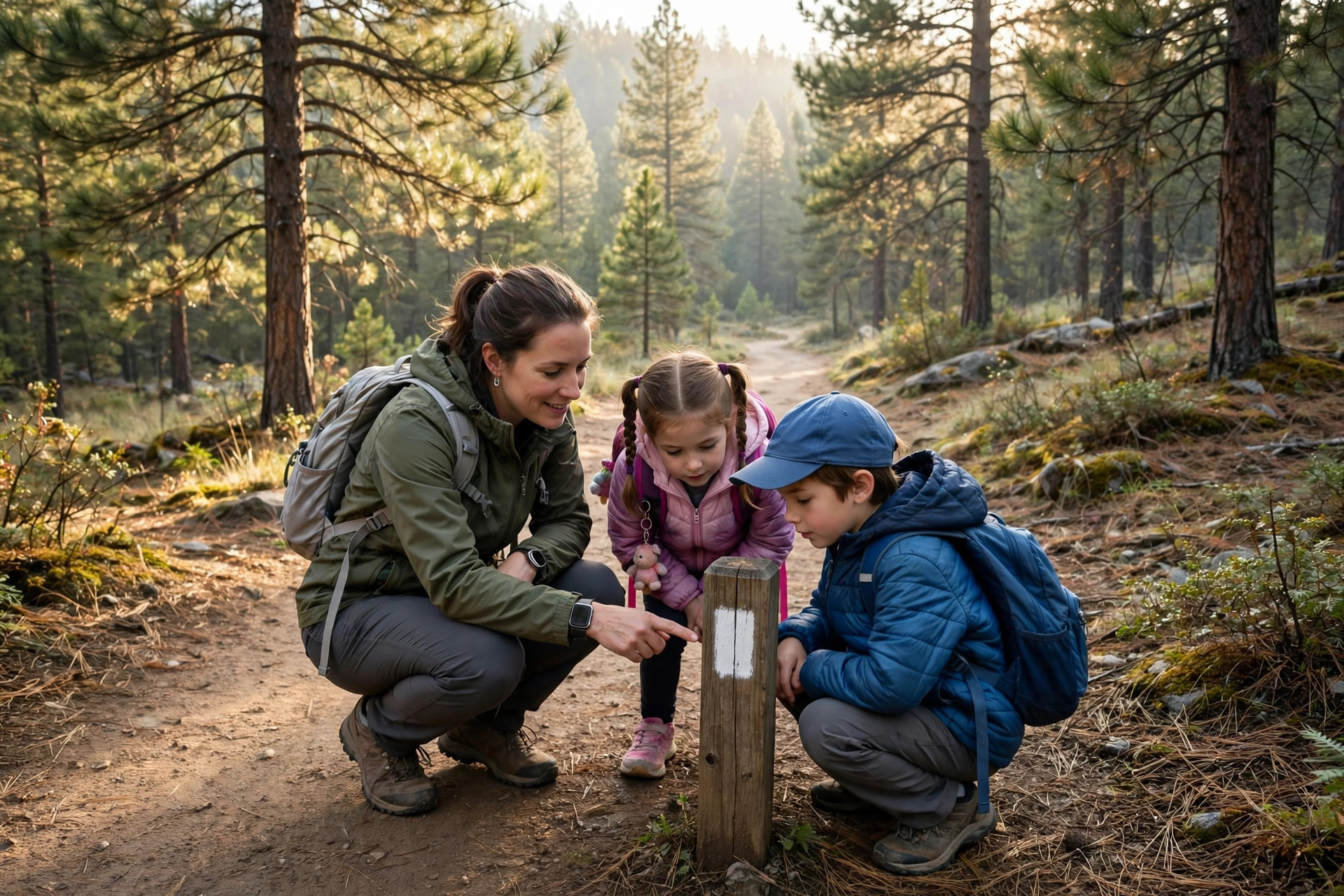
Teaching kids trail safety is one of the most valuable things a hiking parent can do — more valuable than the fanciest boots or the lightest backpack. A child who knows how to stay on the trail, what to do if they get lost, and how to behave around wildlife can enjoy the outdoors with real confidence. And the good news: trail safety for kids isn’t about scary lectures. It’s a set of small skills you can build one hike at a time, starting as early as age two.
This guide breaks down the five core trail safety skills every kid should learn, then maps them to age-appropriate stages from toddlers to pre-teens — with games, scripts, and drills that actually work on real trails. If you’ve ever wondered how to teach kids trail safety in a way that sticks, start here.
Why Trail Safety Is a Skill, Not Just a Set of Rules
Most parents teach trail safety the way they were taught: “stay on the trail, don’t touch that, stay close to me.” Rules are fine, but they break down the moment a kid is tired, distracted, or excited — which describes most of childhood hiking. Skills are different. A skill is something a child can do: spot a trail blaze, blow a whistle three times, sit down and stay put. Skills work when a parent isn’t there to give instructions, and that’s exactly when safety matters most.
Think of it like swimming lessons. You wouldn’t just tell a kid “don’t drown” — you’d teach them to float and reach for the edge. Trail skills work the same way: simple, repeatable actions practiced in low-stakes moments, so they’re automatic when it counts.
The 5 Core Trail Safety Skills Every Kid Should Learn
Everything below builds on these five skills. Teach them in order — each one makes the next one easier.
1. Reading Trail Blazes and Staying on the Trail
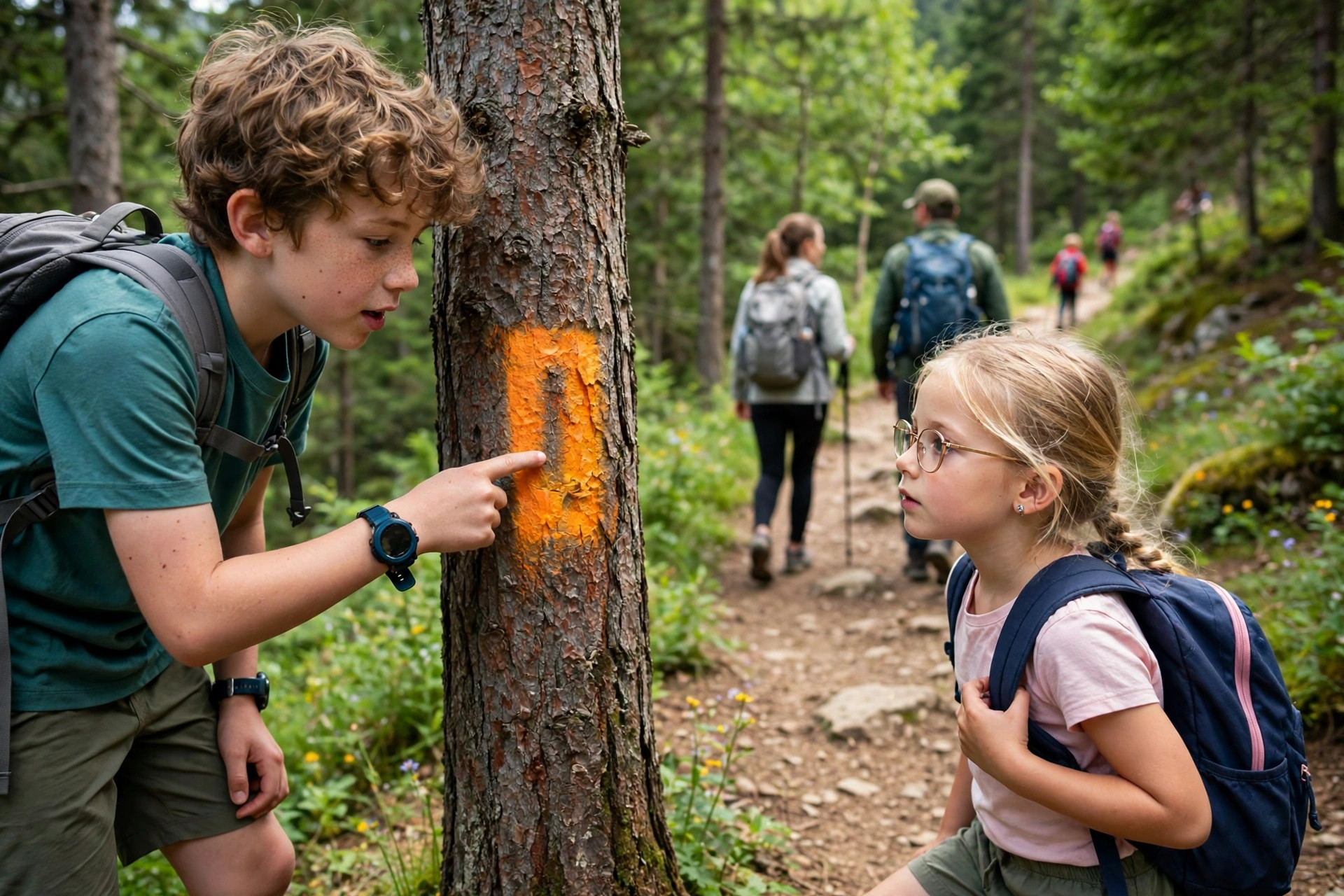
Wandering off-trail is the single most common reason families get into trouble on day hikes. Teach kids that trails are marked with blazes — painted rectangles on trees and rocks, cairns (stacks of stones), or metal tags — and that their job is to always spot the next blaze before leaving the last one. Turn it into a game: “blaze hunter,” where whoever spots the next marker first scores a point. Kids who blaze-hunt rarely wander.
A double blaze (two stacked markers) means a turn or junction ahead — the rule is to stop and look for where the trail goes next.
2. The Buddy System
No kid hikes alone — ever. Every child has a buddy (a parent for small kids, a sibling or friend for older ones), and buddies stay within sight at all times: “If you can’t see your buddy, stop moving and call out.” Practice it with “buddy check!” calls every fifteen minutes on your first few hikes.
3. S.T.O.P. — What to Do If You Get Lost
The number one safety skill, taught by park rangers across America, is what to do if you get separated or lost. Teach the S.T.O.P. acronym:
- S — Sit down. Stop moving. Wandering makes everything worse.
- T — Think. Remember what the trail looked like. When did you last see your group?
- O — Observe. Look and listen for the trail, voices, or familiar landmarks.
- P — Plan. Stay put, blow your whistle, and wait for help to come to you.
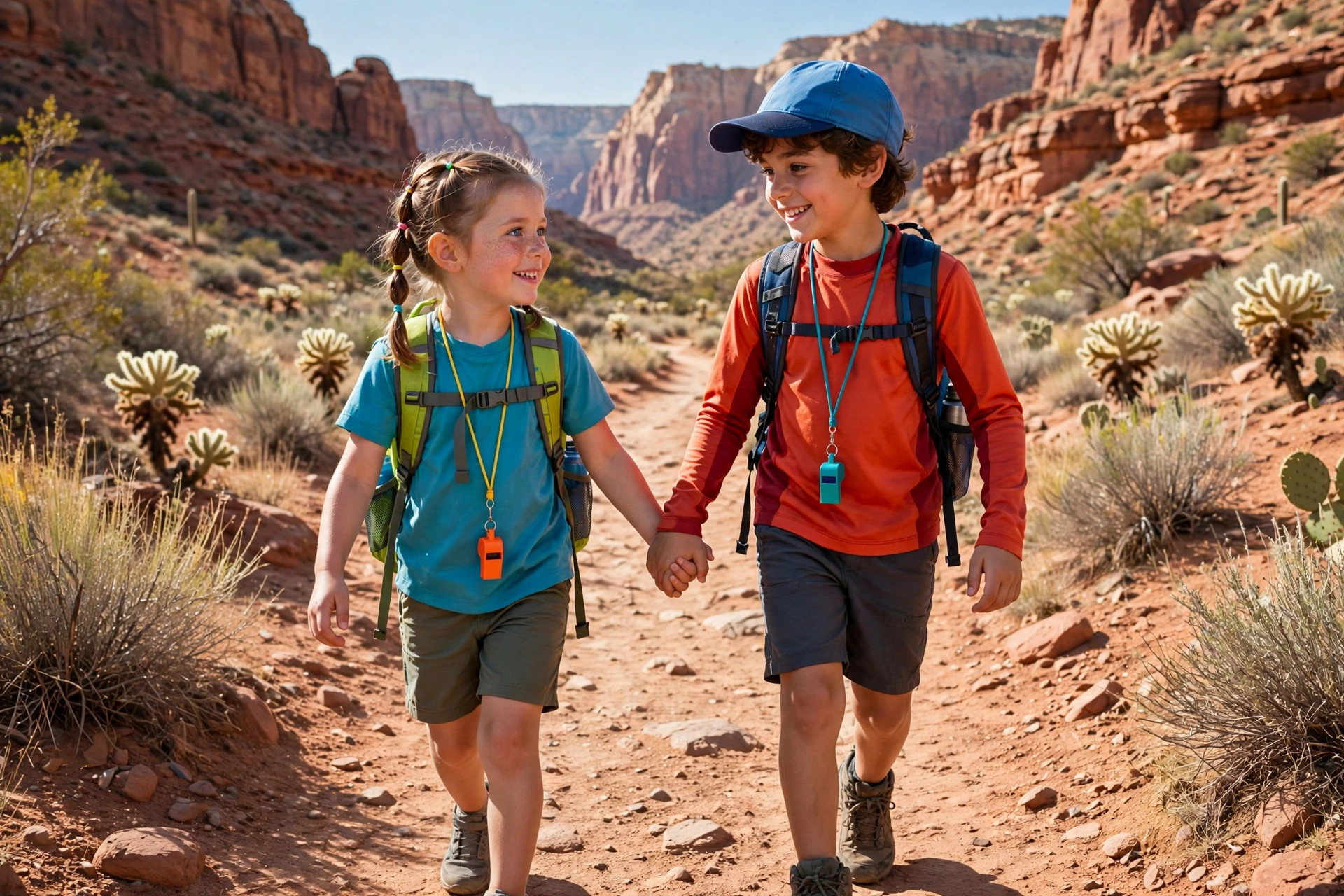
Kids as young as five can memorize S.T.O.P. Make it real with backyard practice: have them “get lost” in the yard, sit down, and blow three whistle blasts — the universal distress signal on trails.
For the full step-by-step version of what a lost child should do, our lost-hiking safety plan walks through the exact sequence to rehearse as a family.
4. Wildlife Awareness
Kids are naturally curious about animals, which is exactly why wildlife rules need to be explicit:
- Never approach or feed wildlife — even chipmunks. Food rewards teach animals to beg, and begging animals bite.
- Make noise on the trail. Talking and singing lets bears and moose know you’re coming — almost all negative encounters happen when an animal is surprised.
- Back away slowly from anything bigger than a rabbit. No running (it triggers chase instincts) — just calmly increase distance.
Also teach kids to watch where they put their hands and feet: flip-flop-free zones like rock ledges and log crossings are where snakes and stinging insects hide. The National Park Service’s 7 ways to safely watch wildlife is a great resource to review before a trip to the parks.
5. Carrying Their Own 10 Essentials
Once a kid is old enough to carry a small daypack (usually around age 6–7), they should carry a kid-sized version of the 10 essentials: a printed trail map and simple compass, sun protection, an extra layer, a headlamp, basic first aid (bandages and antiseptic wipes in a zip bag), their own snacks and water bottle, an emergency blanket — and the non-negotiable whistle on a lanyard around the neck, not buried in the pack. Skip the fire kit and knife (parent carries those); add a bandana instead.
It’s a mindset shift: a child with their own pack starts thinking like a real hiker, not cargo.
Trail Safety Skills by Age: What to Teach When
Kids don’t all develop at the same pace, but these stages are a reliable guide. The principle: each stage keeps everything from the last stage and adds one new layer.
Ages 2–4: Simple Rules and Rhymes
Toddlers can’t learn navigation, and that’s fine — at this age, trail safety means two things: stay close and stop on command. Two rules are enough:
- “Stay where you can see me.” Concrete and checkable.
- “Freeze means freeze.” Practice the freeze game at home: when you say “freeze,” they stop instantly. Make it silly, make it fun, repeat it until it’s reflex.
Use rhymes they can chant on the trail: “Eyes on the path, feet on the trail, stay with the group and you cannot fail.” Corny works. At this age, also start our realistic trail distances by age — an overtired toddler is a wandering toddler.
Ages 5–7: Practicing the Basics
This is the golden age for trail safety training. Five-to-seven-year-olds love rules, roles, and being “in charge.” Teach them to be the family’s official blaze hunter (spotting trail markers), memorize S.T.O.P. (quiz them on hikes), wear their own whistle around the neck with the three-blast distress rule, run buddy checks every 15 minutes, and follow the three wildlife rules above.
Give them jobs: carrying the map, announcing trail junctions, setting the pace on easy stretches. Responsibility makes the rules stick. REI’s guide to hiking with kids has more ideas for making young hikers feel like partners, not passengers.
Ages 8–10: Real Navigation Basics
By 8, most kids can handle genuine map reading — and they’re proud of it. This is when trail safety starts looking like real hiking competence:
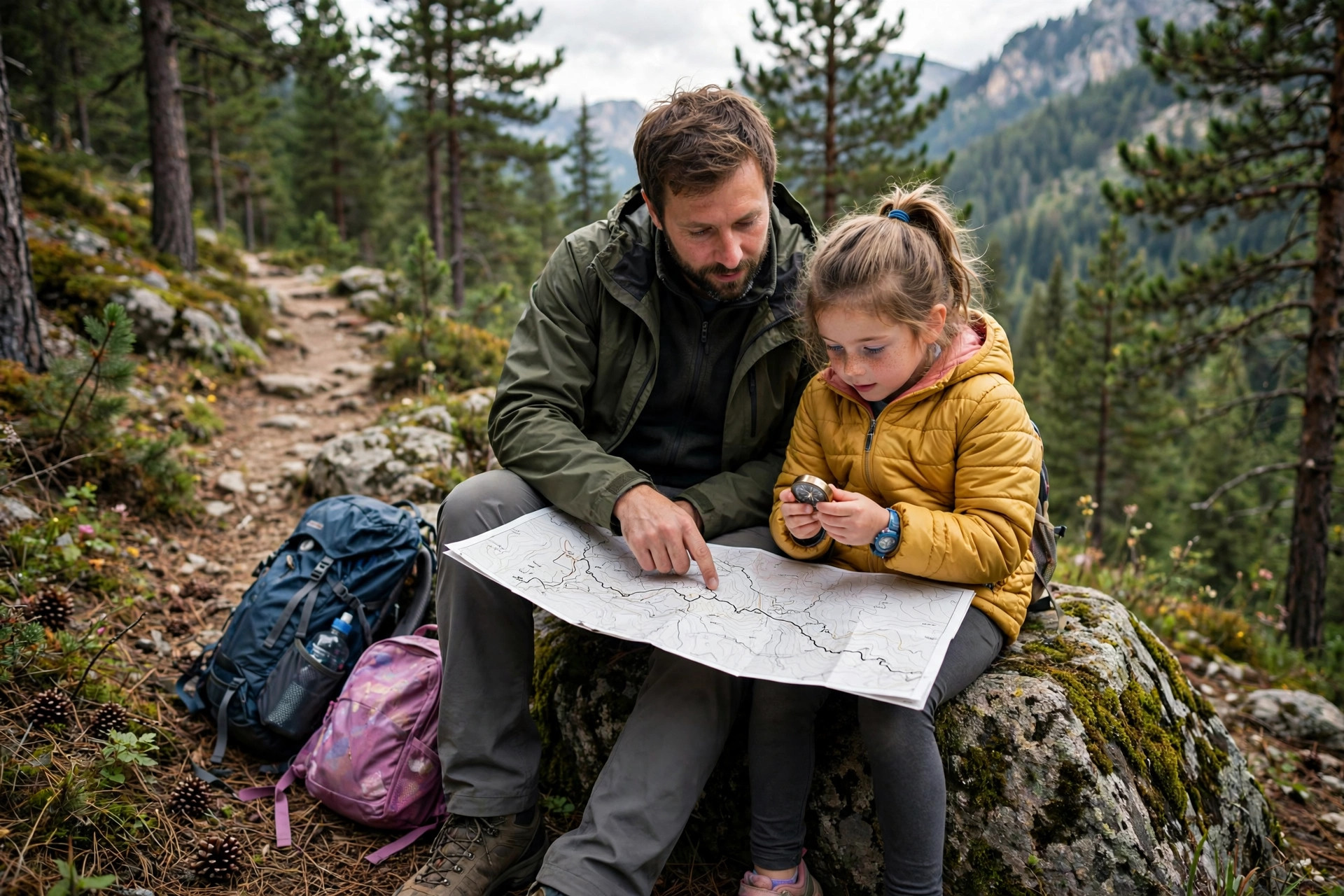
- Read a topographic trail map together — point out the trailhead, the route, and water sources. Let the child trace the route with a finger.
- Compass basics — just this: the red needle points north, the map’s top is north, so line them up. That’s enough to reorient if turned around.
- Distance and time math — “the lake is 2 miles away, we hike 1.5 miles an hour, so about an hour and twenty minutes.” It builds the habit of knowing where they are on a route.
- Lead the hike — let them lead on safe, well-marked stretches, making the navigation calls. You follow and coach.
- Weather awareness — teach them to watch the sky, recognize building thunderheads, and understand the turn-around rule: if lightning is possible, the summit can wait.
Ages 11 and Up: Junior Trail Leaders
Pre-teens can take on near-adult responsibility in stages. By 11–12, a well-trained kid should be able to:
- Plan a route with you using a trail app or paper map, including mileage, elevation gain, and water stops
- Carry a full set of their own 10 essentials and know how to use each item
- Make the turn-around call — and understand that turning back is a leadership decision, not a failure
- Understand leave-no-trace principles at a deeper level — our leave-no-trace guide for kids pairs perfectly with this stage
The goal at this stage isn’t independence on day one — it’s building a kid who could handle a problem, which makes the whole family safer.
How to Practice Trail Safety at Home (Before the Trailhead)
Don’t wait for the first hike to start teaching. A weekend of backyard practice makes the first real trail outing dramatically smoother. Play the freeze game until stopping is instant and fun. Run a backyard S.T.O.P. drill: child closes eyes, spins, then practices sitting, thinking, observing, planning — plus three whistle blasts. Set up a map treasure hunt in the yard or a local park with an X to navigate to. Try a 10-essentials packing race with silly decoys (a video game controller) mixed in, and time them. Finish with a night walk with headlamps — it teaches headlamp use and staying close in the dark. And when you’re ready to plan the trip itself, our 12 questions to ask before booking a family campground helps you pick a safe, kid-friendly base.
Trail Etiquette Kids Should Know
Safety and etiquette overlap: a kid who knows trail etiquette is a kid paying attention to their surroundings. Teach these five:
| Etiquette rule | Why it matters (kid-friendly version) |
|---|---|
| Yield to uphill hikers | They’re working harder — step aside and smile |
| Stay single file on narrow trails | So everyone, including bikers, can pass safely |
| Keep voices low near wildlife and other groups | Quiet hikers see more animals; loud ones scare them off |
| Pack out everything, including orange peels and tissues | “Leave nothing but footprints” — animals eat trash and get sick |
| Stay on the trail, even through puddles | Walking around mud widens the trail and kills plants |
Gear That Makes Teaching Trail Safety Easier
You don’t need much, but a few kid-specific items turn safety from a lecture into something they own:
- A real whistle (not a toy) on a breakaway lanyard — worn around the neck on every hike
- Their own daypack — small and fitted; carrying their own gear builds the hiker mindset
- A headlamp — kids treat headlamps like treasure; use that enthusiasm
- A simple baseplate compass — a $10 compass they’ll actually use beats a fancy one they won’t touch
- A printed trail map in a zip bag — let them be the navigator, even if you’re quietly double-checking
- Bright clothing — a neon shirt makes a child visible at 100 yards; the cheapest safety upgrade there is
Frequently Asked Questions
At what age can kids start learning trail safety?
Start the basics — “stay where you can see me” and the freeze game — as early as age 2. Structured skills like S.T.O.P. and blaze hunting click best around ages 5–7, and real navigation (maps, compass) works from about age 8. Keep every skill from earlier stages and add one new layer as they grow.
What should a child do first if they get lost on a trail?
Stop moving and sit down — the S in S.T.O.P. Teach it as a hard rule: “If you can’t see us, you sit down and blow your whistle three times.” Most lost-child searches succeed quickly precisely because the child stayed put. Practice this in your backyard until it’s automatic.
Should kids carry a whistle while hiking?
Yes — a whistle on a lanyard around the neck is arguably the most important piece of kid hiking gear. A whistle’s sound carries much farther than a child’s voice and works when they’re tired or scared. Teach the three-blast distress pattern: one blast is a hello, three blasts means “I need help.”
How do I teach my child about wildlife safety on trails?
Three rules: never approach or feed any animal, make noise while hiking so animals hear you coming, and back away slowly from anything bigger than a rabbit. Rehearse the calm version at home — kids’ instinct is to run or scream, so practice until the slow-back-away feels natural.
Can an 8-year-old really learn to read a trail map?
Absolutely — most 8-year-olds can trace a marked route, identify the trailhead and destination, and understand basic distance. Add a simple compass lesson (red needle points north, line it up with the map) and they can reorient themselves if turned around. Let them lead on safe, well-marked trail sections to build confidence.
The Bottom Line
Teaching kids trail safety isn’t a one-time talk — it’s a skill set you build hike by hike, starting with “freeze” at age two and ending with a pre-teen who can plan a route and make the turn-around call. Keep it playful, keep it hands-on, and give them real responsibility at every stage. The kids who learn trail safety young don’t just stay safer — they grow into the confident hikers who’ll one day be leading you down the trail.
Happy trails — and see you out there.
— Emma
