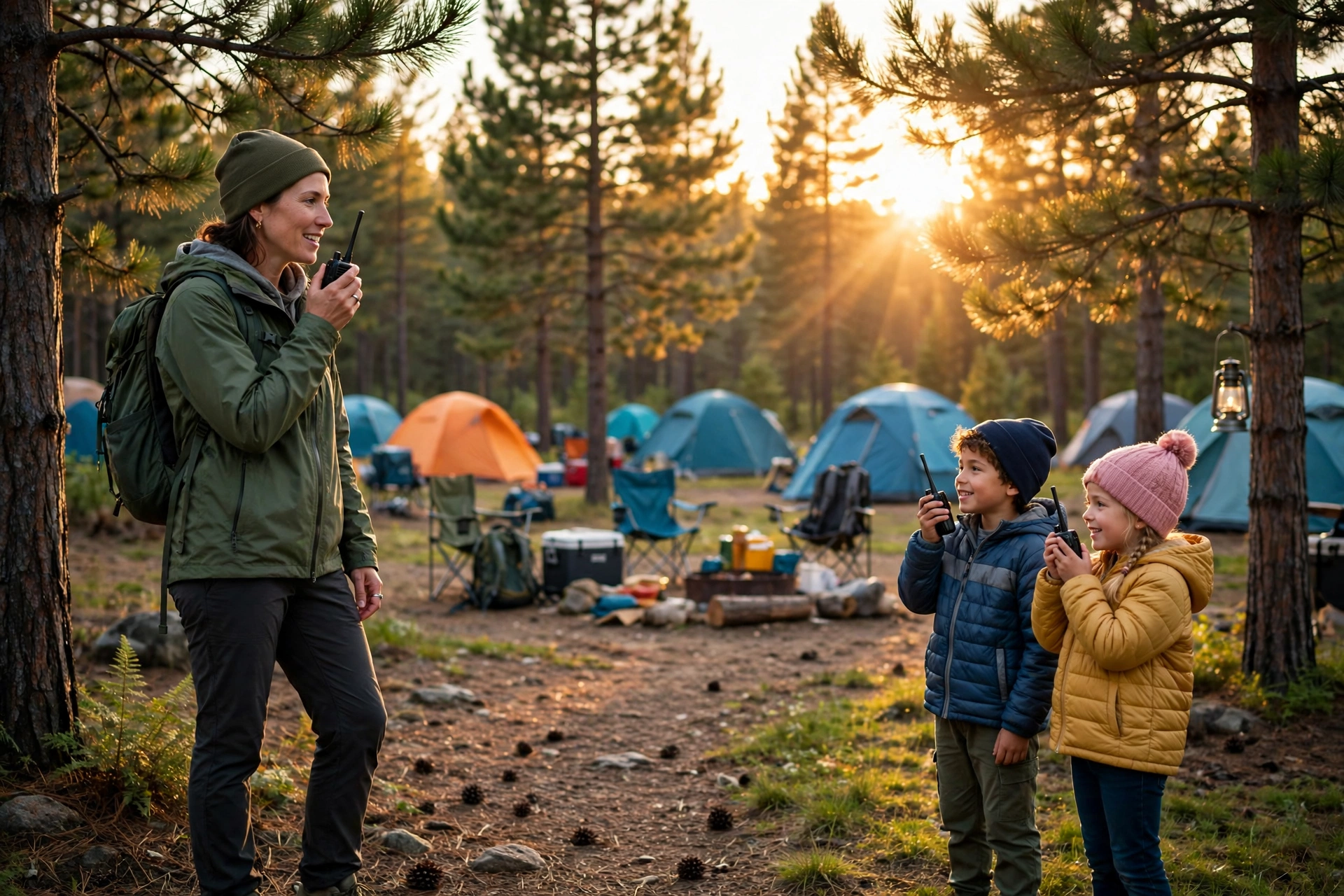
If you’re packing walkie talkies for your family’s next camping trip, you’ve probably asked the same question every parent asks in the store aisle: how far can walkie talkies reach when it actually matters? The box says “up to 36 miles,” but your campground isn’t a mountaintop-to-valley science experiment. Here’s the honest, campground-tested answer: most family walkie talkies reach 0.5 to 2 miles in real camping conditions — and that’s usually more than enough if you buy and use them the right way.
This guide breaks down real-world walkie talkie range for families: what the box claims mean, how FRS and GMRS radios actually perform at campgrounds, which terrain helps or kills your signal, and a simple pre-trip range test you can do with your kids in one afternoon.
The Quick Answer: Real-World Walkie Talkie Range
Forget the marketing number on the packaging. Here is what consumer walkie talkies actually deliver, hand to hand, in conditions families really encounter:
| Environment | FRS radio (real range) | GMRS radio (real range) |
|---|---|---|
| Open field, lake, flat farmland | 2–3 miles | 3–6 miles |
| Typical forest campground | 0.5–1.5 miles | 1–3 miles |
| Suburban / small-town campground edge | 0.5–2 miles | 1–3 miles |
| Hilly or ridge-separated terrain | 0.5–1 mile | 1–2 miles |
| Clear line of sight, hilltop to valley | 3–5 miles | 5–10+ miles |
Most family campgrounds are smaller than a mile across — even the big ones rarely stretch beyond a mile end to end. That means a basic pair of FRS walkie talkies (the kind sold in blister packs at any big-box store) comfortably covers the whole campground in typical conditions. Where families actually lose signal is on separated activities: one group hikes the ridge trail while the other stays at the site, or kids bike to the camp store while parents cook dinner. That’s where knowing your real range — and which radio you bought — makes all the difference.
What “Up to 36 Miles” on the Box Really Means
That 36-mile claim isn’t a lie, exactly — it’s a laboratory number. Manufacturers test range with two radios on hilltops, in perfect line of sight, with no trees, buildings, hills, or interference between them. It’s technically accurate and completely useless as a shopping guide.
Walkie talkies send radio waves that travel mostly in straight lines. On flat ground, the horizon for a person holding a radio at chest height is only about 3 miles away — the curve of the Earth itself blocks anything beyond that. Trees, hills, buildings, and even rain absorb and scatter the signal long before distance alone would stop it.
Think of it like shouting across a valley: on a clear day with nothing between you, your voice carries far. Put a ridge, a stand of pines, and a thunderstorm between you, and you can’t hear a thing. Same physics, just radio waves.
FRS vs GMRS: The Two Radios Families Actually Buy
Nearly every walkie talkie a family buys falls into one of two FCC services. Understanding the difference is the single most important thing in this guide:
| FRS (Family Radio Service) | GMRS (General Mobile Radio Service) | |
|---|---|---|
| Max power | 2 watts (0.5W on channels 8–14) | 5 watts (handheld) |
| License needed? | No — use it out of the box | Yes — $35 FCC license, covers your whole family for 10 years |
| Antenna | Fixed (can’t be replaced) | Can be replaced/upgraded |
| Repeaters | Not supported | Can use repeaters (range jumps to 20+ miles) |
| Real family range | 0.5–2 miles | 1–5 miles |
| Best for | Campground-to-campground chatting, kids’ games, bike rides | Split groups, trailheads, bigger parks, emergencies |
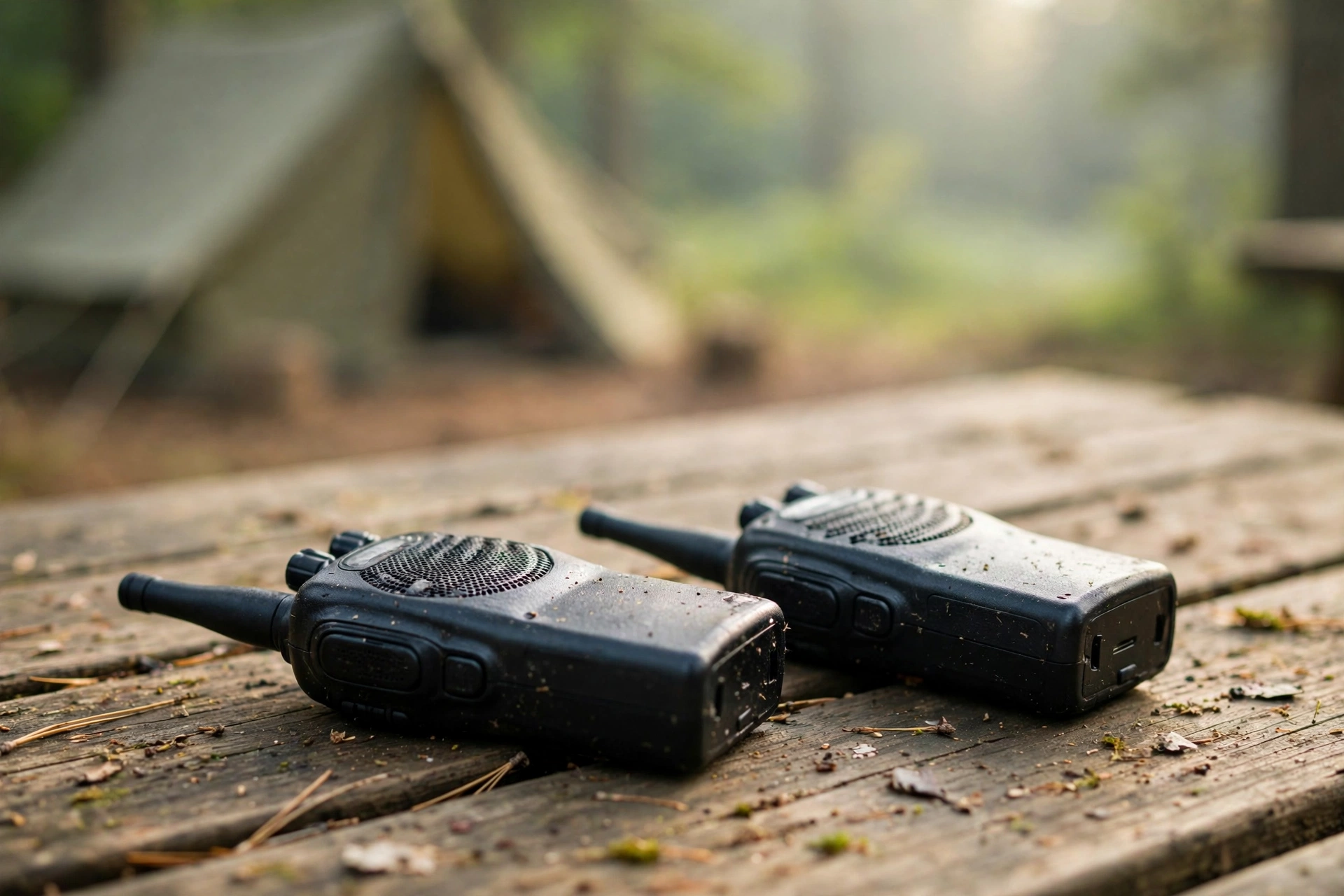
For most families, FRS is enough. The blister-pack radios at the store are FRS. They need no license, cost little, and cover a typical campground easily. GMRS makes sense when your family splits up regularly — a teen group hikes one trail while parents hike another, or you camp in big national parks where sites and trailheads are miles apart.
If you bought our recommended picks, you already own one of these two types — see our walkie talkies for kids guide for which models suit different ages. One caution from that guide: radios marketed as “long range” in kid packaging are almost always standard FRS radios with the same 2-watt limit as everyone else. The physics doesn’t care about the cartoon on the box.
Range by Campground Terrain: What to Expect Where You Camp
Not all campgrounds are equal for radio range. Here’s how the places families actually camp shake out:
Open, flat campgrounds (lakes, prairies, desert sites)
Best case for radio. With few trees and flat ground, even basic FRS radios can stretch toward 2–3 miles — roughly the length of 50 football fields. Great for bike-riding kids at a big lakeside campground.
Forested campgrounds (most state parks, national forests)
The most common family camping scenario, and the toughest on signal. Wet leaves and dense trunks absorb UHF radio waves. Expect 0.5–1.5 miles from FRS radios here. This still covers most loop-style campgrounds, where the farthest two sites are rarely more than half a mile apart — but it won’t reach a group that drove to a trailhead on the other side of the ridge.
Hilly or canyon campgrounds
Hills are the ultimate signal killer because radio waves travel in straight lines — if the hill is between you, the signal has to diffract around it, which costs most of the range. In rolling or canyon terrain, count on under a mile for FRS, and don’t plan check-ins across a ridge unless you test it first.
A real example: the 200-site campground
A big loop campground is roughly 3,000 feet end to end — just over half a mile. Two FRS radios, one at each end, will connect easily in open conditions and usually in forest conditions too. That’s why most families never discover their range limits at the campsite itself. The surprise comes on trail days — so always test that scenario, not just the campsite.
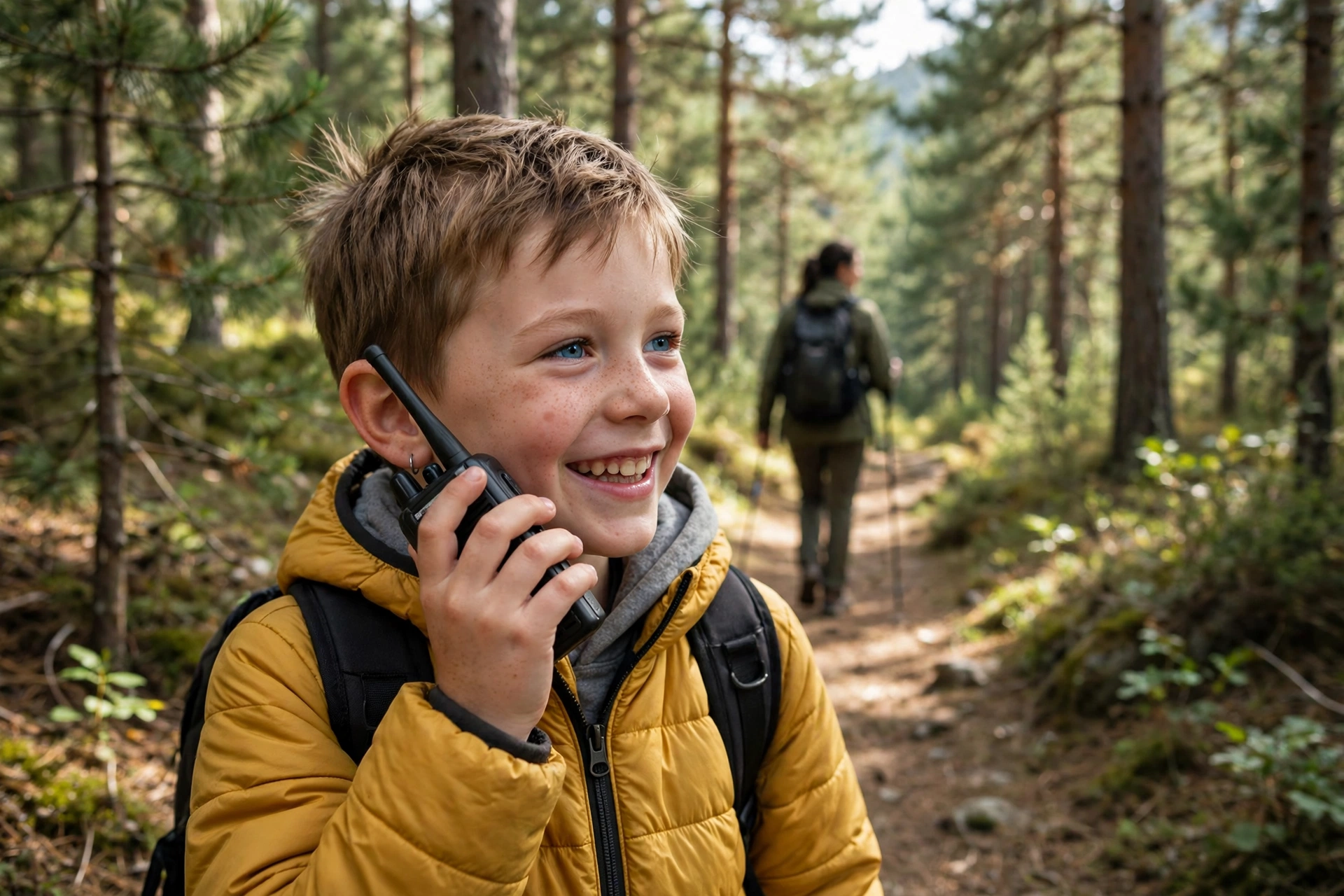
7 Things That Shrink Your Range (and How to Fix Each)
- Trees and wet foliage. The biggest range killer at campgrounds. Fix: hold the radio higher — even waist-to-shoulder height gains range. Stand in a clearing to transmit.
- Hills and ridges. Nothing gets through a hill. Fix: plan check-ins at trail junctions on high ground; agree beforehand that “no signal” means “head to the agreed high point.”
- Buildings and RVs. Metal RVs and bathhouses block signal. Fix: step outside and away from the vehicle to talk.
- Low batteries. A weak battery cuts transmit power. Fix: charge fully before trail days; carry spare AAs or a power bank.
- Antenna held wrong. Tilting the antenna sideways wastes signal. Fix: hold the radio vertical, antenna up — and teach kids this one; they love the “superhero antenna” rule.
- Channel congestion. Channels 1–7 are the busiest at family campgrounds. Fix: agree on a quieter channel and a privacy code with your group.
- Weather. Heavy rain and electrical storms degrade UHF signals. Fix: treat stormy days as low-range days and shorten your check-in intervals.
How to Test Your Range Before the Trip (30-Minute Family Activity)
Don’t discover your range limits when your 9-year-old is already out of earshot. Do this test at home or on your first afternoon at camp — it takes 30 minutes and kids treat it like a mission:
- Charge both radios fully. Testing on half batteries gives you false numbers.
- Station one adult at the campsite (or your front porch for a home test) with radio A.
- Walk away with radio B, checking in every 100–200 yards. Have your kid call “radio check” at each stop.
- Mark where the signal breaks up — not where it dies completely, but where voices get scratchy. That’s your reliable range boundary.
- Repeat in the direction of tomorrow’s trail or the camp store — range isn’t a circle; a hill in one direction halves it while an open field doubles it.
- Write the result on masking tape stuck to each radio: “Reliable to the big oak, ~0.4 mi.” Kids remember limits they helped measure.
This single exercise prevents the two classic family radio failures: assuming the box number applies everywhere, and assuming “we heard each other at the site” means “we’ll hear each other on the trail.”
Family Walkie Talkie Protocol: Check-Ins That Keep Kids Safe
Range numbers only matter inside a communication habit. Before your first trip with radios, set these five rules with the whole family:
- Check-in interval: every 15–20 minutes when groups separate. Set a phone timer; kids take the “timer captain” job seriously.
- The “three and free” rule: three missed check-ins in a row means the roaming group heads back to the last spot where contact worked — no exceptions, no “one more trail.”
- Channel + privacy code written down and taped inside each kid’s daypack, in case a radio gets reset or borrowed.
- Emergency channel plan: agree that in a real emergency anyone switches to channel 1 with no privacy code, so nearby campers can hear and help.
- Battery rule: radios go on the charger with the phones every night. A dead radio is a decoration.
Pair these habits with the trail-safety basics in our age-by-age trail safety guide — radios are a tool inside a plan, not the plan itself.
Do You Need a License? (FCC Rules in Plain English)
FRS radios: no license, ever. If your radios came in a blister pack and the box says “no license required,” you’re done — just turn them on. FRS is capped at 2 watts by FCC rules, which is exactly why the real-world range numbers above top out where they do.
GMRS radios: yes, a $35 FCC license. The license covers you, your spouse, your kids, and your parents — your whole immediate family — for 10 years, and there’s no test. You apply on the FCC’s website; it takes about 15 minutes. One license covers every GMRS radio your family owns.
Repeaters: only GMRS (and ham) radios can use repeaters — automated stations, often on mountaintops, that rebroadcast your signal at high power. A repeater can stretch a 5-watt handheld’s range to 20+ miles. Some national park gateway towns have community repeaters; check local listings before a big trip. For the FCC’s official rules, see the FCC Family Radio Service page.
One more rule: whatever radio you use, keep conversations brief on shared channels — especially channels 1–7 at busy campgrounds. Dozens of families may be sharing them.
Frequently Asked Questions
How far can kid walkie talkies reach?
Kid-branded walkie talkies are almost always standard FRS radios limited to 2 watts, so the same numbers apply: 0.5–2 miles in real campground conditions. The “kid” part is the packaging and the simpler buttons — the physics is identical. See our walkie talkies for kids guide for models with genuinely kid-friendly controls.
Do walkie talkies work in national parks?
Yes — they’re legal in national parks, and they work well within the range limits above. They’re actually more reliable than cell phones in parks, since most parks have little or no cell coverage at campsites. For backcountry split-group hiking, GMRS with its higher power is the better choice. Fold radios into your first family camping trip plan as your backup communication.
Can walkie talkies reach 30+ miles like the box says?
Only in perfect line-of-sight conditions — hilltop to hilltop with zero obstacles. For a family at a campground, no. Plan on 0.5–2 miles for FRS and 1–5 miles for GMRS, and you’ll never be disappointed.
What’s the difference between FRS and GMRS range?
Power and antennas. FRS is capped at 2 watts with a fixed antenna (no license). GMRS handhelds run 5 watts with better antennas (license required), roughly doubling real-world range — and GMRS can use repeaters, which FRS cannot.
How can I get more range from my walkie talkies?
Hold the radio vertically with the antenna up, stand in a clearing or on higher ground, keep batteries full, and move to a quieter channel. For a permanent upgrade, step up from FRS to GMRS — see the FCC’s GMRS licensing page for how the $35 family license works.
Are walkie talkies better than phones at the campground?
For quick group coordination — yes. No dialing, no waiting, one button, and they work where there’s zero cell signal. For emergencies, carry both: radios for the group, a charged phone for 911. Camping with pets and kids adds moving parts; our dogs-and-kids safety guide covers the full checklist.
The Bottom Line
How far can walkie talkies reach? For family camping: 0.5 to 2 miles with the FRS radios most families buy, and 1 to 5 miles with GMRS. That’s plenty for any campground and most trail days — as long as you test your actual range, set a check-in routine, and remember that the “36 miles” on the box belongs to a mountaintop, not your campsite. Do the 30-minute range test with your kids on day one, and your radios will be the most-used piece of gear in the bin.
