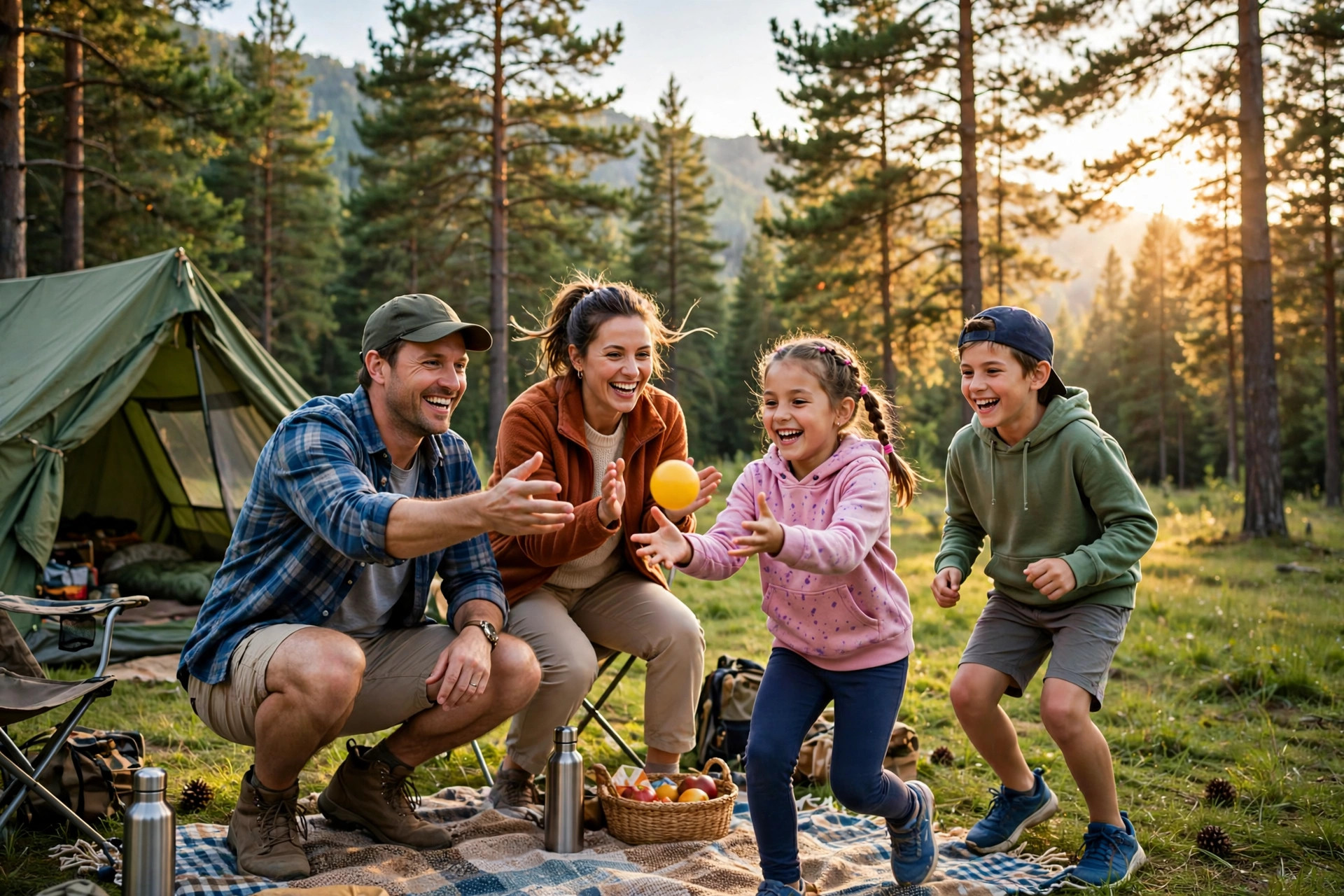
Every parent has lived this moment: you arrive at the campsite, the kids are already bored, and the bag of board games is sitting on the kitchen table at home. The good news — you do not need a single piece of equipment to keep kids happy at camp. What you need is a short list of camping games for kids that live in your head, each needing nothing but people, voices, and a little imagination.
This guide gives you 21 no-equipment camping games for kids with real how-to-play rules, the ages each game fits, and where to play it: daytime campsite games, rainy-day tent games, and campfire night games. No packing list, no batteries, no screen time.
Two Rules Before You Start
First, set physical boundaries before any active game — point out the trees or campsite posts kids may not pass, and keep everyone clear of the fire pit, roads, water, and tent guylines. Second, match the game to the moment: active games burn afternoon energy, quiet seated games fit rainy tent hours, campfire games wind everyone down. For the wind-down part, our guide to getting kids to sleep while camping pairs well with the night games below.
8 Daytime Campsite Games
1. I Spy, Camp Edition
Players: 2+ | Ages: 3+ | Energy: low
The spy picks something visible — a pine cone, a red tent, a bird — and says, “I spy with my little eye something…” plus a one-word clue like “brown.” Everyone guesses in turn; the first correct guesser becomes the next spy. Rule: the object must be visible from where the group sits. Use color-only clues for toddlers; allow sound and smell clues for older kids.
2. Hide and Seek, Campground Rules
Players: 3+ | Ages: 4+ | Energy: high
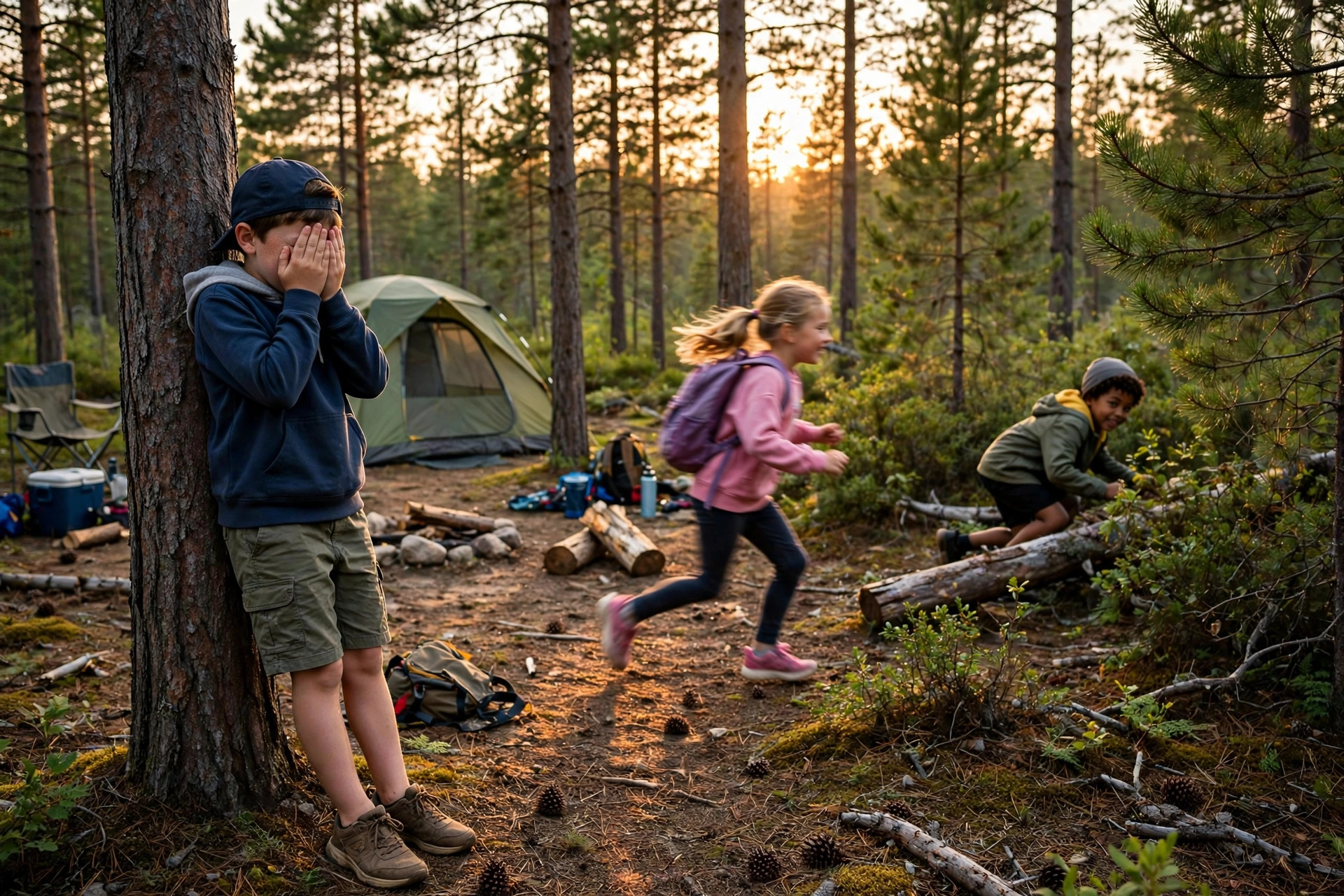
Walk the boundary together first and agree on a “base” (a tree or the tent door). One person counts to 30 out loud while everyone hides. Anyone spotted running for base is out next round. Ban hiding spots near roads, water, or vehicles, and set a whistle or shout as the recall signal. Give under-5s a head start.
3. Red Light, Green Light
Players: 4+ | Ages: 3+ | Energy: high
The “traffic light” stands 30–40 feet away, back turned. On “green light!” everyone runs toward them; on “red light!” they freeze. Anyone caught moving returns to the start. First to tag the traffic light becomes the new caller. Campground twist: call it “Bear, freeze!” and freezers pose like statues.
4. Simon Says, Nature Edition
Players: 3+ | Ages: 4+ | Energy: medium
Follow only commands that start with “Simon says.” Keep every command nature-rooted: “Simon says touch a pine cone,” “hop like a rabbit,” “stand next to something taller than you.” Anyone who moves on a fake command sits out one round — let young kids back in quickly.
5. Shadow Tag
Players: 3+ | Ages: 5+ | Energy: high
Regular tag, but you tag by stepping on someone’s shadow instead of touching them. Best in late afternoon when shadows stretch long. It keeps everyone in the sunny, open part of camp where you can see them — and feels brand new to kids who have played tag a thousand times.
6. Animal Walk Parade
Players: 2+ | Ages: 2–7 | Energy: medium
Call out an animal and everyone crosses the clearing moving like it — hop like rabbits, waddle like penguins, stomp like elephants. After a few animals, hand the calling to a kid. Keep the “parade” inside your boundary for a perfect five-minute toddler energy burner.
7. Sardines (Reverse Hide and Seek)
Players: 4+ | Ages: 6+ | Energy: medium
One person hides while the rest count to 30. Searchers who find the hider quietly squeeze in and hide with them. The last person still searching becomes the next hider. Use a slightly larger safe zone than regular hide and seek — ideal for older kids who find the classic version boring.
8. Nature Alphabet Race
Players: 2+ | Ages: 5+ | Energy: medium
Race to spot something in nature for each letter in order — A for acorn, B for bark, C for cone — calling each find out loud. Pointing counts, so nothing gets collected and the campsite stays untouched. First to Z wins. Play as one team with little kids so everyone reaches Z together.
7 Rainy-Day Tent Games
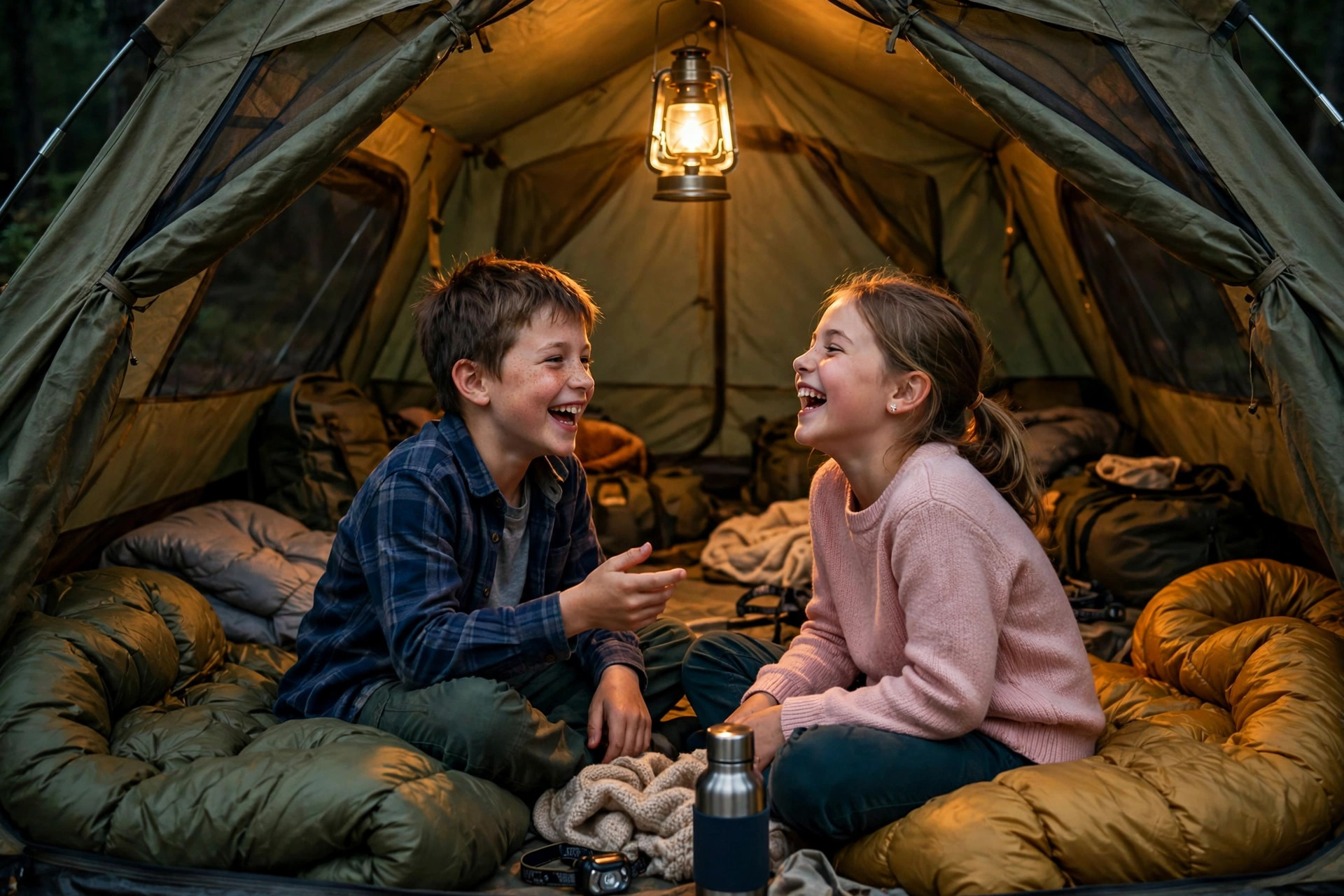
When rain pins the family inside the tent, these seated games turn a tent-bound afternoon into the part of the trip kids remember. For a bigger rainy-weather arsenal, see our rainy-day camping activities guide.
9. 20 Questions, Camping Edition
Players: 2+ | Ages: 5+ | Energy: low
One person thinks of something; everyone else gets 20 yes-or-no questions to guess it. Count questions on fingers and let the winner pick the next secret word. Camping flavor: limit rounds to “things you can find in this forest.”
10. The Picnic Game
Players: 2+ | Ages: 6+ | Energy: low
“I went on a picnic and I brought…” something starting with A, like an apple. Each player repeats the whole list and adds the next letter. Miss an item and you are out. It gets brutally funny around letter M. Drop the alphabet rule for younger kids and just keep adding items.
11. Story Chain
Players: 2+ | Ages: 4+ | Energy: low
One person starts with a sentence — “We found a map under our tent.” Each player adds one sentence around the circle. After two full rounds, the group votes on an ending: scary, funny, or surprising. One rule: no “and then we woke up” to escape a corner.
12. Would You Rather, Camp Style
Players: 2+ | Ages: 5+ | Energy: low
Take turns asking impossible questions: “Would you rather sleep in a tent full of frogs or spiders?” Everyone picks one and defends it in a sentence. It works as a conversation starter with quiet teens — keep the questions silly, never personal.
13. Telephone
Players: 4+ | Ages: 4+ | Energy: low
Sit in a row. The first person whispers a sentence — “A raccoon stole my sandwich at midnight” — ear to ear down the line. The last person says it aloud. The sentence almost never survives, and the reveal gets the biggest laugh. With three players, just run more rounds.
14. Fortunately / Unfortunately
Players: 2+ | Ages: 6+ | Energy: low
“Fortunately, we found a cave full of treasure.” — “Unfortunately, a bear lived in the cave.” — “Fortunately, the bear only wanted a sandwich.” Alternate twists as long as the rain lasts. It teaches quick thinking and works beautifully with sarcastic tweens.
15. Two Truths and a Lie
Players: 3+ | Ages: 8+ | Energy: low
Each person states three things about themselves — two true, one invented. Everyone gets one guess at the lie. Agree upfront: keep topics light and never embarrass someone else. This is the game that gets quiet teens talking.
6 Campfire & Night Games
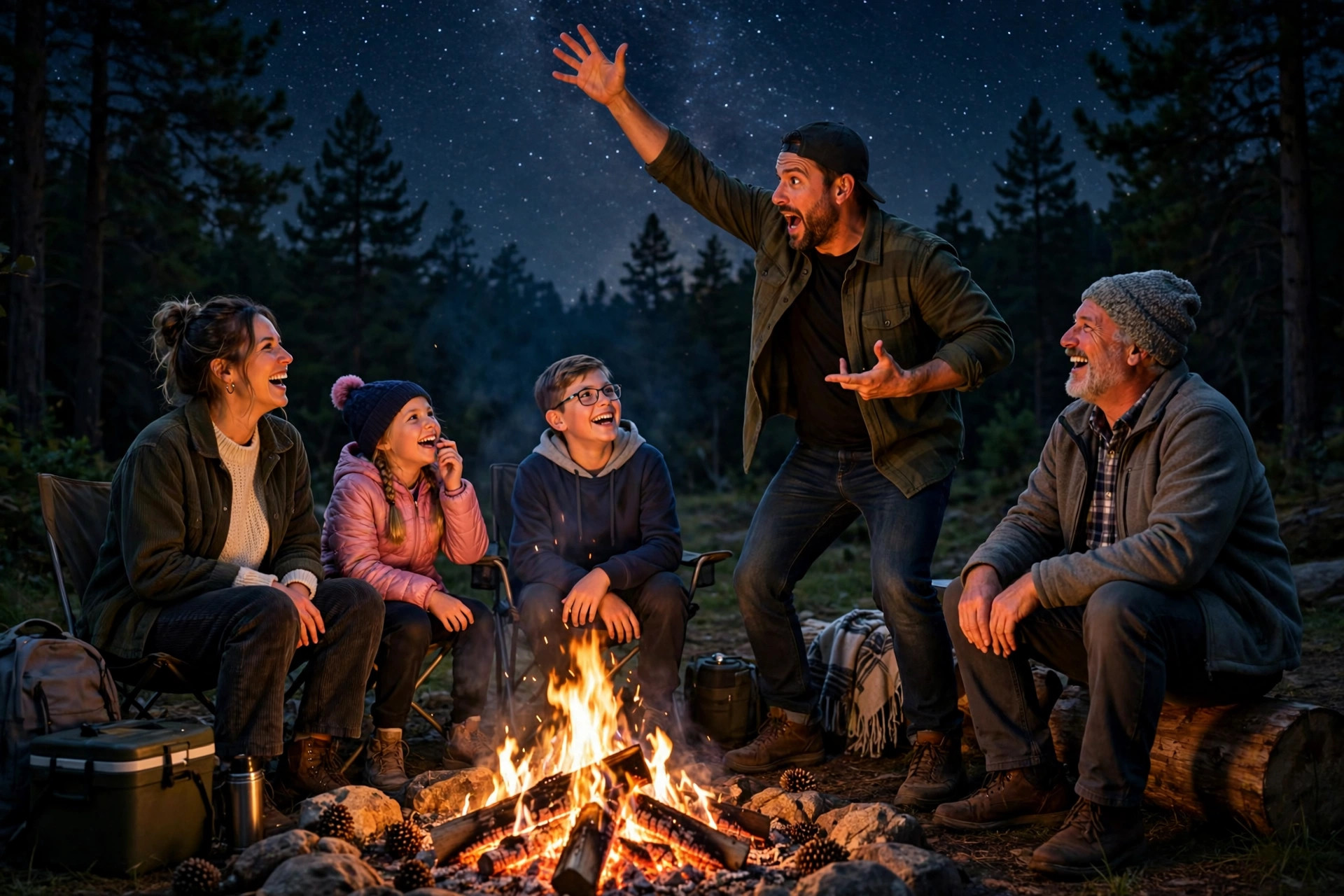
After dinner, switch to calm, seated games at a safe distance from the flames. Two minutes on campfire safety rules for kids before you start is always worth it — Smokey Bear’s campfire safety tips make a good family read too.
16. Campfire Charades
Players: 4+ | Ages: 5+ | Energy: low–medium
Two teams. Each team whispers a camping-themed word to the other team’s actor — “pitching a tent,” “a bear,” “toasting a marshmallow.” The actor mimes silently; their team gets ten guesses. Three turns per team, rotating actors. For a no-competition version, let everyone guess together.
17. Campfire Story Builders
Players: 3+ | Ages: 5+ | Energy: low
Story Chain with campfire rules: stories must be about the forest around you, and each teller stands for their sentence like a performance. Pick a theme — mysteries, animal adventures — and end after three rounds with a group-chosen ending. Kids quote these stories for years.
18. Night Sounds Detective
Players: 2+ | Ages: 3+ | Energy: low
Everyone closes their eyes for one full minute and listens. Each person names every sound they heard — wind, an owl, water, another camper’s dog — and the group guesses what each was. Most distinct sounds wins. It turns bedtime restlessness into quiet focus, and works from inside the tent too.
19. Constellation Storytelling
Players: 2+ | Ages: 6+ | Energy: low
Find a real constellation first — start with the Big Dipper or Orion — then each person invents a story about what the stars “really” are. Compare your versions with the real mythology using our stargazing guide for kids. The National Park Service’s kids programs page has more junior-ranger-style sky activities.
20. Sing-Along Challenge
Players: 3+ | Ages: 4+ | Energy: low
One person sings a song’s first line; the next must start a song with the last word of the previous one. Keep the chain alive as long as possible. With younger kids, drop the word-linking rule and take turns picking favorites.
21. Campfire Mafia (Simplified)
Players: 6+ | Ages: 10+ | Energy: low
For older kids: eyes closed, the narrator secretly taps two “raccoons” who “steal snacks” each round. The group debates and votes one person out per round. Keep rounds to two minutes, keep the theme silly, and cap it at three rounds so younger siblings don’t feel excluded.
Quick-Pick Table: Which Game, When
| Game | Best ages | Where | Energy |
|---|---|---|---|
| I Spy, Camp Edition | 3+ | Anywhere | Low |
| Hide and Seek | 4+ | Daytime campsite | High |
| Red Light, Green Light | 3+ | Daytime campsite | High |
| Simon Says, Nature Edition | 4+ | Daytime campsite | Medium |
| Shadow Tag | 5+ | Daytime, open area | High |
| Animal Walk Parade | 2–7 | Daytime campsite | Medium |
| Sardines | 6+ | Daytime campsite | Medium |
| Nature Alphabet Race | 5+ | Daytime campsite | Medium |
| 20 Questions | 5+ | Tent | Low |
| The Picnic Game | 6+ | Tent | Low |
| Story Chain | 4+ | Tent or campfire | Low |
| Would You Rather | 5+ | Tent or campfire | Low |
| Telephone | 4+ | Tent | Low |
| Fortunately / Unfortunately | 6+ | Tent | Low |
| Two Truths and a Lie | 8+ | Tent or campfire | Low |
| Campfire Charades | 5+ | Campfire | Low–Medium |
| Campfire Story Builders | 5+ | Campfire | Low |
| Night Sounds Detective | 3+ | Night, anywhere | Low |
| Constellation Storytelling | 6+ | Night, clear sky | Low |
| Sing-Along Challenge | 4+ | Campfire | Low |
| Campfire Mafia | 10+ | Campfire | Low |
5 Safety Rules for No-Equipment Games
- Walk the boundary first. Before any running game, walk the play area with the kids and point to the exact markers they cannot pass.
- Keep active games away from hazards. No running near the fire pit, roads, water, or tent guylines.
- Set a recall signal. One whistle blast or shout means “come back now” — practice it once before the first game.
- Night games stay close and seated. No running games after dark; everyone stays within the firelight.
- Respect quiet hours. Most campgrounds go quiet around 10 PM — move loud games earlier. If this is your first family camping trip, REI’s family camping checklist is a good pre-trip read alongside this list.
Frequently Asked Questions
What are the best camping games for kids with no equipment?
I Spy, 20 Questions, campfire charades, story chains, and hide and seek top the list — they use voices, imagination, and the campsite itself, need zero props, and work for mixed ages. For rainy tent time, the Picnic Game and Telephone keep kids engaged without leaving the tent.
How do you keep toddlers entertained while camping without toys?
Toddlers respond to movement and repetition: the Animal Walk Parade, I Spy with color-only clues, and singing games hold them in five-minute bursts. Rotate quickly instead of finishing long rounds, and let them “win” the first round to build confidence.
What games can kids play inside a tent during rain?
Seated word and imagination games: 20 Questions, the Picnic Game, Story Chain, Would You Rather, Telephone, and Two Truths and a Lie for older kids. They need nothing but voices, take up no floor space, and build memory and language skills.
Are there no-equipment camping games for teenagers?
Yes — teens engage when games have social or performance elements: simplified Mafia, Two Truths and a Lie, scored campfire charades, and Sardines. Let teens lead or narrate; giving them authority keeps them invested.
How do you play camping games safely at night?
After dark, switch to seated games within the firelight — storytelling, singing, and listening games. No running games at night, keep kids at arm’s length from flames, and review campfire safety rules before the first night game.
What if the kids get bored of every game?
Let boredom do its job — unstructured time is when kids invent their own games. Announce a 20-minute “make up your own game” window; the kids’ invented games usually become the trip’s legend. Then return to this list with fresh energy.
These 21 no-equipment camping games for kids weigh nothing, cost nothing, and can never be left on the kitchen table. Memorize three or four favorites before your next trip — one active, one tent, one campfire — and you will never hear “I’m bored” at the campsite again.
