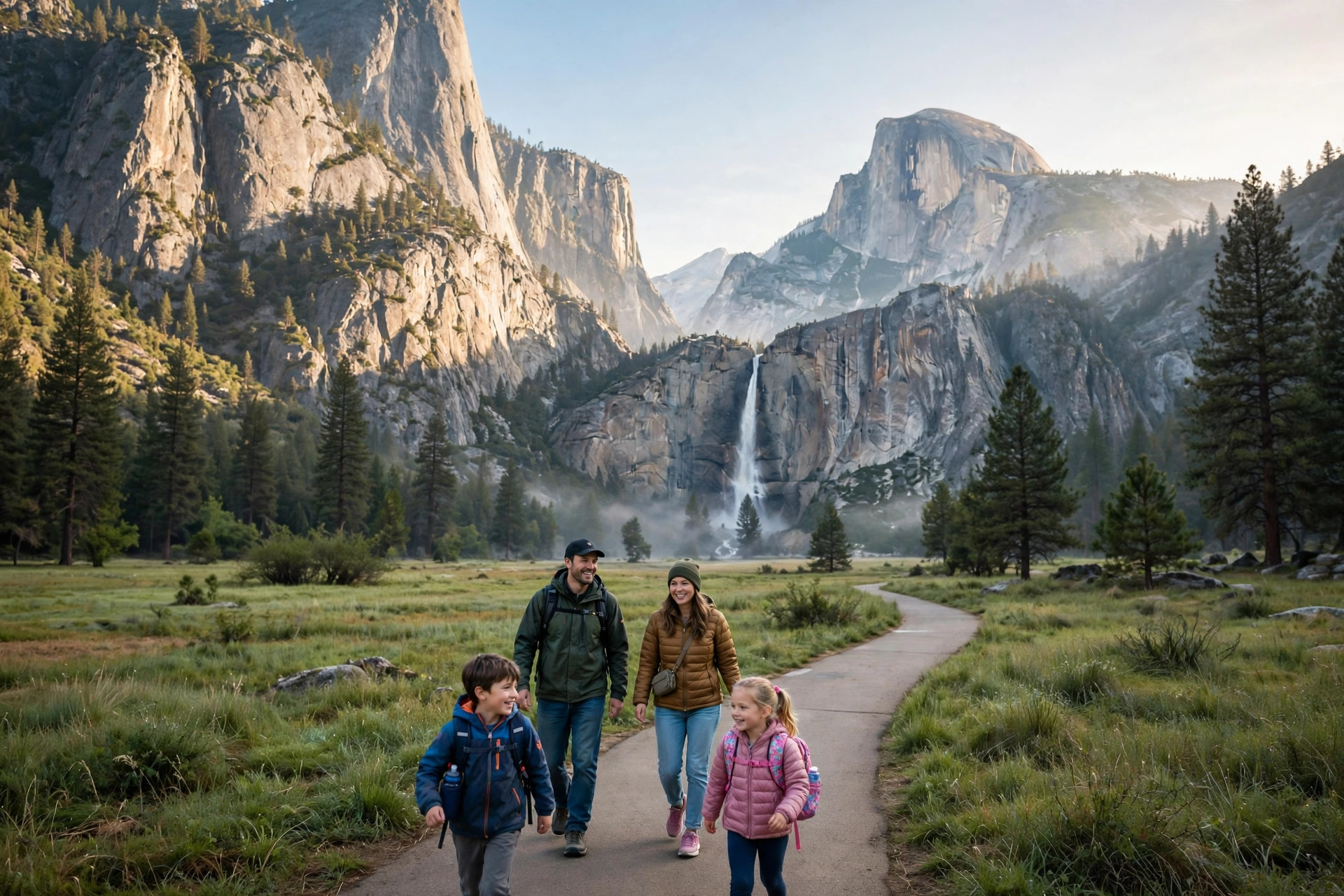
Planning Yosemite with kids? You picked one of the easiest big national parks to visit as a family — and one of the most rewarding. The valley floor is flat, the free shuttle does the driving, and the biggest sights (Yosemite Falls, El Capitan, Half Dome from the road) need no hiking at all. The trick is matching the park’s huge scale to little legs and short attention spans. This guide does exactly that: the easiest trails by age, a realistic 3-day family itinerary, where to stay, and the packing list that saves the trip.
We have visited Yosemite as a family more than once, in different seasons and with kids at different ages, and everything below comes from what actually worked.
Is Yosemite Good for Kids?
Yes — for almost every age, with the right expectations. Toddlers ride in a carrier or an all-terrain stroller on the valley’s flat, paved paths. Kids aged 4 or 5 can handle the short valley loops on their own feet. School-age kids (6–12) get the most out of Yosemite: they can walk 2–3 miles, earn a Junior Ranger badge, and actually remember the waterfalls. Teens can take on the Mist Trail and the longer viewpoints.
What Yosemite is not is a park you can wing. Summer crowds, limited parking, and seasonal road closures punish unprepared families. Plan the skeleton of your days in advance, then leave room inside each day to slow down.
What Age Is Best for Yosemite?
- Ages 0–3: Stick to the valley floor. Paved loops, meadow viewpoints, and the shuttle. Bring a carrier — strollers struggle on unpaved sections.
- Ages 4–6: Short, flat trails up to about 1.5 miles. Lower Yosemite Fall and Cook’s Meadow are perfect. Build in a midday break.
- Ages 7–11: The sweet spot. Mirror Lake, the Mist Trail footbridge, Mariposa Grove, and the Junior Ranger program.
- Ages 12+: Add Glacier Point, Sentinel Dome, and longer hikes like the Mist Trail to Nevada Fall.
Best Easy Trails in Yosemite for Kids
Every trail below is one we would actually recommend to a family, not just one that is technically walkable.
| Trail | Distance | Difficulty | Best age | Stroller-friendly? |
|---|---|---|---|---|
| Lower Yosemite Fall Trail | 1 mile loop | Easy, paved | All ages | Yes (partly) |
| Cook’s Meadow Loop | About 1 mile | Easy, flat | All ages | Yes |
| Bridalveil Fall Trail | Under 1 mile | Easy | All ages | Mostly |
| Mirror Lake Trail | 2 miles round trip | Easy, paved road | 4+ | Yes (paved section) |
| Mariposa Grove — Big Trees Loop | 0.3 miles | Easy, accessible | All ages | Yes |
| Mist Trail to Vernal Fall footbridge | 3 miles round trip | Moderate | 8+ | No |
| Sentinel Dome Trail | 2.2 miles round trip | Moderate | 8+ | No |
Our honest pick for a first morning: Lower Yosemite Fall. It is short, paved, and it puts kids at the base of North America’s tallest waterfall in under an hour. If you only do one trail, do that one. For realistic distances by age, see our guide to how far toddlers can actually hike.
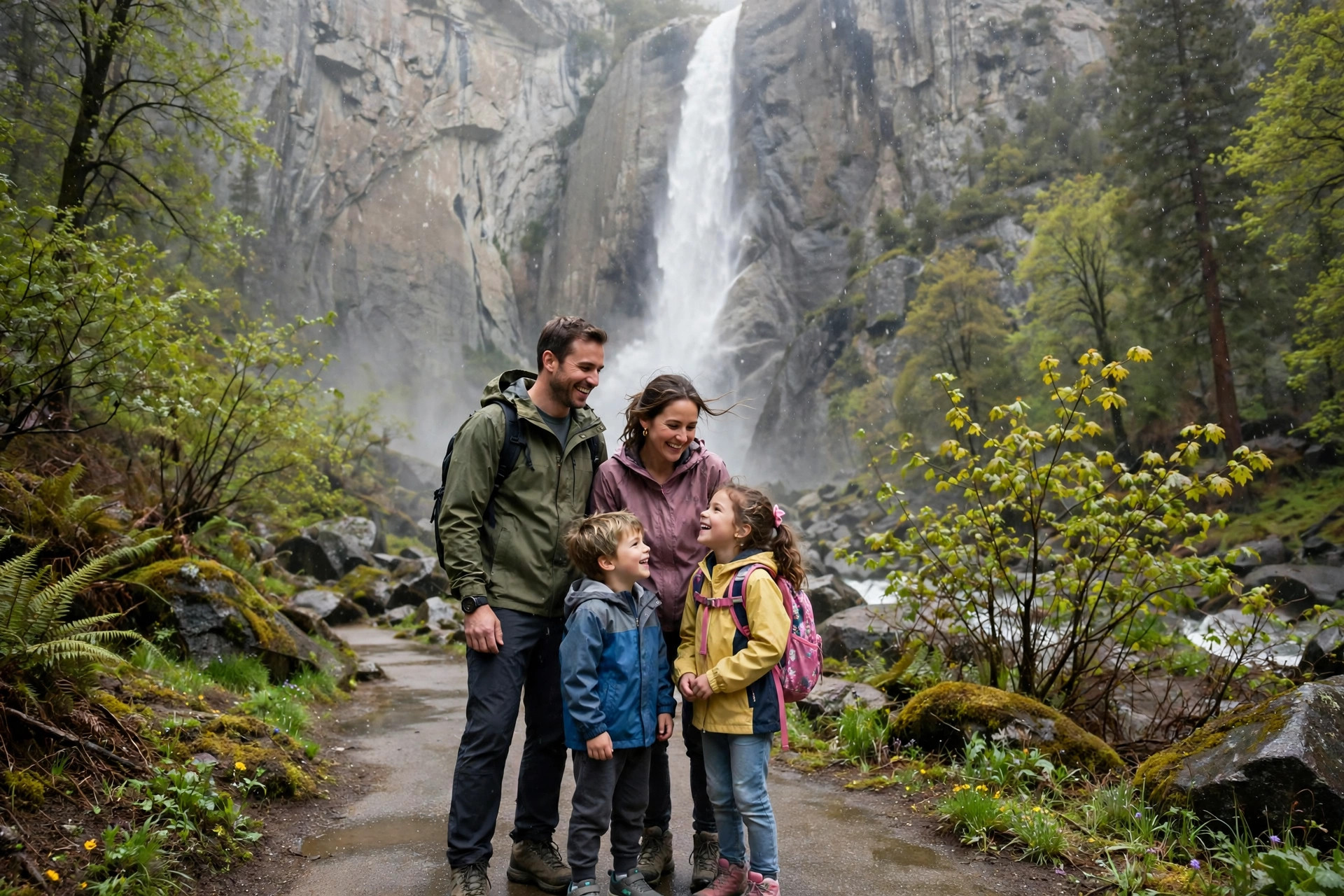
Lower Yosemite Fall Trail
The 1-mile loop is almost entirely flat, with a paved surface for much of it. In May and June the waterfall is at its fullest and the spray reaches the trail — pack a light rain layer even on a sunny day. By late summer the falls slow to a trickle, which is worth knowing before you promise a waterfall. The trail starts at shuttle stop 6.
Mariposa Grove of Giant Sequoias
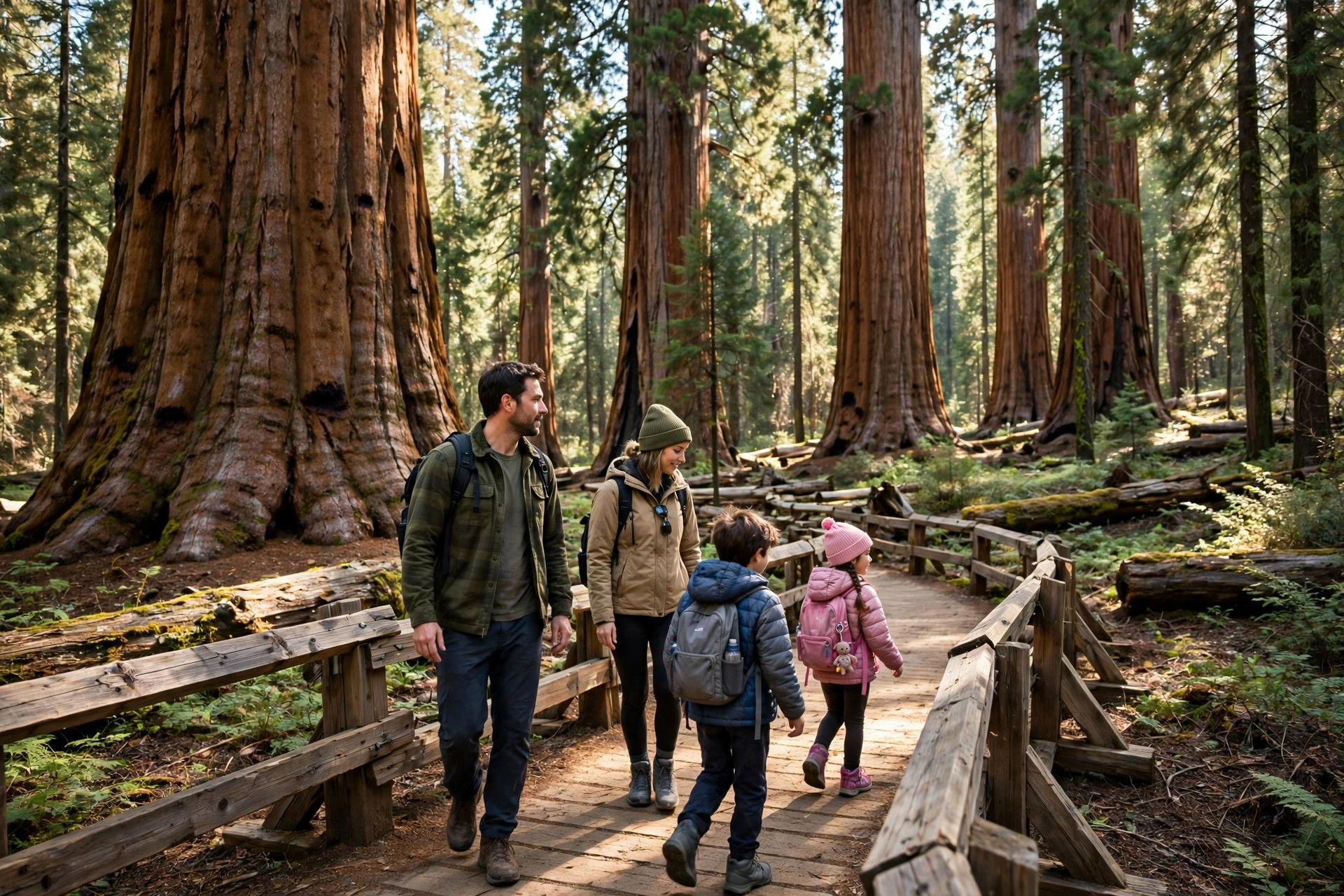
About 45 minutes south of the valley, Mariposa Grove is worth the drive. The Big Trees Loop is a short, flat, accessible boardwalk among sequoias thousands of years old. Arrive early: parking fills fast, and a free shuttle runs from the welcome plaza.
Yosemite with Kids: 3-Day Family Itinerary
Three full days is the minimum for a satisfying family visit. This itinerary assumes you are staying in or near the valley and using the free shuttle. It builds in a midday break every day — the single best decision you can make with kids in a national park.
Day 1 — Yosemite Valley Highlights
- Morning: Enter the park early (before 9 a.m. if you can) and park once. Walk the Lower Yosemite Fall Trail while energy is high and crowds are low.
- Late morning: Cook’s Meadow Loop, then the Yosemite Valley Visitor Center. Pick up the Junior Ranger handbook here — it gives kids a mission for the whole trip.
- Midday break: Picnic by the Merced River or lunch near Valley Lodge. Rest, refill water, let little ones nap.
- Afternoon: Bridalveil Fall (short, easy, dramatic spray) and Tunnel View on your way out — the classic first-look photo stop.
- Evening: Early dinner, then a sunset stroll in Cook’s Meadow.
Day 2 — Glacier Point + Mariposa Grove
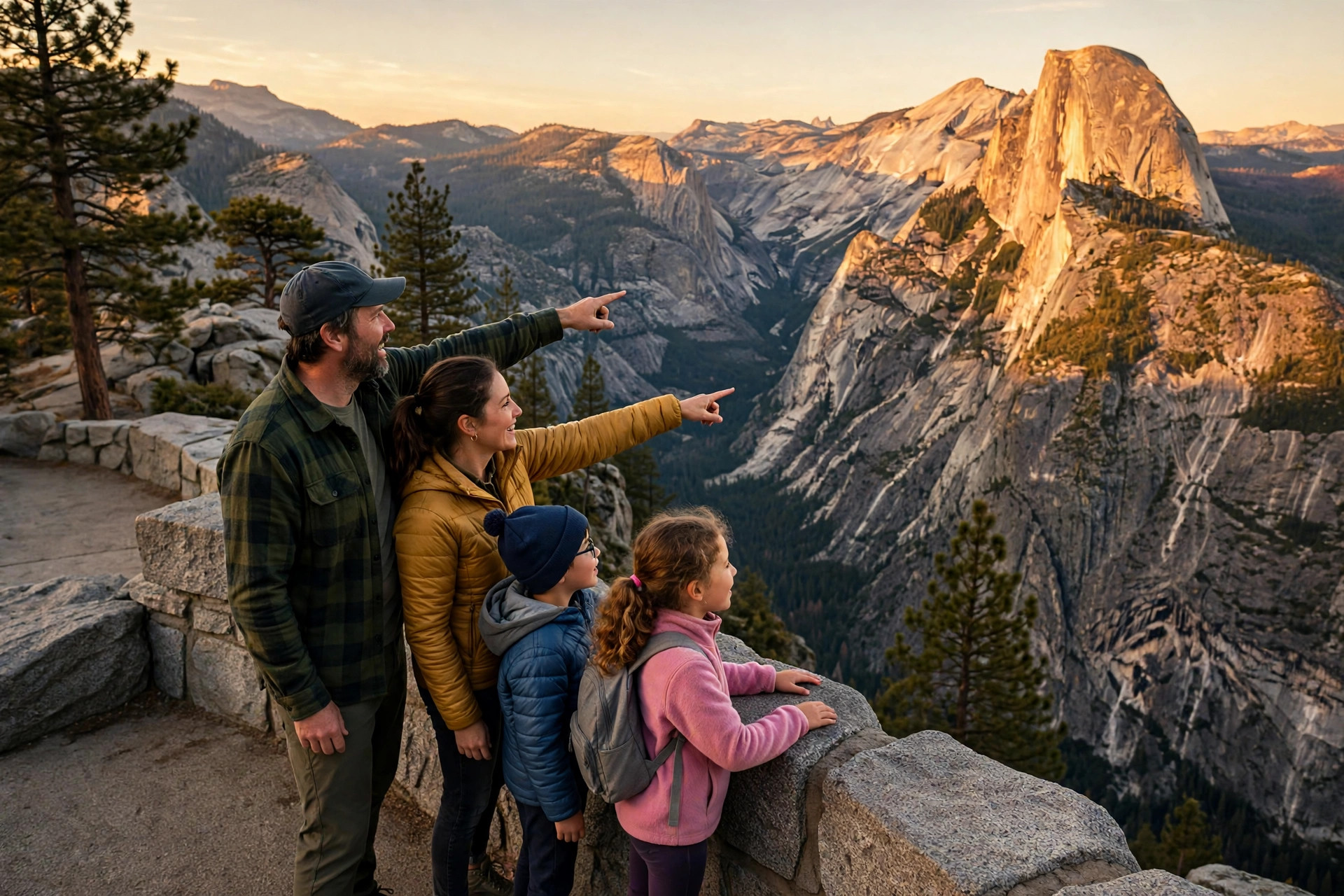
- Morning: Drive Glacier Point Road (open seasonally, late spring through fall) for the head-on view of Half Dome, 3,200 feet above the valley. The viewpoint is a short, paved walk from the parking lot.
- Late morning: Sentinel Dome Trail (2.2 miles, ages 8+) if your kids have the energy; otherwise enjoy the viewpoints and head back down.
- Midday break: Back in the valley for lunch and rest.
- Afternoon: Drive south to Mariposa Grove. Walk the Big Trees Loop and let kids measure themselves against a sequoia trunk.
- Evening: Stargazing from the valley meadow if skies are clear.
Day 3 — Mirror Lake + Junior Ranger Finish
- Morning: Mirror Lake Trail. It is flat, quiet in the morning, and the creek at the end is a perfect play stop.
- Late morning: Finish the Junior Ranger handbook activities and present it to a ranger for the badge — kids take this very seriously, and it is free.
- Midday break: Lunch and one last valley walk, or a bike ride on the valley’s paved bike path.
- Afternoon: One flexible slot: the Mist Trail to Vernal Fall footbridge for older kids, or the Ansel Adams Gallery and valley exhibits for younger ones.
- Evening: Pack up, one last look at El Capitan, and an early night — the drive out is long.
Getting Around Yosemite with Kids
The Free Valley Shuttle
The Yosemite Valley shuttle is free and runs roughly 7 a.m. to 10 p.m. daily, circling the valley floor. It settles the one argument that ruins most family visits: where to park. Park once, then ride. Learn your stop numbers — Lower Yosemite Fall is stop 6, the Visitor Center is stop 5, Mirror Lake is stop 17.
Parking Strategy
Valley parking fills by mid-morning in summer. Arrive before 9 a.m., or use the park-and-ride lots and the shuttle. Never circle the valley hunting for a spot with tired kids in the car — it wastes the best hours of the day.
Entrance Fees and Reservations
Entry is currently $35 per vehicle for a 7-day pass; the America the Beautiful annual pass ($80) covers Yosemite and every other national park for a year. Yosemite did not require entrance reservations for the 2026 season, but rules change year to year — always confirm current requirements on the NPS Yosemite planning page before you go. Campground reservations are a separate system, booked through Recreation.gov, and they sell out months ahead.
Where to Stay in Yosemite with Kids
Staying inside the park is worth it with kids: you skip the daily drive in, you are already at the trails, and evenings in the valley are quiet and magical. In-park lodging ranges from the historic Ahwahnee hotel to the Valley Lodge and Curry Village tent cabins, and all of it books out months ahead for summer.
If in-park lodging is full, the closest family-friendly bases are El Portal (just outside the Arch Rock entrance, about 30 minutes to the valley), Mariposa, and Oakhurst to the south, and Groveland to the west. Each adds 30–60 minutes of driving each way, so weigh the savings against two hours of daily car time with kids.
What to Pack for Yosemite with Kids
- Water: At least 1 liter per person per hike, more in summer. Refill stations are available in the valley.
- Sun protection: Sunscreen, hats, and sunglasses. The valley sits at 4,000 feet and the sun is strong, even on cloudy days.
- Layers: Mornings and evenings are cool even in July; afternoons are hot. Pack a light jacket for everyone.
- Rain layer: For waterfall spray in spring and afternoon thunderstorms in summer.
- Sturdy shoes: Closed-toe shoes with grip. Sandals are fine at camp, not on trails.
- Snacks: Trail mix, fruit, and sandwiches. Food in the valley is expensive and lines are long at midday.
- Carrier: For toddlers — a soft carrier beats a stroller on any unpaved trail.
- First aid basics: Blister care, children’s pain relief, and any regular medication. See our family camping first aid kit guide for the full list.
Junior Ranger Program: Free and Worth It
Yosemite’s Junior Ranger program is free and genuinely well designed. Pick up the self-guided handbook at any visitor center, work through the activities that fit your day, then show the finished book to a ranger and collect the badge. Kids aged 5–12 get the most out of it, but younger children can do the simpler pages with a parent.
Safety Tips for Families in Yosemite
- Altitude: The valley floor sits at about 4,000 feet, but Tioga Road and Glacier Point climb much higher. If you drive straight to 8,000+ feet, take it slow, drink water, and watch for headaches or nausea in kids.
- Water: Never let kids swim in the Merced River above the waterfalls — currents are stronger than they look, especially in spring snowmelt.
- Bears: Yosemite is black bear country. Store all food, scented items, and trash in bear lockers or your car’s trunk — never in your tent. Teach kids the basics before you arrive; our bear safety for kids guide covers it in kid-friendly language.
- Cliffs and drops: Keep kids away from unfenced overlook edges, especially at Glacier Point and Taft Point. Hold hands at viewpoints.
- Heat: Summer afternoons in the valley can be very hot. Hike in the morning, rest at midday, and know the signs of heat exhaustion.
- Wildlife distance: Teach kids the rule before the trip — stay at least 25 yards from most wildlife and 100 yards from bears. Our trail safety by age guide has scripts you can practice at home.
When Is the Best Time to Visit Yosemite with Kids?
May and June are the best months for families: waterfalls are at their fullest, temperatures are mild, and the high country is opening up. September is the other sweet spot — lighter crowds, warm days, and golden light. July and August bring the biggest crowds and the hottest valley, but also the fullest access to Tioga Road and Tuolumne Meadows. Winter is beautiful and quiet, but many roads close — save it for a return trip with older kids.
Frequently Asked Questions
How many days do you need in Yosemite with kids?
Three full days is the sweet spot for a first family visit: one day for the valley highlights, one for Glacier Point and Mariposa Grove, and one for Mirror Lake and the Junior Ranger program. Two days works if you skip the grove, but it feels rushed. With toddlers, add a fourth day for naps and slow mornings.
Is Yosemite stroller-friendly?
Parts of it are. The valley floor has paved, flat paths — Lower Yosemite Fall, Cook’s Meadow, and the Mirror Lake road all work with an all-terrain stroller. Unpaved trails and the Mist Trail do not. For toddlers, bring a carrier too.
Do kids need reservations to enter Yosemite?
Entrance reservations were not required for the 2026 season, but the rules change year to year. Check the NPS Yosemite planning page before your trip. Campground and in-park lodging reservations are separate and should be booked months ahead regardless.
What is the best first hike for kids in Yosemite?
The Lower Yosemite Fall Trail: a flat, paved 1-mile loop to the base of North America’s tallest waterfall. It takes under an hour, works for every age, and delivers a genuine wow moment with almost no effort.
Is Yosemite safe for toddlers?
Yes, with the usual precautions. Stick to paved valley trails, use a carrier on uneven ground, keep toddlers away from unfenced edges and fast water, and store all food properly in bear country. The flat valley floor and free shuttle make logistics with a toddler far easier than in most national parks.
When do the waterfalls dry up in Yosemite?
Yosemite Falls and Bridalveil Fall peak in May and June with spring snowmelt, then slow through the summer. By late August and September they can be a trickle or nearly dry. If waterfalls are the priority, plan a spring or early summer visit.
Yosemite rewards families who slow down. Pick one trail a morning, build in a real break, and let the kids earn their Junior Ranger badge. For the drive in, our road trip games for kids will keep the car happy all the way to the valley.
