Best Colorado Winter Hikes
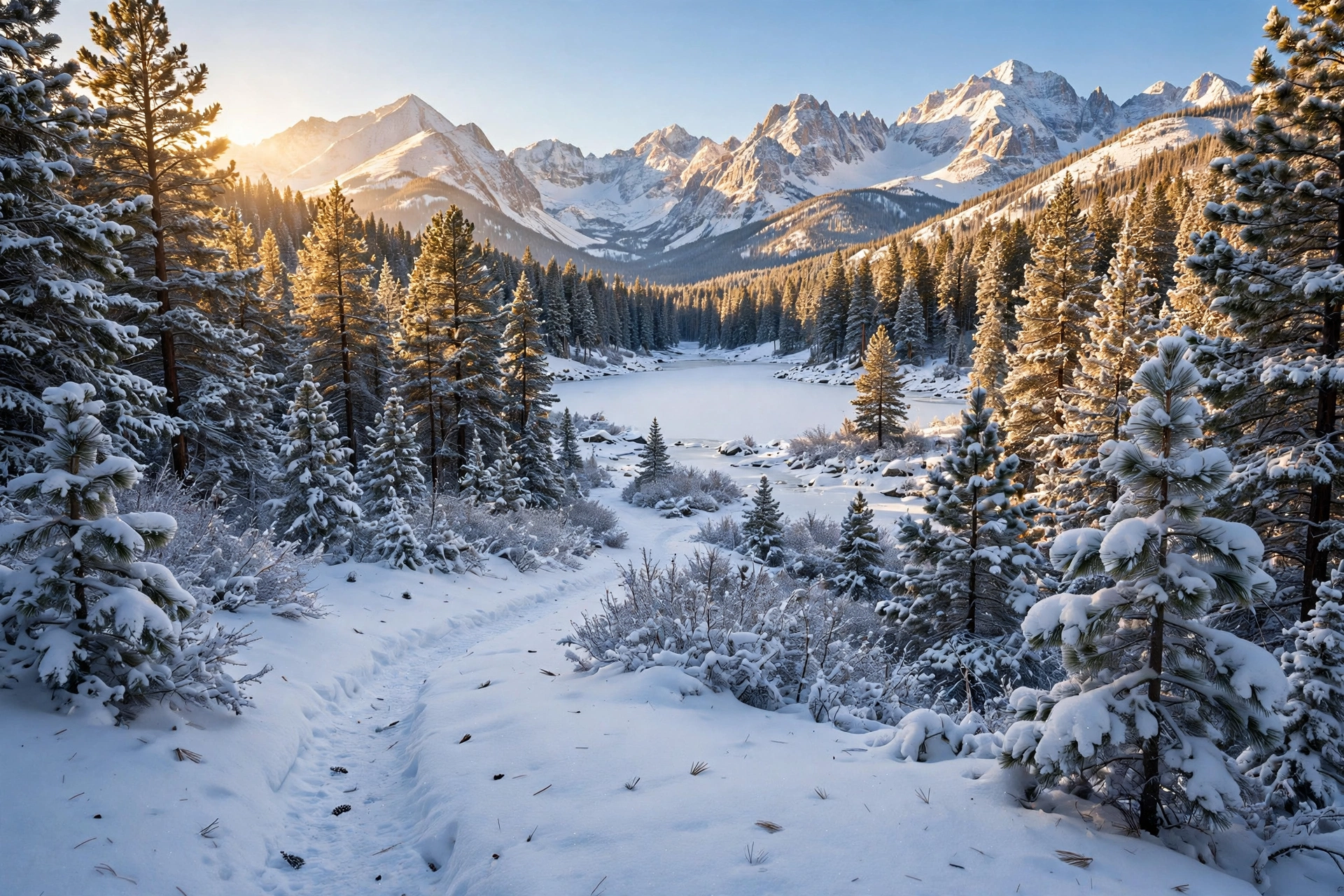
When I moved from Wisconsin to Colorado in the middle of winter, I was honestly nervous about hiking season being over. Back home, winter meant months of waiting. Here, it meant learning an entirely new skill: hiking on snow. It took one sunrise walk to a frozen alpine lake — the air still, the peaks glowing pink, nobody else on the trail — to change my mind completely. Winter hiking in Colorado is not a consolation prize. On the right trails, it is the best season there is.
This guide was fully refreshed for the 2026–2027 winter season: updated trail logistics, current permit and parking rules, and eight tried-and-true winter hikes near Denver, Boulder, and Rocky Mountain National Park. If you are new to cold-weather hiking, start with the safety and gear sections below — then pick one easy trail and go early.
Why Winter Hiking in Colorado Is Worth It
Colorado gets about 300 days of sunshine a year, and winter is no exception. Cold air holds less moisture, so winter days here are often crisp, clear, and startlingly blue — the kind of visibility you rarely get in summer wildfire season. Here is what keeps me lacing up my boots all winter:
- Empty trails. Iconic trailheads that feel like festivals in July are quiet enough for solitude in January.
- A different landscape entirely. Frozen waterfalls, wind-carved snowfields, and lakes you can walk across safely transform familiar summer trails.
- Less wildlife traffic, more sunrises. Short days mean you can catch sunrise at a reasonable hour — and watch the alpenglow paint the Front Range from a fire lookout with zero competition for the view.
- Perfect family terrain. Many Colorado winter trails are short, low-angle, and packed down by skiers — ideal first snow hikes for kids. If you are hiking with little ones, pair this guide with our realistic trail distances by age and our layering system that actually keeps kids warm.
Staying Safe on Winter Trails
Winter hiking is safe when you prepare; it is dangerous when you wing it. Every point below has earned its place through experience:
- Pack the Ten Essentials — navigation, headlamp, sun protection, insulation layers, first aid, fire starter, repair kit, food, water, emergency shelter — with a winter twist (more insulation, more calories).
- Check avalanche conditions. Always check the Colorado Avalanche Information Center forecast before heading out, and stay off steep, loaded slopes during elevated danger. Consider an avalanche safety course through Colorado Mountain School before attempting any trail marked as avalanche terrain.
- Read trip reports. Use AllTrails to check recent trip reports for trail conditions, road access, and parking. Download offline maps before you lose cell service.
- Bring the right traction. Microspikes for packed snow and ice, snowshoes for deep powder — often both in the car, deciding at the trailhead.
- Dress for the forecast, not the parking lot. Temperatures can swing 20+ degrees with wind chill at elevation. Details in what to wear winter hiking.
- Tell someone your plan — trail name, turnaround time, and when to expect you back. Start early: winter daylight is short, and many summits get ferociously windy after noon.
- Know your turnaround. If you are slower than expected, turn back while you still have daylight and warm fingers.
Disclaimer: This guide is for informational purposes only. Your safety is your responsibility. Always check weather and avalanche conditions, carry appropriate gear, and use your best judgment. Conditions in the mountains change fast.
Essential Gear for Winter Hiking
A solid winter hiking kit is mostly the same as your summer kit, plus traction, insulation, and a plan for keeping water and batteries warm. Full checklist in our winter hiking gear list; here are the highlights:
- Layers: moisture-wicking base layer, fleece mid-layer, insulated puffy, and a windproof/waterproof shell jacket and pants.
- Footwear: waterproof, insulated hiking boots with wool socks (bring a dry backup pair in the car).
- Traction: microspikes for icy trails, snowshoes for deep snow, trekking poles with snow baskets.
- Accessories: warm hat, balaclava or neck gaiter, insulated gloves plus liner gloves, hand warmers.
- Safety gear: headlamp with fresh batteries (keep a spare inside your jacket), first aid kit, emergency bivvy, fire starter, and a satellite communicator if you head beyond cell service.
- Navigation: offline maps on your phone plus a paper map and compass — phone batteries die fast in the cold, so keep the phone in an inside pocket and bring a portable charger.
- Sun protection: sunglasses and sunscreen — snow reflects up to 90% of UV, and winter sunburn is real.
The 8 Best Colorado Winter Hikes
These are the trails I keep coming back to, ordered from easiest to most challenging. Every one is verified for the 2026–2027 season.
1. Dream Lake: A Frozen Winter Wonderland
- Distance: 2 miles roundtrip • Elevation gain: 426 ft • Difficulty: Easy • Route: Out-and-back
- Trailhead: Bear Lake Trailhead, Rocky Mountain National Park (near Estes Park) • Dogs: Not allowed (national park)
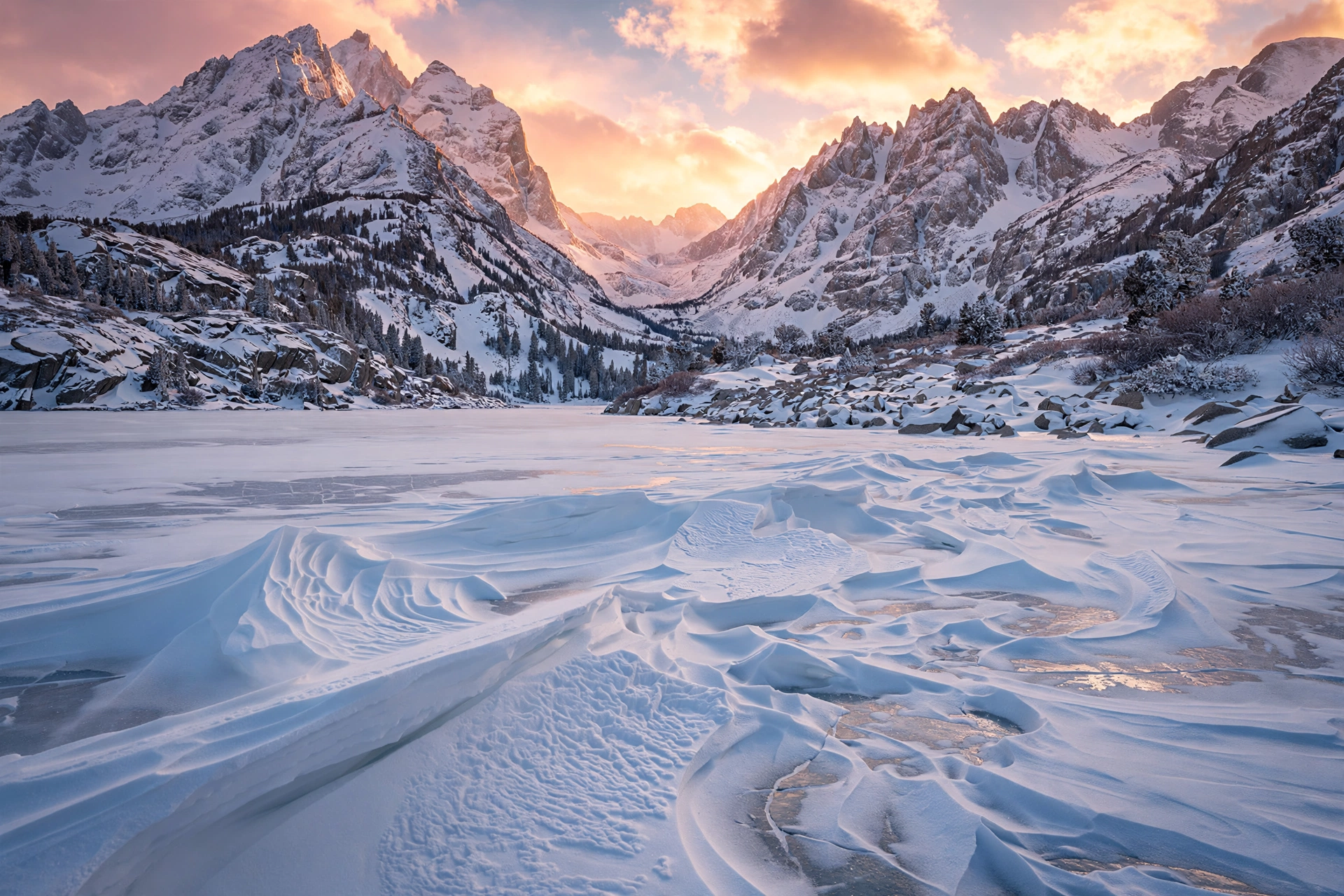
Dream Lake is the perfect first Colorado winter hike: short, spectacular, and easy to reach. The frozen lake sits beneath Hallett Peak and Flattop Mountain, and on a calm morning the snow-covered shoreline is pure magic. 2026 update: RMNP’s timed-entry permit system runs roughly late May through mid-October, so winter hikers can simply drive in — just be aware Bear Lake Road is plowed but can close during heavy storms, so check NPS road status before you go. This area is avalanche terrain, so check the CAIC forecast and stick to the packed main trail.
2. Emerald Lake: A Scenic Extension of Dream Lake
- Distance: 3.2 miles roundtrip • Elevation gain: 698 ft • Difficulty: Moderate • Route: Out-and-back
- Trailhead: Bear Lake Trailhead, Rocky Mountain National Park • Dogs: Not allowed (national park)
Keep going past Dream Lake to reach Emerald Lake, a gem tucked into a cirque of towering cliffs. The extra mile passes Nymph Lake along the way, so one hike delivers three frozen lakes. Like Dream Lake, this route travels through avalanche terrain — check conditions and carry traction. Microspikes are nearly always needed between December and March; snowshoes help after fresh storms.
3. Sugarloaf Mountain: A Quick Escape Near Boulder
- Distance: 1.3 miles roundtrip • Elevation gain: 439 ft • Difficulty: Easy/Moderate • Route: Out-and-back
- Trailhead: Sugarloaf Mountain Trailhead • Dogs: Allowed, on leash
For the best effort-to-view ratio near Boulder, this is it: a short climb to sunrise over the city and the foothills. Arrive 30 minutes before sunrise on a clear day and watch the light move across the plains. Parking is limited, so go on weekdays or early weekends.
4. NCAR Ramble Trail: Flatiron Views on a Quiet Loop
- Distance: 3.4 miles roundtrip • Elevation gain: 721 ft • Difficulty: Easy/Moderate • Route: Loop (or short out-and-back)
- Trailhead: NCAR Trailhead, Boulder • Dogs: Allowed, on leash
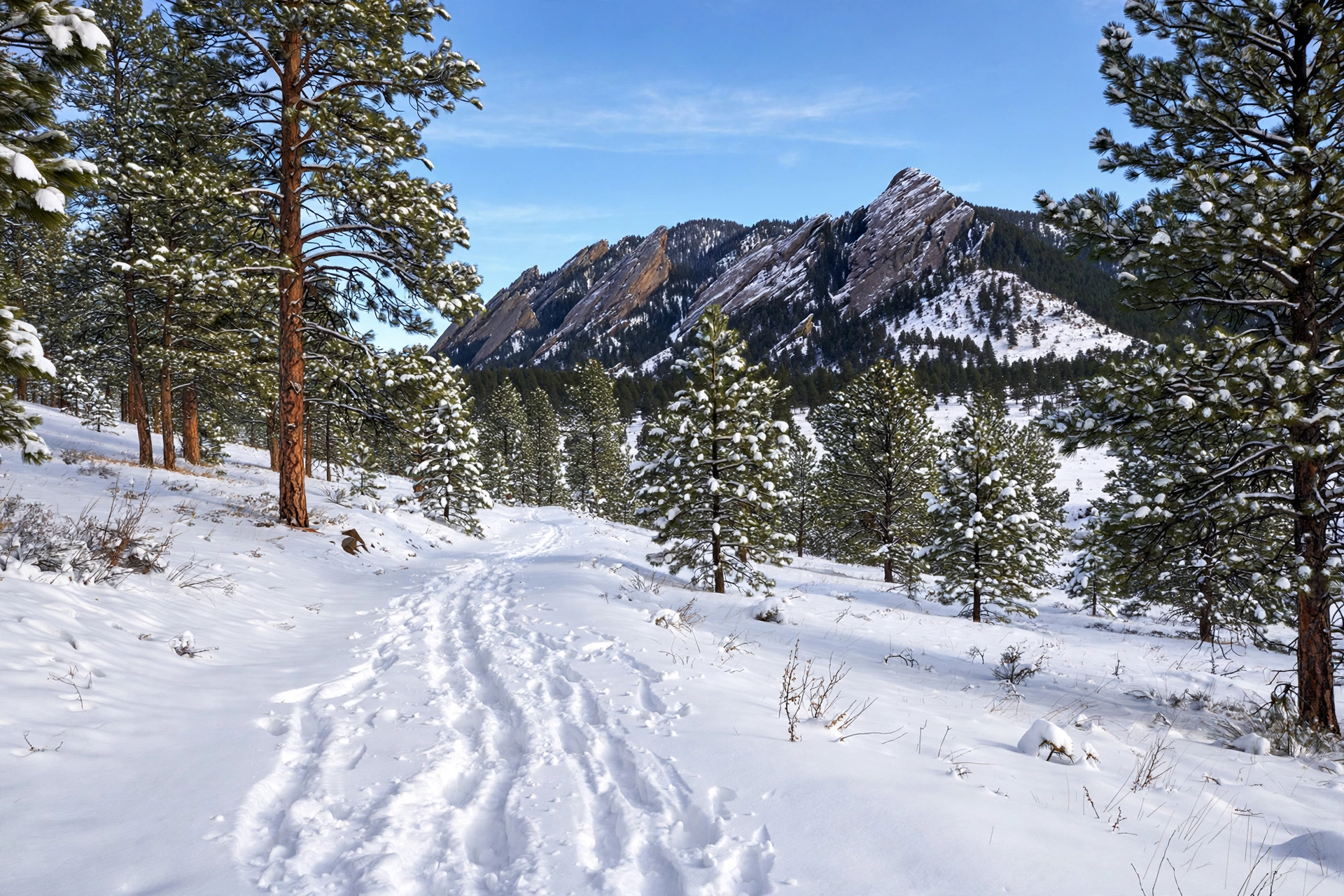
The NCAR Ramble sits below the National Center for Atmospheric Research and is a local favorite for low-angle winter miles with constant Flatiron views. The south-facing sections often melt out mid-winter, so it is a good choice when deeper trails are buried. Conditions vary week to week — check recent trip reports before committing.
5. Chief Mountain: Panoramic Winter Views
- Distance: 2.8 miles roundtrip • Elevation gain: 941 ft • Difficulty: Moderate • Route: Out-and-back
- Trailhead: Roadside parking off Colorado Highway 103 near Chief Mountain Trailhead • Dogs: Allowed, on leash
Chief Mountain is the hidden gem of this list: a straightforward climb to 360-degree views including Mount Evans to the west. I did this one for sunrise last winter and had the summit entirely to myself. Highway 103 is plowed in winter but can be slick — carry chains or AWD with good tires on storm days.
6. Mestaa’ehehe Mountain Fire Lookout: A Sunrise Adventure
- Distance: 4.1 miles roundtrip • Elevation gain: 892 ft • Difficulty: Moderate • Route: Out-and-back
- Trailhead: Roadside parking off Colorado Highway 103 near the lookout trailhead • Dogs: Allowed, on leash
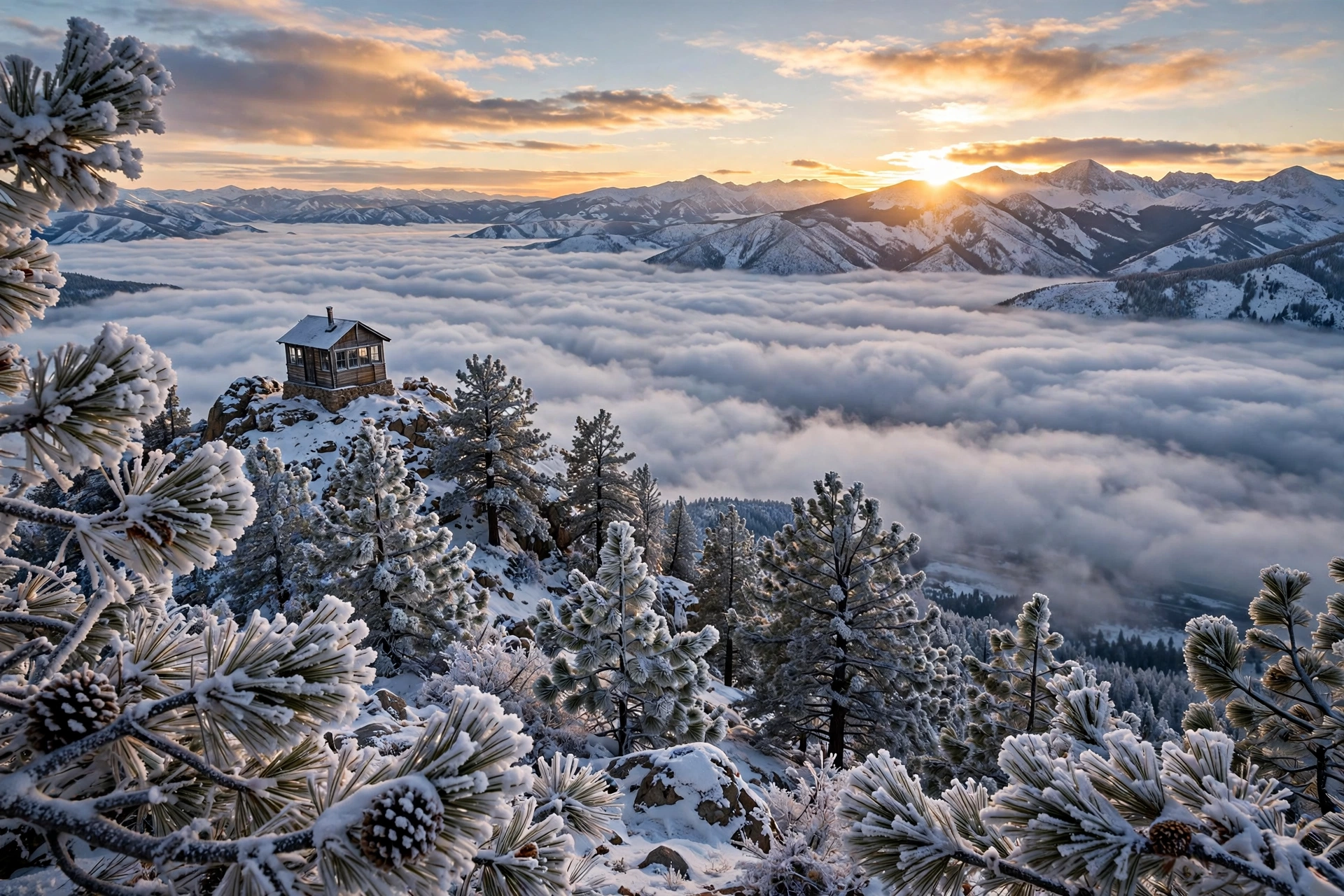
This is the most memorable hike on the list: a historic fire lookout on a snowy summit, best done at sunrise. The lookout itself can be reserved on Recreation.gov for overnight trips — waking up above a sea of clouds with hot coffee is a top-tier Colorado experience. The trail is gentle and well-marked, making it approachable for confident beginners.
7. St. Mary’s Glacier: Frozen Falls Near Idaho Springs
- Distance: 2 miles roundtrip • Elevation gain: ~445 ft • Difficulty: Easy/Moderate • Route: Out-and-back
- Trailhead: St. Mary’s Glacier Trailhead off Fall River Road • Dogs: Allowed, on leash
New in this update. St. Mary’s Glacier is a short, dramatic winter hike to a year-round snowfield and a frozen lake framed by cliffs — about an hour from Denver. The parking lot is private and charges a small per-car fee (cash/card), which keeps crowds thinner than the free trailheads. The final stretch crosses a frozen lake surface — stay on the established, packed route and turn back if ice looks sketchy. On a sunny weekday morning, it feels like the backcountry with almost none of the risk.
8. Lost Lake: A Frozen Gem Near Boulder
- Distance: 4 miles roundtrip • Elevation gain: 830 ft • Difficulty: Moderate • Route: Out-and-back
- Trailhead: Hessie Trailhead • Dogs: Allowed, on leash
Lost Lake is the workout of this list: a steady climb through the trees to a frozen alpine lake with huge mountain views. Hessie Trailhead fills up early year-round, so arrive before 8 a.m. on weekends. The upper trail crosses avalanche terrain — check the CAIC forecast and skip it during elevated danger. Snowshoes are worth bringing from December through March.
Winter Trailhead Logistics (2026–2027 Season)
A few practical notes that have changed since this guide was first published:
- RMNP in winter: Timed-entry reservations are a summer/fall system (roughly Memorial Day to mid-October). In winter you can drive straight into Rocky Mountain National Park with just a valid park pass — but Trail Ridge Road is closed at Many Parks Curve, so Bear Lake and Moraine Park are your winter hubs.
- Trailhead road closures: Guanella Pass and Mount Evans Road close for winter; Highway 103 (Chief Mountain, Mestaa’ehehe) stays plowed but is frequently icy. Check CDOT cotrip.org on storm mornings.
- Parking: Hessie Trailhead and Bear Lake lots overflow by 8–9 a.m. on winter weekends. Weekdays are dramatically quieter.
- Hiking with toddlers in winter? Short, low-angle trails like Dream Lake and Sugarloaf work well — but invest in proper gear first. Start with our guides to winter hiking clothes for women, toddler hiking gear, toddler hiking shoes, and the best child carrier backpacks of 2026.
Frequently Asked Questions
Do I need snowshoes or microspikes for Colorado winter hikes?
Microspikes are the single most-used winter hiking tool in Colorado — bring them to every hike on this list from November through April. Snowshoes matter on trails like Lost Lake after fresh storms or when breaking trail through unconsolidated powder. On well-packed Front Range trails, microspikes alone usually suffice.
Are these winter hikes safe for beginners?
Dream Lake, Sugarloaf Mountain, the NCAR Ramble, and St. Mary’s Glacier are all excellent beginner winter hikes: short, low-angle, and popular enough to be packed down. Start with one of these, check avalanche conditions, and save Lost Lake and Emerald Lake for when you are comfortable with traction and winter navigation.
Is a timed-entry permit required at Rocky Mountain National Park in winter?
No. RMNP’s timed-entry system runs in the summer/fall season only. In winter, you need only a valid park pass to access Bear Lake and the rest of the open park. Always verify current policies on the NPS website before your trip, as seasons and rules can change.
Can I hike in Colorado winter with kids?
Absolutely — winter hiking is wonderful with kids on the right trails. Keep distances short, dress them in real layers (no cotton), and carry extra snacks and warm drinks. Our toddler trail distance guide and kids’ layering system were written for exactly this.
What is the best month for winter hiking in Colorado?
January through March offers the most reliable snow and the deepest winter scenery, but late November/December and April can be perfect on south-facing Front Range trails. The trade-off: mid-winter is colder but quieter, while shoulder season is warmer but muddier in spots.
Final Thoughts
Winter hiking turned me from someone who dreaded the cold into someone who plans for it. Pick one trail from this list, check the avalanche forecast, pack traction, and go early. The mountains in winter are quiet, honest, and — if you ask me — at their most beautiful. See you out there.

1 comment
[…] This is also an excellent conditioning hike if you are building toward a spring thru-hike or a magical winter hike in bigger […]